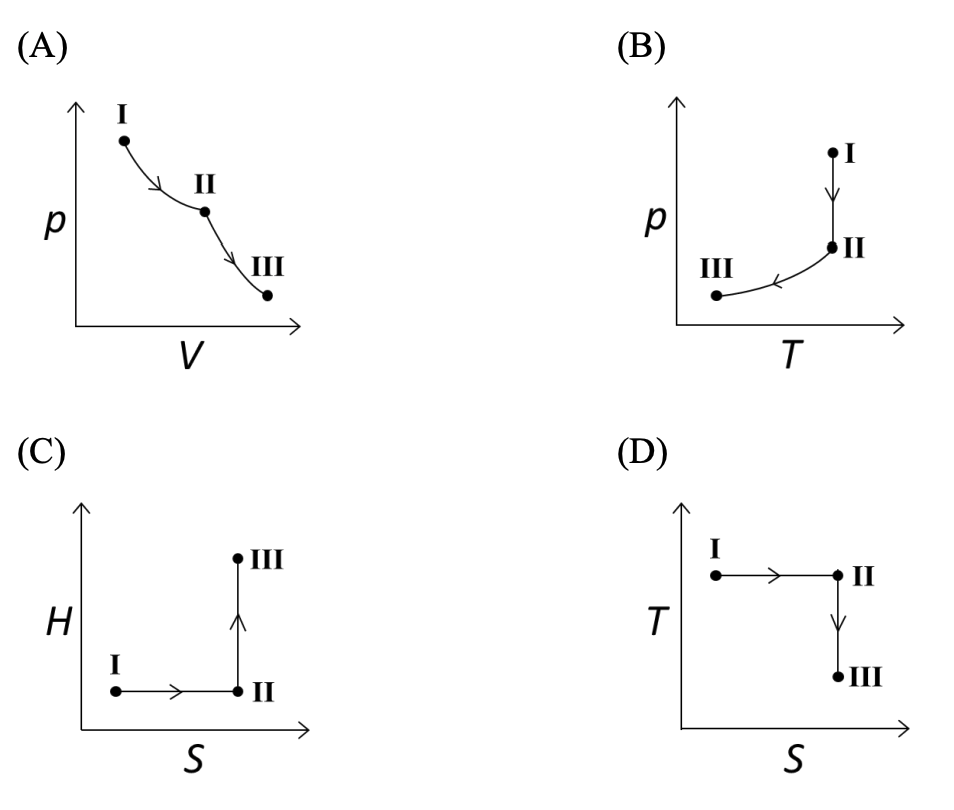
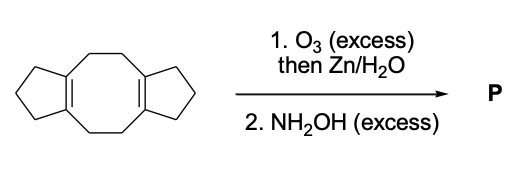
Question Stem for Question Nos. 5 and 6
A projectile is thrown from a point O on the ground at an angle 45° from the vertical and with a speed $5\sqrt{2}$ m/s. The projectile at the highest point of its trajectory splits into two equal parts. One part falls vertically down to the ground, 0.5 s after the splitting. The other part, $t$ seconds after the splitting, falls to the ground at a distance $x$ meters from the point O. The acceleration due to gravity $g = 10 \text{ m/s}^2$.
Question Stem for Question Nos. 7 and 8
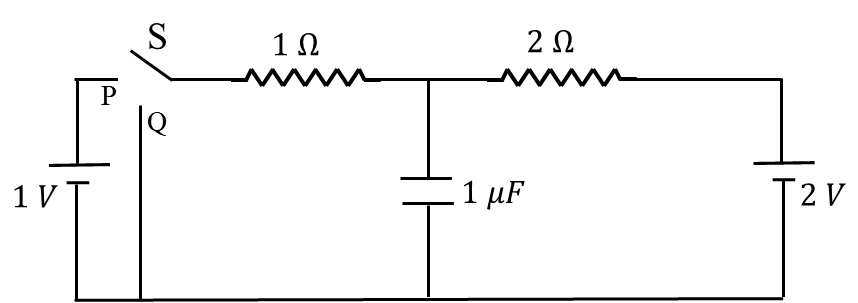
In the circuit shown below, the switch S is connected to position P for a long time so that the
charge on the capacitor becomes $q_1$ µC. Then S is switched to position Q. After a long time, the
charge on the capacitor is $q_2$ µC.
Question Stem for Question Nos. 9 and 10
Two point charges $-Q$ and $+Q/\sqrt{3}$ are placed in the $xy$-plane at the origin $(0, 0)$ and a
point $(2, 0)$, respectively, as shown in the figure. This results in an equipotential circle of
radius $R$ and potential $V = 0$ in the $xy$-plane with its center at $(b, 0)$. All lengths are
measured in meters.
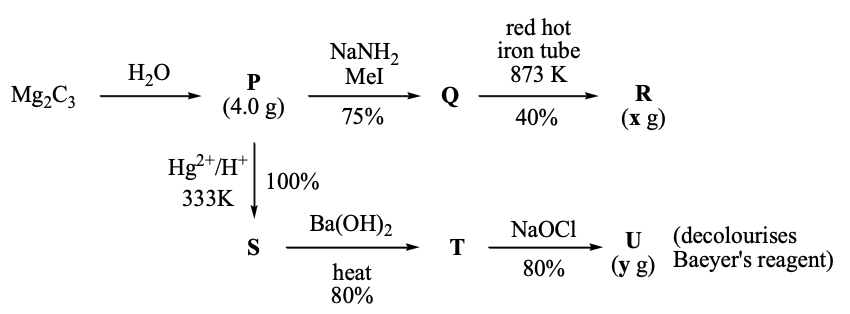
For the following reaction scheme, percentage yields are given along the arrow:
$x$ g and $y$ g are mass of R and U, respectively.
(Use: Molar mass (in g mol$^{-1}$) of H, C and O as 1, 12 and 16, respectively)
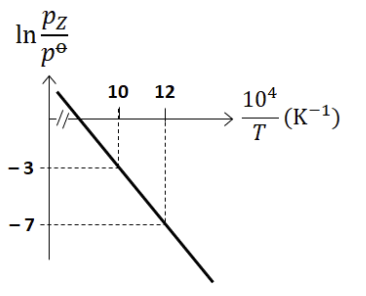
For the reaction, $\mathbf{X}(s) \rightleftharpoons \mathbf{Y}(s) + \mathbf{Z}(g)$, the plot of $\ln \frac{p_Z}{p^\circ}$ versus $\frac{10^4}{T}$ is given below (in solid line), where $p_Z$ is the pressure (in bar) of the gas $\mathbf{Z}$ at temperature $T$ and $p^\circ = 1$ bar.
(Given, $\frac{d(\ln K)}{d(\frac{1}{T})} = -\frac{\Delta H^\circ}{R}$, where the equilibrium constant, $K = \frac{p_Z}{p^\circ}$ and the gas constant, $R = 8.314 \text{ J K}^{-1} \text{ mol}^{-1}$)
The boiling point of water in a 0.1 molal silver nitrate solution (solution A) is $x^\circ$C. To this solution A, an equal volume of 0.1 molal aqueous barium chloride solution is added to make a new solution B. The difference in the boiling points of water in the two solutions A and B is $y \times 10^{-2} {}^\circ$C.
(Assume: Densities of the solutions A and B are the same as that of water and the soluble salts dissociate completely. Use: Molal elevation constant (Ebullioscopic Constant), $K_b = 0.5 \text{ K kg mol}^{-1}$; Boiling point of pure water as $100^\circ$C.)
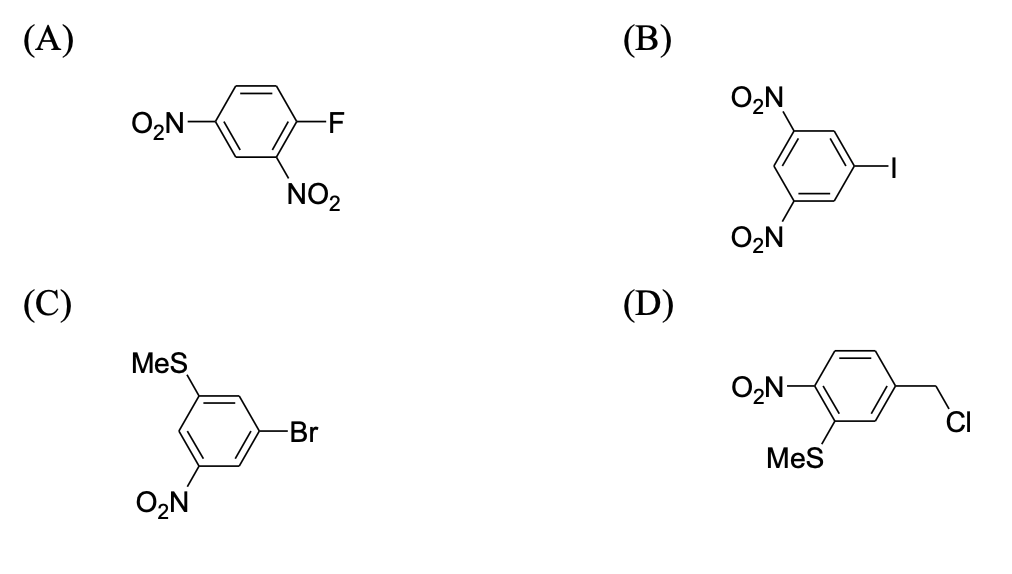
The compound(s), which on reaction with HNO$_3$ will give the product having degree of rotation, $[\alpha]_D = -52.7^\circ$ is(are):
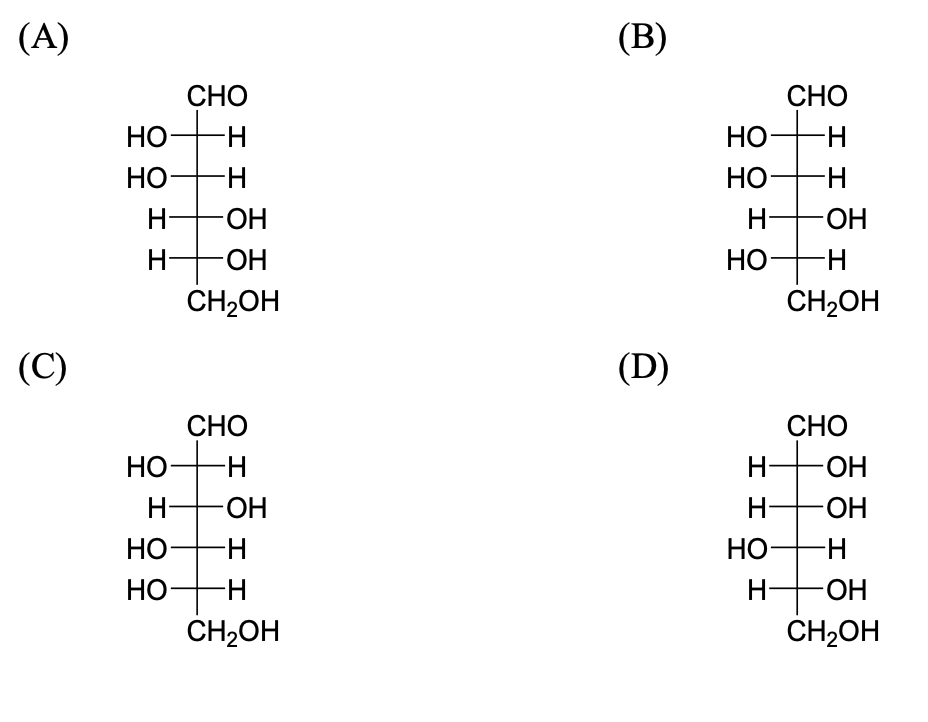
The correct option(s) for the salt mixture is(are)