Solution
We need to find the value of:
$$ \tan\left(\sin^{-1}\left(\frac{3}{5}\right) - 2\cos^{-1}\left(\frac{2}{\sqrt{5}}\right)\right) $$Step 1: Convert inverse trigonometric functions to $\tan^{-1}$.
For $\sin^{-1}\left(\frac{3}{5}\right)$, consider a right-angled triangle with perpendicular $3$ and hypotenuse $5$. The base is $\sqrt{5^2 - 3^2} = 4$.
$$ \therefore \sin^{-1}\left(\frac{3}{5}\right) = \tan^{-1}\left(\frac{3}{4}\right) $$For $\cos^{-1}\left(\frac{2}{\sqrt{5}}\right)$, consider a triangle with base $2$ and hypotenuse $\sqrt{5}$. The perpendicular is $\sqrt{(\sqrt{5})^2 - 2^2} = \sqrt{5-4} = 1$.
$$ \therefore \cos^{-1}\left(\frac{2}{\sqrt{5}}\right) = \tan^{-1}\left(\frac{1}{2}\right) $$Step 2: Substitute these values back into the expression.
$$ \text{Expression} = \tan\left( \tan^{-1}\frac{3}{4} - 2\tan^{-1}\frac{1}{2} \right) $$Step 3: Simplify the term $2\tan^{-1}\frac{1}{2}$.
Using the formula $2\tan^{-1}x = \tan^{-1}\left(\frac{2x}{1-x^2}\right)$:
$$ 2\tan^{-1}\left(\frac{1}{2}\right) = \tan^{-1}\left( \frac{2 \times \frac{1}{2}}{1 - (\frac{1}{2})^2} \right) = \tan^{-1}\left( \frac{1}{1 - \frac{1}{4}} \right) = \tan^{-1}\left( \frac{1}{3/4} \right) = \tan^{-1}\left(\frac{4}{3}\right) $$Step 4: Evaluate the final expression.
$$ \text{Expression} = \tan\left( \tan^{-1}\frac{3}{4} - \tan^{-1}\frac{4}{3} \right) $$Using the formula $\tan(A - B) = \frac{\tan A - \tan B}{1 + \tan A \tan B}$, where $A = \tan^{-1}\frac{3}{4}$ and $B = \tan^{-1}\frac{4}{3}$:
$$ = \frac{\frac{3}{4} - \frac{4}{3}}{1 + \left(\frac{3}{4}\right)\left(\frac{4}{3}\right)} $$ $$ = \frac{\frac{9 - 16}{12}}{1 + 1} $$ $$ = \frac{-7/12}{2} = \frac{-7}{24} $$Thus, the value is $\frac{-7}{24}$.
Option Distractor Reasons
Likely sign error in the numerator of the subtraction formula ($3/4 - 4/3$).
Potential arithmetic error during fraction simplification ($9-16 \neq -5$).
Incorrect sign and arithmetic calculation.
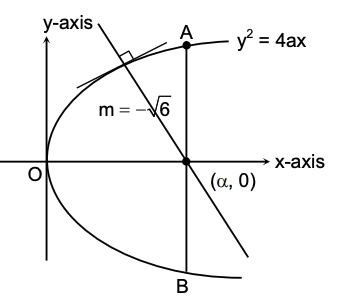
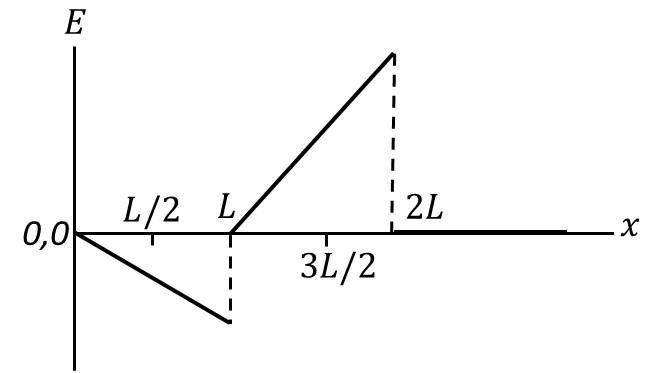
 Which of the following graph best depicts the variation of the induced emf ($E$) in the loop
as a function of the distance ($x$) starting from $x = 0$?
Which of the following graph best depicts the variation of the induced emf ($E$) in the loop
as a function of the distance ($x$) starting from $x = 0$?
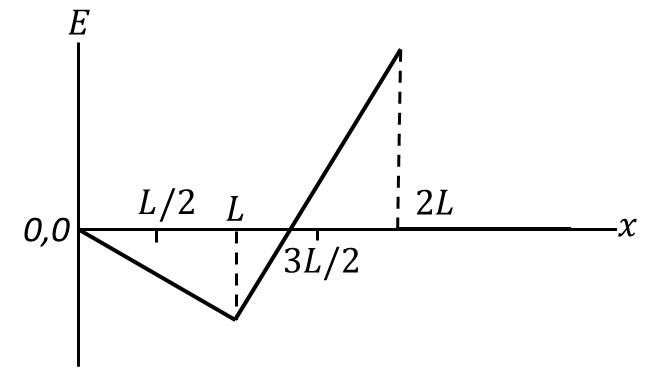

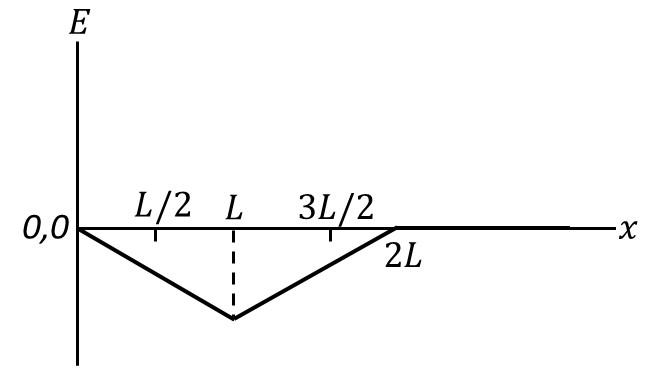

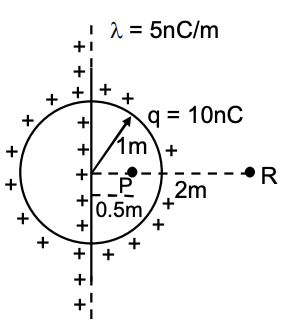
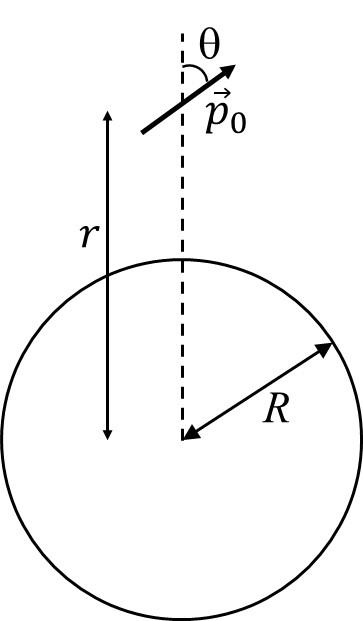 If released from rest, then which of the following statement(s) is(are) correct?
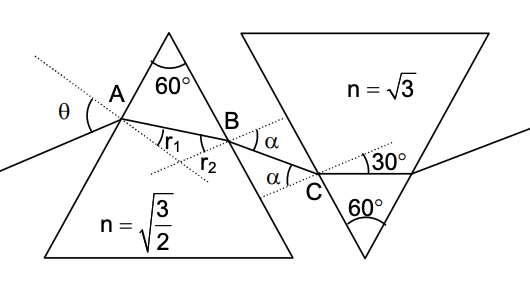
 Which of the following option(s) is(are) correct?


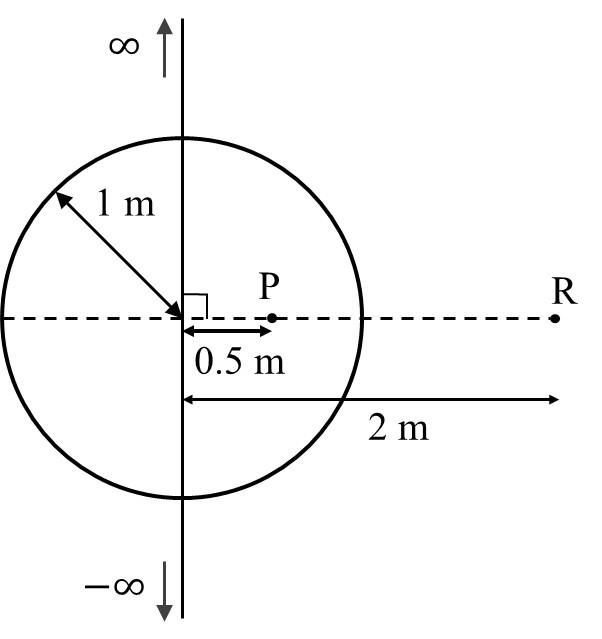 [Given: In SI units $\frac{1}{4\pi\epsilon_0} = 9 \times 10^9$, $\ln 2 = 0.7$. Ignore the
area pierced by the wire.]
[Given: In SI units $\frac{1}{4\pi\epsilon_0} = 9 \times 10^9$, $\ln 2 = 0.7$. Ignore the
area pierced by the wire.]

 The amount of energy required to split the double strand DNA into two single strands is
_____ kcal $mol^{-1}$.
The amount of energy required to split the double strand DNA into two single strands is
_____ kcal $mol^{-1}$.