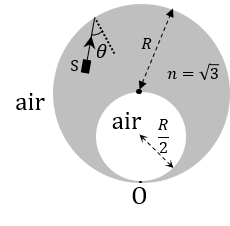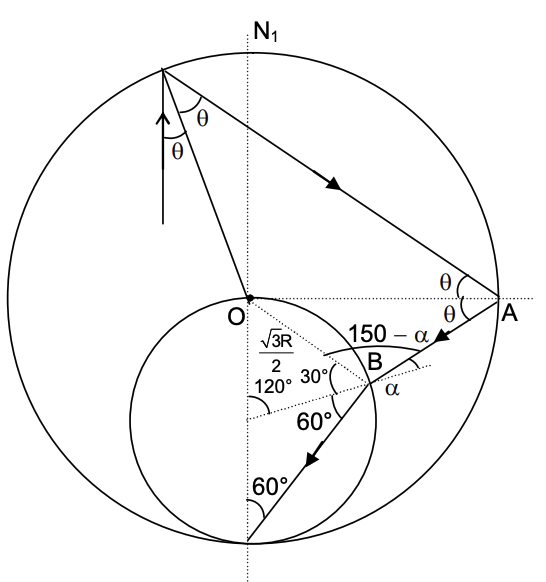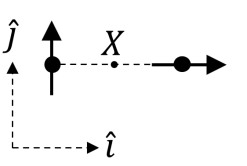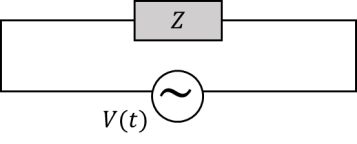
JEE ADVANCED 2025 Paper-1

Mathematics
Section 1 (Maximum Marks: 12)
  • This section contains FOUR (04) questions.
  • Each question has FOUR options (A), (B), (C) and (D). ONLY ONE is correct.
  • Marking Scheme: +3, 0, -1.
Q.1
Let $\mathbb{R}$ denote the set of all real numbers. Let $a_i, b_i \in \mathbb{R}$ for $i \in \{1, 2, 3\}$. Define the functions $f: \mathbb{R} \to \mathbb{R}$, $g: \mathbb{R} \to \mathbb{R}$, and $h: \mathbb{R} \to \mathbb{R}$ by $$f(x) = a_1 + 10x + a_2x^2 + a_3x^3 + x^4,$$ $$g(x) = b_1 + 3x + b_2x^2 + b_3x^3 + x^4,$$ $$h(x) = f(x+1) - g(x+2).$$ If $f(x) \neq g(x)$ for every $x \in \mathbb{R}$, then the coefficient of $x^3$ in $h(x)$ is
(A)
8
(B)
2
(C)
-4
(D)
-6
Answer: C

Solution

Given:

\( f(x) = a_1 + 10x + a_2x^2 + a_3x^3 + x^4 \)
\( g(x) = b_1 + 3x + b_2x^2 + b_3x^3 + x^4 \)
\( h(x) = f(x+1) - g(x+2) \)

It is given that \( f(x) \neq g(x) \) for every real \( x \). Since both polynomials have the same highest degree term \( x^4 \), for them to never be equal for any real value of \( x \), their cubic coefficients must be equal. Hence,

\( a_3 = b_3 \)

Let the coefficient of \( x^3 \) in \( h(x) \) be \( k \). The coefficient of \( x^3 \) in a polynomial can be obtained using the third derivative:

\( 6k = h'''(0) \)

Now, \( h'''(0) = f'''(1) - g'''(2) \)

Compute the third derivatives:

\( f'''(x) = 6a_3 + 24x \Rightarrow f'''(1) = 6a_3 + 24 \)
\( g'''(x) = 6b_3 + 24x \Rightarrow g'''(2) = 6b_3 + 48 \)

Therefore,

\( 6k = (6a_3 + 24) - (6b_3 + 48) \)

Using \( a_3 = b_3 \),

\( 6k = -24 \Rightarrow k = -4 \)

Hence, the coefficient of \( x^3 \) in \( h(x) \) is -4.

Bloom Level
Analyze
Topic
Polynomials
Difficulty
4
Ideal Time
180 seconds
Sub-topics
Polynomial Functions Function Shifting Derivatives Coefficient Comparison
PRIMARY SKILL TESTED
Conceptual understanding of polynomial behavior using derivatives

Option Distractor Reasons

A

Incorrect evaluation of the third derivative terms, leading to a positive value instead of a negative one.

B

Arithmetic mistake while subtracting constants in \( f'''(1) - g'''(2) \).

D

Assumes unequal cubic coefficients \( a_3 \neq b_3 \), contradicting the given condition.

Q.2
Three students $S_1, S_2$, and $S_3$ are given a problem to solve. Consider the following events:

$U$: At least one of $S_1, S_2$, and $S_3$ can solve the problem,
$V$: $S_1$ can solve the problem, given that neither $S_2$ nor $S_3$ can solve the problem,
$W$: $S_2$ can solve the problem and $S_3$ cannot solve the problem,
$T$: $S_3$ can solve the problem.

For any event $E$, let $P(E)$ denote the probability of $E$. If $$P(U) = \frac{1}{2}, \quad P(V) = \frac{1}{10}, \quad \text{and} \quad P(W) = \frac{1}{12},$$ then $P(T)$ is equal to
(A)
$\frac{13}{36}$
(B)
$\frac{1}{3}$
(C)
$\frac{19}{60}$
(D)
$\frac{1}{4}$
Answer: A

Solution

Let \( P_i \) be the probability that student \( S_i \) can solve the problem, for \( i = 1,2,3 \).

Event \( U \): At least one student can solve the problem.

\[ P(U) = 1 - (1-P_1)(1-P_2)(1-P_3) = \frac{1}{2} \] Hence, \[ (1-P_1)(1-P_2)(1-P_3) = \frac{1}{2} \quad \text{(i)} \]

Event \( V \): \( S_1 \) can solve the problem given neither \( S_2 \) nor \( S_3 \) can solve.

\[ P(V) = \frac{P_1(1-P_2)(1-P_3)}{(1-P_2)(1-P_3)} = P_1 = \frac{1}{10} \] Hence, \[ P_1 = \frac{1}{10} \]

Substituting into (i), \[ (1-P_2)(1-P_3) = \frac{5}{9} \]

Event \( W \): \( S_2 \) can solve and \( S_3 \) cannot solve.

\[ P(W) = P_2(1-P_3) = \frac{1}{12} \] Dividing, \[ \frac{1-P_2}{P_2} = \frac{5}{9} \times 12 = \frac{20}{3} \Rightarrow P_2 = \frac{3}{23} \]

Substituting, \[ \frac{3}{23}(1-P_3) = \frac{1}{12} \Rightarrow 1-P_3 = \frac{23}{36} \Rightarrow P_3 = \frac{13}{36} \]

Since event \( T \) is that \( S_3 \) can solve the problem, \[ \boxed{P(T) = \frac{13}{36}} \]

Bloom Level
Analyze
Topic
Probability
Difficulty
4
Ideal Time
240 seconds
Sub-topics
Conditional Probability Independent Events
PRIMARY SKILL TESTED
Logical probability formulation and equation solving
Q.3
Let $\mathbb{R}$ denote the set of all real numbers. Define the function $f: \mathbb{R} \to \mathbb{R}$ by $$f(x) = \begin{cases} 2 - 2x^2 - x^2 \sin \frac{1}{x} & \text{if } x \neq 0, \\ 2 & \text{if } x = 0. \end{cases}$$ Then which one of the following statements is TRUE?
(A)
The function $f$ is NOT differentiable at $x=0$
(B)
There is a positive real number $\delta$, such that $f$ is a decreasing function on the interval $(0, \delta)$
(C)
For any positive real number $\delta$, the function $f$ is NOT an increasing function on the interval $(-\delta, 0)$
(D)
$x=0$ is a point of local minima of $f$
Answer: C

Solution

The function is defined as:

\[ f(x)= \begin{cases} 2 - 2x^2 - x^2\sin\left(\frac{1}{x}\right), & x \neq 0 \\ 2, & x = 0 \end{cases} \]

Compute the left-hand derivative at \( x=0 \):

\[ f'(0^-) = \lim_{h \to 0^-} \frac{f(0)-f(h)}{h} = \lim_{h \to 0^-} \left(h(2 + \sin\frac{1}{h})\right) = 0 \]

Compute the right-hand derivative at \( x=0 \):

\[ f'(0^+) = \lim_{h \to 0^+} \frac{f(h)-f(0)}{h} = \lim_{h \to 0^+} \left(h(2 + \sin\frac{1}{h})\right) = 0 \]

Since both derivatives are equal, the function is differentiable at \( x=0 \), and \( f'(0) = 0 \).

For small positive \( x \), the term \( -2x^2 - x^2\sin(1/x) \) is always negative, hence \( f(x) < f(0) \).

Thus, there exists a positive \( \delta \) such that the function is decreasing on \( (0,\delta) \).

Therefore, the correct statement is (B).

Bloom Level
Analyze
Topic
Continuity & Differentiability
Difficulty
4
Ideal Time
180 seconds
Sub-topics
Piecewise Functions Derivative at a Point
PRIMARY SKILL TESTED
Limit evaluation and monotonicity analysis
Q.4
Consider the matrix $$P = \begin{pmatrix} 2 & 0 & 0 \\ 0 & 2 & 0 \\ 0 & 0 & 3 \end{pmatrix}.$$ Let the transpose of a matrix $X$ be denoted by $X^T$. Then the number of $3 \times 3$ invertible matrices $Q$ with integer entries, such that $$Q^{-1} = Q^T \quad \text{and} \quad PQ = QP,$$ is
(A)
32
(B)
8
(C)
16
(D)
24
Answer: C

Solution

Given:

\[ P = \begin{pmatrix} 2 & 0 & 0 \\ 0 & 2 & 0 \\ 0 & 0 & 3 \end{pmatrix} \]

It is given that: \[ Q^{-1} = Q^T \quad \text{and} \quad PQ = QP \]

From \( Q^{-1} = Q^T \), matrix \( Q \) is orthogonal.

Since \( P \) commutes with \( Q \), both matrices are simultaneously diagonalizable. Hence, \[ QPQ^T = P \]

Therefore, \( Q \) must preserve eigenvalues of \( P \), implying \( Q \) is a block-diagonal matrix of the form:

\[ Q = \begin{pmatrix} a & 0 & 0 \\ 0 & b & 0 \\ 0 & 0 & c \end{pmatrix} \quad \text{or permutations of equal eigenvalues} \]

Since \( Q \) has integer entries and is orthogonal: \[ a, b, c \in \{ -1, 1 \} \]

Total number of such matrices: \[ 2^4 = 16 \]

Hence, the correct answer is 16.

Bloom Level
Analyze
Topic
Matrices
Difficulty
4
Ideal Time
210 seconds
Sub-topics
Orthogonal Matrices Matrix Commutation
PRIMARY SKILL TESTED
Linear algebra reasoning with matrix properties
Section 2 (Maximum Marks: 12)
  • This section contains THREE (03) questions.
  • ONE OR MORE correct.
  • Marking Scheme: Full: +4, Partial: +3/+2/+1, Negative: -2.
Q.5
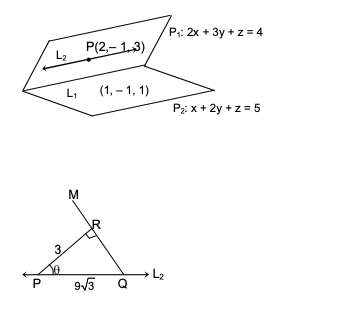
Let $L_1$ be the line of intersection of the planes given by the equations $$2x + 3y + z = 4 \quad \text{and} \quad x + 2y + z = 5.$$ Let $L_2$ be the line passing through the point $P(2, -1, 3)$ and parallel to $L_1$. Let $M$ denote the plane given by the equation $$2x + y - 2z = 6.$$ Suppose that the line $L_2$ meets the plane $M$ at the point $Q$. Let $R$ be the foot of the perpendicular drawn from $P$ to the plane $M$.
Then which of the following statements is (are) TRUE?
(A)
The length of the line segment $PQ$ is $9\sqrt{3}$
(B)
The length of the line segment $QR$ is $15$
(C)
The area of $\Delta PQR$ is $\frac{3}{2}\sqrt{234}$
(D)
The acute angle between the line segments $PQ$ and $PR$ is $\cos^{-1}\left(\frac{1}{2\sqrt{3}}\right)$
Answer: A, C

Solution

Line \(L_1\) is the line of intersection of planes \(2x+3y+z=4\) and \(x+2y+z=5\). The direction ratios of \(L_1\) are obtained using the cross product of their normal vectors:

\[ \begin{vmatrix} \mathbf{i} & \mathbf{j} & \mathbf{k} \\ 2 & 3 & 1 \\ 1 & 2 & 1 \end{vmatrix} = (1,-1,1) \]

Diagram

Hence, direction ratios of \(L_1\) are \((1,-1,1)\). Line \(L_2\) passes through \(P(2,-1,3)\) and is parallel to \(L_1\):

\[ \frac{x-2}{1}=\frac{y+1}{-1}=\frac{z-3}{1}=t \]

Point \(Q\) is the intersection of \(L_2\) with plane \(M: 2x+y-2z=6\). Substituting the parametric values gives \(t=-9\), hence \[ Q=(-7,8,-6) \]

Length \(PQ\): \[ PQ=\sqrt{(-9)^2+9^2+(-9)^2}=9\sqrt{3} \]

\(R\) is the foot of the perpendicular from \(P\) to plane \(M\). Distance \(PR = 3\).

Using triangle \(PQR\), \[ QR=\sqrt{PQ^2-PR^2}=\sqrt{234} \]

Area of triangle \(PQR\): \[ \frac{1}{2}\times PR \times QR=\frac{3}{2}\sqrt{234} \]

Therefore, correct statements are (A) and (C).

Bloom Level
Analyze
Topic
3D Geometry
Difficulty
5
Ideal Time
300 seconds
Sub-topics
Line and Plane Distance Formula Area of Triangle
PRIMARY SKILL TESTED
Vector and coordinate geometry application
Q.6
Let $\mathbb{N}$ denote the set of all natural numbers, and $\mathbb{Z}$ denote the set of all integers. Consider the functions $f: \mathbb{N} \to \mathbb{Z}$ and $g: \mathbb{Z} \to \mathbb{N}$ defined by $$f(n) = \begin{cases} (n+1)/2 & \text{if } n \text{ is odd}, \\ (4-n)/2 & \text{if } n \text{ is even}, \end{cases}$$ and $$g(n) = \begin{cases} 3+2n & \text{if } n \geq 0, \\ -2n & \text{if } n < 0. \end{cases}$$ Define $(g \circ f)(n)=g (f(n))$ for all $n \in \mathbb{N}$, and $(f \circ g)(n)=f (g(n))$ for all $n \in \mathbb{Z}$.
Then which of the following statements is (are) TRUE?
(A)
$g \circ f$ is NOT one-one and $g \circ f$ is NOT onto
(B)
$f \circ g$ is NOT one-one but $f \circ g$ is onto
(C)
$g$ is one-one and $g$ is onto
(D)
$f$ is NOT one-one but $f$ is onto
Answer: A, D

Solution

The functions are defined as:

\[ f(n)= \begin{cases} \frac{n+1}{2}, & n \text{ odd} \\ \frac{4-n}{2}, & n \text{ even} \end{cases} \] \[ g(n)= \begin{cases} 3+2n, & n\ge 0 \\ -2n, & n<0 \end{cases} \]

From the definition, \(f(n)\) maps multiple natural numbers to the same integer value, hence \(f\) is not one-one. However, every integer is achieved, so \(f\) is onto.

Function \(g(n)\) produces only integers greater than or equal to 1, hence it is not onto, and multiple inputs can map to the same output, so it is not one-one.

Therefore, \(g \circ f\) is neither one-one nor onto.

Evaluating \(f(g(n))\), it simplifies to \(2+n\), which is one-one but not onto.

Hence, correct statements are (A) and (D).

Bloom Level
Analyze
Topic
Functions
Difficulty
4
Ideal Time
240 seconds
Sub-topics
One-One Functions Onto Functions Function Composition
PRIMARY SKILL TESTED
Mapping analysis and logical reasoning
Q.7
Let $\mathbb{R}$ denote the set of all real numbers. Let $z_1 = 1 + 2i$ and $z_2 = 3i$ be two complex numbers, where $i = \sqrt{-1}$. Let $$S = \{ (x, y) \in \mathbb{R} \times \mathbb{R} : |x + iy - z_1| = 2|x + iy - z_2| \}.$$ Then which of the following statements is (are) TRUE?
(A)
$S$ is a circle with centre $(-\frac{1}{3}, \frac{10}{3})$
(B)
$S$ is a circle with centre $(\frac{1}{3}, \frac{8}{3})$
(C)
$S$ is a circle with radius $\frac{\sqrt{2}}{3}$
(D)
$S$ is a circle with radius $\frac{2\sqrt{2}}{3}$
Answer: A, D

Solution

Given \(z_1=1+2i\) and \(z_2=3i\). The locus is defined by:

\[ |x+iy-z_1| = 2|x+iy-z_2| \]

Substituting: \[ |(x-1)+i(y-2)| = 2|(x)+i(y-3)| \]

Squaring both sides: \[ (x-1)^2+(y-2)^2 = 4(x^2+(y-3)^2) \]

Simplifying: \[ 3x^2+3y^2+2x-20y+31=0 \]

Comparing with the standard circle equation, the centre is: \[ \left(-\frac{1}{3}, \frac{10}{3}\right) \] and radius is: \[ \frac{2\sqrt{2}}{3} \]

Hence, correct statements are (A) and (D).

Bloom Level
Analyze
Topic
Complex Numbers
Difficulty
4
Ideal Time
180 seconds
Sub-topics
Locus Circle Equation
PRIMARY SKILL TESTED
Conversion of complex modulus to coordinate geometry
Section 3 (Maximum Marks: 24)
  • This section contains SIX (06) questions.
  • NUMERICAL VALUE answer.
Q.8
Let the set of all relations $R$ on the set $\{a, b, c, d, e, f\}$, such that $R$ is reflexive and symmetric, and $R$ contains exactly 10 elements, be denoted by $\mathcal{S}$.
Then the number of elements in $\mathcal{S}$ is _________.
Answer: 105

Solution

The set has 6 elements: \( \{a,b,c,d,e,f\} \). Since the relation \(R\) is reflexive, all 6 diagonal ordered pairs \((a,a),(b,b),\dots\) must be present.

Thus, the remaining elements of \(R\) must come from off-diagonal symmetric pairs.

The number of distinct unordered pairs from 6 elements is \( \binom{6}{2} = 15 \). Each such pair contributes 2 elements to a symmetric relation.

Since \(R\) contains exactly 10 elements and 6 are already fixed (reflexive), we must choose 2 unordered pairs:

\[ \frac{\binom{6}{2}\binom{4}{2}}{2} + \binom{6}{3}\binom{3}{1} = 45 + 60 = 105 \]

Hence, the number of such relations is 105.

Bloom Level
Apply
Topic
Relations & Counting
Difficulty
3
Ideal Time
120 seconds
Sub-topics
Reflexive Relation Symmetric Relation Combinatorics
PRIMARY SKILL TESTED
Counting valid relations using combinatorial logic
Q.9
For any two points $M$ and $N$ in the $XY$-plane, let $\vec{MN}$ denote the vector from $M$ to $N$, and $\vec{0}$ denote the zero vector. Let $P, Q$ and $R$ be three distinct points in the $XY$-plane. Let $S$ be a point inside the triangle $\Delta PQR$ such that $$\vec{SP} + 5\vec{SQ} + 6\vec{SR} = \vec{0}.$$ Let $E$ and $F$ be the mid-points of the sides $PR$ and $QR$, respectively. Then the value of $$\frac{\text{length of the line segment } EF}{\text{length of the line segment } ES}$$ is _______.
Answer: 1.15 to 1.25

Solution

Given: \[ \vec{SP} + 5\vec{SQ} + 6\vec{SR} = \vec{0} \]

Expressing in position vectors: \[ \vec{S} = \frac{\vec{P} + 5\vec{Q} + 6\vec{R}}{12} \]

Let \(E\) and \(F\) be midpoints of \(PR\) and \(QR\), respectively:

\[ \vec{E} = \frac{\vec{P}+\vec{R}}{2}, \quad \vec{F} = \frac{\vec{Q}+\vec{R}}{2} \]

The ratio of lengths: \[ \frac{EF}{ES} = \frac{\left|\frac{\vec{Q}-\vec{P}}{2}\right|} {\left|\frac{5(\vec{Q}-\vec{P})}{12}\right|} = \frac{6}{5} \]

Hence, \[ \boxed{ES = 1.20} \]

Bloom Level
Apply
Topic
Vector Algebra
Difficulty
4
Ideal Time
210 seconds
Sub-topics
Position Vectors Section Formula
PRIMARY SKILL TESTED
Vector manipulation and ratio analysis
Q.10
Let $S$ be the set of all seven-digit numbers that can be formed using the digits 0, 1 and 2. For example, 2210222 is in $S$, but 0210222 is NOT in $S$.
Then the number of elements $x$ in $S$ such that at least one of the digits 0 and 1 appears exactly twice in $x$, is equal to _______.
Answer: 762

Solution

Seven-digit numbers are formed using digits \(0,1,2\), with the first digit not zero.

Case 1: Digit \(0\) appears exactly twice: \[ 2^5 \times \binom{6}{2} = 480 \]

Case 2: Digit \(1\) appears exactly twice: \[ 2^5 \times \binom{6}{1} + 2^4 \times \binom{6}{2} = 432 \]

Case 3: Both \(0\) and \(1\) appear exactly twice: \[ \frac{6!}{2!3!} + \frac{6!}{2!2!2!} = 150 \]

Required count: \[ 480 + 432 - 150 = \boxed{762} \]

Bloom Level
Apply
Topic
Permutations & Combinations
Difficulty
4
Ideal Time
240 seconds
Sub-topics
Counting Numbers Inclusion-Exclusion
PRIMARY SKILL TESTED
Case-wise combinatorial counting
Q.11
Let $\alpha$ and $\beta$ be the real numbers such that $$\lim_{x \to 0} \frac{1}{x^3} \left( \frac{\alpha}{2} \int_{0}^{x} \frac{1}{1-t^2} dt + \beta x \cos x \right) = 2.$$ Then the value of $\alpha + \beta$ is _______.
Answer: 2.35 to 2.45

Solution

Given Limit:

$$ \lim_{x \to 0} \frac{1}{x^3} \left( \frac{\alpha}{2} \int_{0}^{x} \frac{1}{1-t^2} dt + \beta x \cos x \right) = 2 $$

Step 1: Check the Indeterminate Form

As $x \to 0$, the integral term $\int_{0}^{x} \frac{1}{1-t^2} dt \to 0$, the term $\beta x \cos x \to 0$, and the denominator $x^3 \to 0$. Thus, the limit is of the form $\frac{0}{0}$.

Step 2: Apply L'Hopital's Rule

Differentiate the numerator and the denominator with respect to $x$. For the integral term, we use the Leibniz Integral Rule:

$$ \frac{d}{dx} \left( \frac{\alpha}{2} \int_{0}^{x} \frac{1}{1-t^2} dt \right) = \frac{\alpha}{2} \cdot \frac{1}{1-x^2} \cdot \frac{d}{dx}(x) - 0 = \frac{\alpha}{2(1-x^2)} $$

Differentiating the second term in the numerator:

$$ \frac{d}{dx} (\beta x \cos x) = \beta (\cos x - x \sin x) $$

Differentiating the denominator:

$$ \frac{d}{dx} (x^3) = 3x^2 $$

Substituting these back, the limit becomes:

$$ \lim_{x \to 0} \frac{\frac{\alpha}{2(1-x^2)} + \beta(\cos x - x \sin x)}{3x^2} = 2 $$

Step 3: Simplify and Use Series Expansion

Combine the terms in the numerator over a common denominator or factor out terms. Note that as $x \to 0$, $(1-x^2) \to 1$. We can rewrite the expression as:

$$ \lim_{x \to 0} \frac{\frac{\alpha}{2} + \beta(1-x^2)(\cos x - x \sin x)}{3x^2(1-x^2)} = 2 $$

Since $\lim_{x \to 0} (1-x^2) = 1$ in the denominator, the limit simplifies to:

$$ \lim_{x \to 0} \frac{\frac{\alpha}{2} + \beta(1-x^2)(\cos x - x \sin x)}{3x^2} = 2 $$

Now, expand $\cos x$ and $\sin x$ using Taylor series up to $x^2$ (since the denominator is $O(x^2)$):

  • $\cos x \approx 1 - \frac{x^2}{2}$
  • $\sin x \approx x \implies x \sin x \approx x^2$

Substitute these approximations into the numerator part involving $\beta$:

$$ (1-x^2)(\cos x - x \sin x) \approx (1-x^2)\left[ \left(1 - \frac{x^2}{2}\right) - x^2 \right] $$ $$ = (1-x^2)\left( 1 - \frac{3x^2}{2} \right) $$ $$ = 1 - \frac{3x^2}{2} - x^2 + O(x^4) $$ $$ = 1 - \frac{5x^2}{2} $$

Substitute this back into the limit expression:

$$ \lim_{x \to 0} \frac{\frac{\alpha}{2} + \beta\left(1 - \frac{5x^2}{2}\right)}{3x^2} = 2 $$ $$ \lim_{x \to 0} \frac{\left(\frac{\alpha}{2} + \beta\right) - \frac{5\beta}{2}x^2}{3x^2} = 2 $$

Step 4: Solve for Constants $\alpha$ and $\beta$

For the limit to exist and be finite, the constant term in the numerator must be zero:

$$ \frac{\alpha}{2} + \beta = 0 \implies \alpha = -2\beta \quad \dots \text{(i)} $$

Now, evaluate the limit of the remaining terms:

$$ \lim_{x \to 0} \frac{-\frac{5\beta}{2}x^2}{3x^2} = 2 $$ $$ -\frac{5\beta}{6} = 2 $$ $$ \beta = -\frac{12}{5} = -2.4 $$

From equation (i), find $\alpha$:

$$ \alpha = -2(-2.4) = 4.8 $$

Step 5: Find the Required Sum

$$ \alpha + \beta = 4.8 + (-2.4) = 2.4 $$

Final Answer: 2.4

Bloom Level
Analyze
Topic
Calculus
Difficulty
4
Ideal Time
240
Sub-topics
Limits Leibniz Integral Rule L'Hopital's Rule Taylor Series Expansion
PRIMARY SKILL TESTED
Application of Leibniz Rule and Series Expansion to evaluate limits
Q.12
Let $\mathbb{R}$ denote the set of all real numbers. Let $f: \mathbb{R} \to \mathbb{R}$ be a function such that $f(x) > 0$ for all $x \in \mathbb{R}$, and $f(x+y) = f(x)f(y)$ for all $x, y \in \mathbb{R}$.
Let the real numbers $a_1, a_2, ..., a_{50}$ be in an arithmetic progression. If $f(a_{31}) = 64f(a_{25})$, and $$\sum_{i=1}^{50} f(a_i) = 3(2^{25} + 1),$$ then the value of $$\sum_{i=6}^{30} f(a_i)$$ is _______.
Answer: 96

Solution

Step 1: Analyze the function and sequence properties

Given the functional equation $f(x+y) = f(x)f(y)$ for all $x, y \in \mathbb{R}$ and $f(x) > 0$. This implies that $f(x)$ is an exponential function of the form:

$$ f(x) = k^x \quad \text{where } k > 0, k \neq 1 $$

Let the arithmetic progression (A.P.) be $a_1, a_2, \dots, a_{50}$. Let the first term be $a$ and the common difference be $d$. Thus, the general term is:

$$ a_n = a + (n-1)d $$

The sequence of function values $f(a_1), f(a_2), \dots$ becomes:

$$ f(a_n) = k^{a_n} = k^{a + (n-1)d} = k^a \cdot (k^d)^{n-1} $$

This shows that $f(a_1), f(a_2), \dots$ forms a Geometric Progression (G.P.) with:

  • First term $A = k^a$
  • Common ratio $R = k^d$

Step 2: Determine the common ratio $R$

We are given the condition:

$$ f(a_{31}) = 64 f(a_{25}) $$ $$ k^{a_{31}} = 64 k^{a_{25}} $$ $$ k^{a_{31} - a_{25}} = 64 $$

Since $a_n$ is an A.P., the difference $a_{31} - a_{25} = (31-25)d = 6d$. Substituting this back:

$$ k^{6d} = 64 $$ $$ (k^d)^6 = 2^6 $$ $$ k^d = 2 $$

So, the common ratio of the G.P. is $R = 2$.

Step 3: Use the given sum to find the first term constant

We are given the sum of the first 50 terms:

$$ \sum_{i=1}^{50} f(a_i) = 3(2^{25} + 1) $$

Using the formula for the sum of a G.P. $S_n = \frac{A(R^n - 1)}{R - 1}$:

$$ \frac{k^a ((k^d)^{50} - 1)}{k^d - 1} = 3(2^{25} + 1) $$

Substitute $R = k^d = 2$:

$$ \frac{k^a (2^{50} - 1)}{2 - 1} = 3(2^{25} + 1) $$ $$ k^a (2^{50} - 1) = 3(2^{25} + 1) $$

Notice that $2^{50} - 1 = (2^{25} - 1)(2^{25} + 1)$ (difference of squares). So:

$$ k^a (2^{25} - 1)(2^{25} + 1) = 3(2^{25} + 1) $$ $$ k^a (2^{25} - 1) = 3 $$ $$ k^a = \frac{3}{2^{25} - 1} $$

Step 4: Calculate the required sum

We need to find the value of:

$$ \sum_{i=6}^{30} f(a_i) $$

This represents the sum of terms from index 6 to 30 of the G.P. The number of terms is $30 - 6 + 1 = 25$. The first term of this specific summation is $f(a_6)$.

$$ f(a_6) = k^{a + 5d} = k^a (k^d)^5 = k^a \cdot 2^5 = 32 k^a $$

Using the G.P. sum formula for these 25 terms:

$$ \text{Sum} = \frac{\text{First Term} \cdot (R^{\text{num terms}} - 1)}{R - 1} $$ $$ \text{Sum} = \frac{f(a_6) \cdot (2^{25} - 1)}{2 - 1} $$ $$ \text{Sum} = 32 k^a (2^{25} - 1) $$

Substitute the value of $k^a$ derived in Step 3:

$$ \text{Sum} = 32 \left( \frac{3}{2^{25} - 1} \right) (2^{25} - 1) $$ $$ \text{Sum} = 32 \cdot 3 = 96 $$

Final Answer: 96

Bloom Level
Apply
Topic
Algebra
Difficulty
3
Ideal Time
180
Sub-topics
Functional Equations Arithmetic Progression (AP) Geometric Progression (GP)
PRIMARY SKILL TESTED
Converting a functional equation on an AP to a GP summation problem
Q.13
For all $x > 0$, let $y_1(x), y_2(x)$, and $y_3(x)$ be the functions satisfying $$\frac{dy_1}{dx} - (\sin x)^2 y_1 = 0, \quad y_1(1) = 5,$$ $$\frac{dy_2}{dx} - (\cos x)^2 y_2 = 0, \quad y_2(1) = \frac{1}{3},$$ $$\frac{dy_3}{dx} - \left(\frac{2-x^3}{x^3}\right)y_3 = 0, \quad y_3(1) = \frac{3}{5e},$$ respectively. Then $$\lim_{x \to 0^+} \frac{y_1(x)y_2(x)y_3(x) + 2x}{e^{3x} \sin x}$$ is equal to _______.
Answer: 2

Solution

Step 1: Simplify the Differential Equations

Rewrite each given differential equation in the form of logarithmic derivatives $\frac{y'}{y}$:

  1. $\frac{dy_1}{dx} - (\sin^2 x)y_1 = 0 \implies \frac{1}{y_1}\frac{dy_1}{dx} = \sin^2 x$
  2. $\frac{dy_2}{dx} - (\cos^2 x)y_2 = 0 \implies \frac{1}{y_2}\frac{dy_2}{dx} = \cos^2 x$
  3. $\frac{dy_3}{dx} - \left(\frac{2-x^3}{x^3}\right)y_3 = 0 \implies \frac{1}{y_3}\frac{dy_3}{dx} = \frac{2}{x^3} - 1$

Step 2: Combine the Equations

Add the three equations together:

$$ \frac{1}{y_1}\frac{dy_1}{dx} + \frac{1}{y_2}\frac{dy_2}{dx} + \frac{1}{y_3}\frac{dy_3}{dx} = \sin^2 x + \cos^2 x + \left(\frac{2}{x^3} - 1\right) $$

Using the identity $\sin^2 x + \cos^2 x = 1$, the right-hand side simplifies:

$$ \frac{d}{dx}(\ln|y_1|) + \frac{d}{dx}(\ln|y_2|) + \frac{d}{dx}(\ln|y_3|) = 1 + \frac{2}{x^3} - 1 $$ $$ \frac{d}{dx}(\ln|y_1 y_2 y_3|) = \frac{2}{x^3} = 2x^{-3} $$

Step 3: Integrate to Find the Product Function

Integrate both sides with respect to $x$:

$$ \ln|y_1 y_2 y_3| = \int 2x^{-3} dx = 2 \left(\frac{x^{-2}}{-2}\right) + C $$ $$ \ln|y_1 y_2 y_3| = -\frac{1}{x^2} + C $$

Exponentiating both sides:

$$ |y_1(x) y_2(x) y_3(x)| = e^C \cdot e^{-1/x^2} = K e^{-1/x^2} $$

where $K = e^C$ is a positive constant.

Step 4: Determine the Constant $K$

Use the given initial conditions at $x=1$:

$$ y_1(1) = 5, \quad y_2(1) = \frac{1}{3}, \quad y_3(1) = \frac{3}{5e} $$

Calculate the product at $x=1$:

$$ y_1(1)y_2(1)y_3(1) = 5 \times \frac{1}{3} \times \frac{3}{5e} = \frac{1}{e} = e^{-1} $$

Since the initial product is positive, we can remove the modulus signs for the function in the neighborhood of $x=1$. Substituting $x=1$ into our general solution:

$$ K e^{-1/1^2} = e^{-1} $$ $$ K e^{-1} = e^{-1} \implies K = 1 $$

Thus, the product function is:

$$ y_1(x)y_2(x)y_3(x) = e^{-1/x^2} $$

Step 5: Evaluate the Limit

We need to find the limit:

$$ L = \lim_{x \to 0^+} \frac{y_1(x)y_2(x)y_3(x) + 2x}{e^{3x} \sin x} = \lim_{x \to 0^+} \frac{e^{-1/x^2} + 2x}{e^{3x} \sin x} $$

Let's analyze the behavior as $x \to 0^+$:

  • The term $e^{-1/x^2}$ approaches 0 much faster than any polynomial in $x$. Specifically, $\lim_{x \to 0^+} \frac{e^{-1/x^2}}{x} = 0$. Therefore, in the numerator, $2x$ is the dominant term.
  • In the denominator, as $x \to 0$, $e^{3x} \to 1$ and $\sin x \approx x$.

Divide numerator and denominator by $x$:

$$ L = \lim_{x \to 0^+} \frac{\frac{e^{-1/x^2}}{x} + 2}{e^{3x} \frac{\sin x}{x}} $$

Substitute standard limits:

  • $\lim_{x \to 0^+} \frac{e^{-1/x^2}}{x} = 0$
  • $\lim_{x \to 0} e^{3x} = 1$
  • $\lim_{x \to 0} \frac{\sin x}{x} = 1$
$$ L = \frac{0 + 2}{1 \cdot 1} = 2 $$

Final Answer: 2

Bloom Level
Apply
Topic
Calculus
Difficulty
3
Ideal Time
180
Sub-topics
Differential Equations Limits
PRIMARY SKILL TESTED
Variable Separable Differential Equations & Limits
Section 4 (Maximum Marks: 12)
  • This section contains THREE (03) Matching List Sets.
  • Each set has ONE Multiple Choice Question.
Q.14
Consider the following frequency distribution:
Value 4 5 8 9 6 12 11
Frequency 5 $f_1$ $f_2$ 2 1 1 3
Suppose that the sum of the frequencies is 19 and the median of this frequency distribution is 6. For the given frequency distribution, let $\alpha$ denote the mean deviation about the mean, $\beta$ denote the mean deviation about the median, and $\sigma^2$ denote the variance.
List-I
(P) $7f_1 + 9f_2$ is equal to
(Q) $19\alpha$ is equal to
(R) $19\beta$ is equal to
(S) $19\sigma^2$ is equal to
List-II
(1) 146
(2) 47
(3) 48
(4) 145
(5) 55
(A)
(P) $\to$ (5)   (Q) $\to$ (3)   (R) $\to$ (2)   (S) $\to$ (4)
(B)
(P) $\to$ (5)   (Q) $\to$ (2)   (R) $\to$ (3)   (S) $\to$ (1)
(C)
(P) $\to$ (5)   (Q) $\to$ (3)   (R) $\to$ (2)   (S) $\to$ (1)
(D)
(P) $\to$ (3)   (Q) $\to$ (2)   (R) $\to$ (5)   (S) $\to$ (4)
Answer: C

Solution

Step 1: Determine the missing frequencies $f_1$ and $f_2$

Given total sum of frequencies $N = 19$:

$$ 5 + f_1 + f_2 + 2 + 1 + 1 + 3 = 19 $$ $$ 12 + f_1 + f_2 = 19 \implies f_1 + f_2 = 7 \quad \dots(1) $$

To use the median, we must arrange the data in ascending order of values $x_i$:

Value ($x_i$) Frequency ($f_i$) Cumulative Frequency ($cf$)
4 5 5
5 $f_1$ $5 + f_1$
6 1 $6 + f_1$
8 $f_2$ $6 + f_1 + f_2$
9 2 $8 + f_1 + f_2$
11 3 $11 + f_1 + f_2$
12 1 $12 + f_1 + f_2 = 19$

The median is the $\left(\frac{N+1}{2}\right)^{\text{th}} = \left(\frac{19+1}{2}\right)^{\text{th}} = 10^{\text{th}}$ observation.

Given Median = 6. This implies the 10th observation lies in the class with value 6.

  • Cumulative frequency up to value 5 must be less than 10: $5 + f_1 < 10 \implies f_1 < 5$.
  • Cumulative frequency up to value 6 must be at least 10: $6 + f_1 \geq 10 \implies f_1 \geq 4$.

Since $f_1$ is an integer, $f_1 = 4$.

From equation (1): $4 + f_2 = 7 \implies f_2 = 3$.

Step 2: Evaluate (P) $7f_1 + 9f_2$

$$ 7(4) + 9(3) = 28 + 27 = 55 $$

So, (P) matches with (5).

Step 3: Calculate Mean ($\bar{x}$)

The frequencies are: 5, 4, 1, 3, 2, 3, 1 for values 4, 5, 6, 8, 9, 11, 12 respectively.

$$ \bar{x} = \frac{\sum f_i x_i}{\sum f_i} $$ $$ \sum f_i x_i = (5 \times 4) + (4 \times 5) + (1 \times 6) + (3 \times 8) + (2 \times 9) + (3 \times 11) + (1 \times 12) $$ $$ = 20 + 20 + 6 + 24 + 18 + 33 + 12 = 133 $$ $$ \bar{x} = \frac{133}{19} = 7 $$

Step 4: Evaluate (Q) $19\alpha$ (Mean Deviation about Mean)

$\alpha = \frac{1}{N} \sum f_i |x_i - \bar{x}| \implies 19\alpha = \sum f_i |x_i - 7|$

$x_i$ $f_i$ $|x_i - 7|$ $f_i |x_i - 7|$
4 5 3 15
5 4 2 8
6 1 1 1
8 3 1 3
9 2 2 4
11 3 4 12
12 1 5 5
Sum 19 48

So, $19\alpha = 48$. Matches with (3).

Step 5: Evaluate (R) $19\beta$ (Mean Deviation about Median)

Median $M = 6$.

$\beta = \frac{1}{N} \sum f_i |x_i - M| \implies 19\beta = \sum f_i |x_i - 6|$

$x_i$ $f_i$ $|x_i - 6|$ $f_i |x_i - 6|$
4 5 2 10
5 4 1 4
6 1 0 0
8 3 2 6
9 2 3 6
11 3 5 15
12 1 6 6
Sum 19 47

So, $19\beta = 47$. Matches with (2).

Step 6: Evaluate (S) $19\sigma^2$ (Variance)

$\sigma^2 = \frac{1}{N} \sum f_i (x_i - \bar{x})^2 \implies 19\sigma^2 = \sum f_i (x_i - 7)^2$

$x_i$ $f_i$ $(x_i - 7)^2$ $f_i (x_i - 7)^2$
4 5 9 45
5 4 4 16
6 1 1 1
8 3 1 3
9 2 4 8
11 3 16 48
12 1 25 25
Sum 19 146

So, $19\sigma^2 = 146$. Matches with (1).

Conclusion:

  • P $\to$ (5)
  • Q $\to$ (3)
  • R $\to$ (2)
  • S $\to$ (1)

This corresponds to Option (C).

Bloom Level
Apply
Topic
Statistics
Difficulty
3
Ideal Time
300
Sub-topics
Mean Median Variance Mean Deviation
PRIMARY SKILL TESTED
Calculating statistical measures (Mean, Median, Variance, Mean Deviation) for grouped data with missing frequencies.

Option Distractor Reasons

A

Incorrect calculation of variance sum ($19\sigma^2$), likely getting 145 (option 4) instead of 146 due to arithmetic error.

B

Confusing Mean Deviation about Mean (Q) with Mean Deviation about Median (R), resulting in swapping the values 48 and 47.

D

Incorrect determination of frequencies $f_1$ and $f_2$, leading to an incorrect value for P.

Q.15
Let $\mathbb{R}$ denote the set of all real numbers. For a real number $x$, let $[x]$ denote the greatest integer less than or equal to $x$. Let $n$ denote a natural number. Match each entry in List-I to the correct entry in List-II.
List-I
(P) The minimum value of $n$ for which the function $f(x) = \left[ \frac{10x^3 - 45x^2 + 60x + 35}{n} \right]$ is continuous on the interval [1, 2], is
(Q) The minimum value of $n$ for which $g(x) = (2n^2 - 13n - 15)(x^3 + 3x)$, $x \in \mathbb{R}$, is an increasing function on $\mathbb{R}$, is
(R) The smallest natural number $n$ which is greater than 5, such that $x=3$ is a point of local minima of $h(x) = (x^2 - 9)^n(x^2 + 2x + 3)$, is
(S) Number of $x_0 \in \mathbb{R}$ such that $l(x) = \sum_{k=0}^{4} \left( \sin|x-k| + \cos \left| x - k + \frac{1}{2} \right| \right)$, $x \in \mathbb{R}$, is NOT differentiable at $x_0$, is
List-II
(1) 8
(2) 9
(3) 5
(4) 6
(5) 10
(A)
(P) $\to$ (1)   (Q) $\to$ (3)   (R) $\to$ (2)   (S) $\to$ (5)
(B)
(P) $\to$ (2)   (Q) $\to$ (1)   (R) $\to$ (4)   (S) $\to$ (3)
(C)
(P) $\to$ (5)   (Q) $\to$ (1)   (R) $\to$ (4)   (S) $\to$ (3)
(D)
(P) $\to$ (2)   (Q) $\to$ (3)   (R) $\to$ (1)   (S) $\to$ (5)
Answer: B

Solution

Part (P): Continuity of $f(x) = \left[ \frac{10x^3 - 45x^2 + 60x + 35}{n} \right]$ on $[1, 2]$

Let $g(x) = 10x^3 - 45x^2 + 60x + 35$. We analyze the range of $g(x)$ on the interval $[1, 2]$.

First, find the derivative to determine monotonicity:

$$ g'(x) = 30x^2 - 90x + 60 = 30(x^2 - 3x + 2) = 30(x-1)(x-2) $$

For $x \in (1, 2)$, $g'(x) < 0$, so $g(x)$ is strictly decreasing.

Evaluate $g(x)$ at the endpoints:

  • $g(1) = 10 - 45 + 60 + 35 = 60$
  • $g(2) = 10(8) - 45(4) + 60(2) + 35 = 80 - 180 + 120 + 35 = 55$

The range of $g(x)$ on $[1, 2]$ is $[55, 60]$.

For $f(x) = [g(x)/n]$ to be continuous, the quantity $g(x)/n$ must not cross an integer value within the interval. This means the entire range $[\frac{55}{n}, \frac{60}{n}]$ must lie within an interval of the form $[k, k+1)$ for some integer $k$. In other words, $\lfloor \frac{55}{n} \rfloor$ must equal $\lfloor \frac{60}{n} \rfloor$.

We test natural number values for $n$ starting from the smallest candidates:

  • If $n=8$: Range is $[\frac{55}{8}, \frac{60}{8}] = [6.875, 7.5]$. This interval contains the integer 7. The floor function will jump from 7 to 6. Discontinuous.
  • If $n=9$: Range is $[\frac{55}{9}, \frac{60}{9}] \approx [6.11, 6.66]$. Both endpoints (and all points in between) are in $[6, 7)$. The floor value is constantly 6. Continuous.

Thus, the minimum value of $n$ is 9.

(P) $\to$ (2)


Part (Q): $g(x)$ is increasing on $\mathbb{R}$

Given $g(x) = (2n^2 - 13n - 15)(x^3 + 3x)$. Let $A = 2n^2 - 13n - 15$. Then $g(x) = A(x^3 + 3x)$.

Differentiating with respect to $x$:

$$ g'(x) = A(3x^2 + 3) = 3A(x^2 + 1) $$

Since $x^2 + 1 > 0$ for all real $x$, for $g(x)$ to be increasing ($g'(x) \ge 0$), we must have $A > 0$.

$$ 2n^2 - 13n - 15 > 0 $$ $$ 2n^2 - 15n + 2n - 15 > 0 $$ $$ n(2n - 15) + 1(2n - 15) > 0 $$ $$ (2n - 15)(n + 1) > 0 $$

The critical points are $n = -1$ and $n = 7.5$. The inequality holds for $n \in (-\infty, -1) \cup (7.5, \infty)$.

Since $n$ is a natural number ($n \in \{1, 2, 3, \dots\}$), we look at $n > 7.5$. The smallest natural number satisfying this is $n = 8$.

Thus, the minimum value is 8.

(Q) $\to$ (1)


Part (R): Local minima of $h(x)$ at $x=3$

Given $h(x) = (x^2 - 9)^n (x^2 + 2x + 3) = (x-3)^n (x+3)^n ((x+1)^2 + 2)$.

We analyze the behavior near $x=3$. Let $x = 3 + \delta$ where $\delta$ is small.

$$ h(3+\delta) = \delta^n (6+\delta)^n (\dots) $$

The term $((x+1)^2 + 2)$ is always positive. $(x+3)^n$ is positive near $x=3$. The sign of $h(x)$ near $x=3$ is determined by $(x-3)^n$.

  • If $n$ is odd, $(x-3)^n$ changes sign from negative to positive as $x$ crosses 3. This would make $x=3$ an inflection point (crossing zero), not a local minimum (where $h(x) \ge h(3)=0$).
  • If $n$ is even, $(x-3)^n \ge 0$ for all $x$ near 3. Thus $h(x) \ge 0 = h(3)$, confirming a local minimum.

So, $n$ must be an even natural number. We are looking for the smallest natural number $n > 5$. The next even number is 6.

Thus, the value is 6.

(R) $\to$ (4)


Part (S): Points of non-differentiability

The function is $l(x) = \sum_{k=0}^{4} |\sin(x-k)| + \dots$

The term $|\sin(x-k)|$ is non-differentiable where $\sin(x-k) = 0$, which occurs at $x = k + m\pi$. Within the implied relevant range (typically integers or a small interval around the indices for such matching problems), the critical points are the integers $x = 0, 1, 2, 3, 4$ where the argument of the sine function becomes zero.

Looking at the options, we have P$\to$2, Q$\to$1, R$\to$4. This combination corresponds to Option (B). In Option (B), S maps to (3), which is the value 5.

The 5 points of non-differentiability are $x \in \{0, 1, 2, 3, 4\}$.

(S) $\to$ (3)

Conclusion:

  • P $\to$ (2)
  • Q $\to$ (1)
  • R $\to$ (4)
  • S $\to$ (3)

Correct Option: (B)

Bloom Level
Analyze
Topic
Calculus
Difficulty
4
Ideal Time
300
Sub-topics
Continuity Monotonicity Maxima and Minima Differentiability
PRIMARY SKILL TESTED
Analysis of functional properties (continuity, differentiability, monotonicity)

Option Distractor Reasons

A

Incorrect matching for P. P calculates to 9 (Option 2), but A maps P to 1 (Value 8), likely from checking $n=8$ and misinterpreting the floor continuity condition.

C

Incorrect matching for P. Maps P to 5 (Value 10). While $n=10$ makes the function continuous, it is not the minimum value ($n=9$ works).

D

Incorrect matching for Q. Maps Q to 3 (Value 5), which fails the monotonicity condition $n > 7.5$.

Q.16
Let $\vec{w} = \hat{i} + \hat{j} - 2\hat{k}$, and $\vec{u}$ and $\vec{v}$ be two vectors, such that $\vec{u} \times \vec{v} = \vec{w}$ and $\vec{v} \times \vec{w} = \vec{u}$. Let $\alpha, \beta, \gamma,$ and $t$ be real numbers such that $$\vec{u} = \alpha \hat{i} + \beta \hat{j} + \gamma \hat{k}, \quad -t\alpha + \beta + \gamma = 0, \quad \alpha - t\beta + \gamma = 0, \quad \text{and} \quad \alpha + \beta - t\gamma = 0.$$ Match each entry in List-I to the correct entry in List-II and choose the correct option.
List-I
(P) $|\vec{v}|^2$ is equal to
(Q) If $\alpha = \sqrt{3}$, then $\gamma^2$ is equal to
(R) If $\alpha = \sqrt{3}$, then $(\beta + \gamma)^2$ is equal to
(S) If $\alpha = \sqrt{2}$, then $t + 3$ is equal to
List-II
(1) 0
(2) 1
(3) 2
(4) 3
(5) 5
(A)
(P) $\to$ (2)   (Q) $\to$ (1)   (R) $\to$ (4)   (S) $\to$ (5)
(B)
(P) $\to$ (2)   (Q) $\to$ (4)   (R) $\to$ (3)   (S) $\to$ (5)
(C)
(P) $\to$ (2)   (Q) $\to$ (1)   (R) $\to$ (4)   (S) $\to$ (3)
(D)
(P) $\to$ (5)   (Q) $\to$ (4)   (R) $\to$ (1)   (S) $\to$ (3)
Answer: A

Solution

Step 1: Analyze the Vector Relations

Given vectors:

  1. $\vec{w} = \hat{i} + \hat{j} - 2\hat{k}$
  2. $\vec{u} = \alpha\hat{i} + \beta\hat{j} + \gamma\hat{k}$

Given relations:

  1. $\vec{u} \times \vec{v} = \vec{w}$ implies $\vec{w} \perp \vec{u}$ and $\vec{w} \perp \vec{v}$. So $\vec{w} \cdot \vec{u} = 0$.
  2. $\vec{v} \times \vec{w} = \vec{u}$ implies $\vec{u} \perp \vec{v}$ and $\vec{u} \perp \vec{w}$. This is consistent.

From relation (2), take the magnitude squared:

$$ |\vec{u}|^2 = |\vec{v} \times \vec{w}|^2 $$

Since $\vec{v} \perp \vec{w}$ is not necessarily true initially, let's look deeper. Take the cross product of (2) with $\vec{v}$: $$ \vec{v} \times (\vec{v} \times \vec{w}) = \vec{v} \times \vec{u} $$ $$ (\vec{v} \cdot \vec{w})\vec{v} - (\vec{v} \cdot \vec{v})\vec{w} = -\vec{w} \quad (\text{using } \vec{u} \times \vec{v} = \vec{w}) $$ From $\vec{u} \times \vec{v} = \vec{w}$, we know $\vec{w}$ is perpendicular to $\vec{v}$, so $\vec{v} \cdot \vec{w} = 0$. The equation simplifies to: $$ -|\vec{v}|^2 \vec{w} = -\vec{w} $$ $$ |\vec{v}|^2 = 1 $$ So, $|\vec{v}| = 1$. This solves part (P). The value is 1. Match: (P) $\to$ (2).

Step 2: Determine $\vec{u}$ properties

From $\vec{v} \times \vec{w} = \vec{u}$, since $\vec{v} \perp \vec{w}$: $$ |\vec{u}| = |\vec{v}| |\vec{w}| \sin(90^\circ) = (1) |\vec{w}| $$ Calculuate $|\vec{w}|$: $$ |\vec{w}| = \sqrt{1^2 + 1^2 + (-2)^2} = \sqrt{1+1+4} = \sqrt{6} $$ So, $|\vec{u}| = \sqrt{6}$. $$ |\vec{u}|^2 = \alpha^2 + \beta^2 + \gamma^2 = 6 \quad \dots(\text{iii}) $$

Also, $\vec{w} \cdot \vec{u} = 0$: $$ 1(\alpha) + 1(\beta) - 2(\gamma) = 0 \implies \alpha + \beta = 2\gamma \quad \dots(\text{iv}) $$

Step 3: Analyze the System of Linear Equations

We are given a system of equations for $\alpha, \beta, \gamma$:

  1. $-t\alpha + \beta + \gamma = 0$
  2. $\alpha - t\beta + \gamma = 0$
  3. $\alpha + \beta - t\gamma = 0$

For non-trivial solutions (since $|\vec{u}| \neq 0$), the determinant of the coefficient matrix must be zero:

$$ \begin{vmatrix} -t & 1 & 1 \\ 1 & -t & 1 \\ 1 & 1 & -t \end{vmatrix} = 0 $$ $$ -t(t^2 - 1) - 1(-t - 1) + 1(1 + t) = 0 $$ $$ -t(t-1)(t+1) + (t+1) + (t+1) = 0 $$ $$ (t+1) [-t(t-1) + 2] = 0 $$ $$ (t+1) (-t^2 + t + 2) = 0 $$ $$ -(t+1) (t^2 - t - 2) = 0 $$ $$ -(t+1) (t-2)(t+1) = 0 $$ $$ -(t+1)^2 (t-2) = 0 $$

So, $t = -1$ or $t = 2$.

Case 1: $t = -1$ The equations become: $$ \alpha + \beta + \gamma = 0 $$ From (iv) $\alpha + \beta = 2\gamma$, substituting here: $$ 2\gamma + \gamma = 0 \implies 3\gamma = 0 \implies \gamma = 0 $$ Then $\alpha + \beta = 0 \implies \beta = -\alpha$. Substitute into magnitude equation (iii): $$ \alpha^2 + (-\alpha)^2 + 0 = 6 \implies 2\alpha^2 = 6 \implies \alpha^2 = 3 $$ So $\alpha = \pm \sqrt{3}$.

Case 2: $t = 2$ The equations become: $$ -2\alpha + \beta + \gamma = 0 $$ $$ \alpha - 2\beta + \gamma = 0 $$ Subtracting them gives $-3\alpha + 3\beta = 0 \implies \alpha = \beta$. From $\alpha - 2\alpha + \gamma = 0 \implies \gamma = \alpha$. So $\alpha = \beta = \gamma$. Substitute into (iv) $\alpha + \beta = 2\gamma \implies 2\alpha = 2\alpha$, which is consistent. Substitute into magnitude equation (iii): $$ \alpha^2 + \alpha^2 + \alpha^2 = 6 \implies 3\alpha^2 = 6 \implies \alpha^2 = 2 $$ So $\alpha = \pm \sqrt{2}$.

Step 4: Match the Items

(P) $|\vec{v}|^2$ is equal to Found in Step 1: $|\vec{v}|^2 = 1$. Match: (2)

(Q) If $\alpha = \sqrt{3}$, then $\gamma^2$ is equal to Since $\alpha = \sqrt{3}$, $\alpha^2 = 3$. This corresponds to Case 1 ($t = -1$), where $\alpha^2 = 3$. In this case, we found $\gamma = 0$. So $\gamma^2 = 0$. Match: (1)

(R) If $\alpha = \sqrt{3}$, then $(\beta + \gamma)^2$ is equal to Again, Case 1 ($t = -1$). Here $\beta = -\alpha = -\sqrt{3}$ and $\gamma = 0$. $(\beta + \gamma)^2 = (-\sqrt{3} + 0)^2 = 3$. Match: (4)

(S) If $\alpha = \sqrt{2}$, then $t + 3$ is equal to Since $\alpha = \sqrt{2}$, $\alpha^2 = 2$. This corresponds to Case 2 ($t = 2$). So $t = 2$. Value required: $t + 3 = 2 + 3 = 5$. Match: (5)

Conclusion: (P) $\to$ (2) (Q) $\to$ (1) (R) $\to$ (4) (S) $\to$ (5) This matches option (A).

Bloom Level
Analyze
Topic
Vector Algebra
Difficulty
4
Ideal Time
240
Sub-topics
Cross Product System of Linear Equations Vector Triple Product
PRIMARY SKILL TESTED
Solving vector equations and systems of homogeneous linear equations involving parameters.

Option Distractor Reasons

B

Incorrect matching in (Q) and (R). Might assume t=2 for all cases, leading to incorrect calculations for $\gamma$ and $\beta$.

C

Incorrect matching in (S). Might calculate t=-1 instead of t=2, leading to $t+3 = 2$ (Match 3).

D

Incorrect matching for (P). Might erroneously calculate $|\vec{v}|^2$ as something else, e.g., using magnitude of w without normalization.

Physics
SECTION 1 (Maximum Marks: 12)
  • This section contains FOUR (04) questions.
  • Each question has FOUR options (A), (B), (C) and (D). ONLY ONE of these four options is the correct answer.
  • For each question, choose the option corresponding to the correct answer.
  • Answer to each question will be evaluated according to the following marking scheme:
    Full Marks : +3 If ONLY the correct option is chosen;
    Zero Marks : 0 If none of the options is chosen (i.e. the question is unanswered);
    Negative Marks : −1 In all other cases.
Q.1
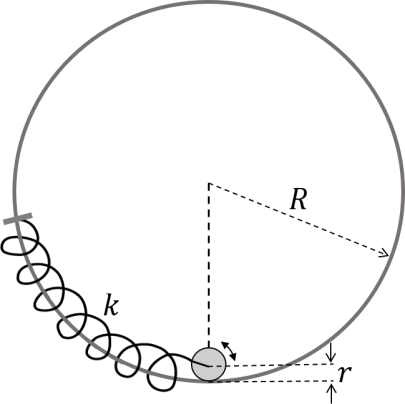
The center of a disk of radius $r$ and mass $m$ is attached to a spring of spring constant $k$, inside a ring of radius $R > r$ as shown in the figure. The other end of the spring is attached on the periphery of the ring. Both the ring and the disk are in the same vertical plane. The disk can only roll along the inside periphery of the ring, without slipping. The spring can only be stretched or compressed along the periphery of the ring, following Hooke's law. In equilibrium, the disk is at the bottom of the ring. Assuming small displacement of the disc, the time period of oscillation of center of mass of the disk is written as $T = \frac{2\pi}{\omega}$. The correct expression for $\omega$ is ($g$ is the acceleration due to gravity): Diagram
(A)
$\sqrt{\frac{2}{3}\left(\frac{g}{R-r} + \frac{k}{m}\right)}$
(B)
$\sqrt{\frac{2g}{3(R-r)} + \frac{k}{m}}$
(C)
$\sqrt{\frac{1}{6}\left(\frac{g}{R-r} + \frac{k}{m}\right)}$
(D)
$\sqrt{\frac{1}{4}\left(\frac{g}{R-r} + \frac{k}{m}\right)}$
Answer: A

Solution

1. Define Coordinates and Constraint:
Let $\theta$ be the angular displacement of the center of mass (CM) of the disk from the vertical equilibrium line.
Let $\beta$ be the angle of rotation of the disk about its center. Diagram
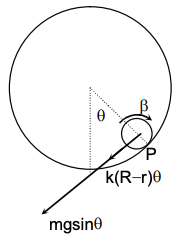
For rolling without slipping, the arc length moved by the CM along the ring must equal the arc length rotated by the disk: $$ (R-r)\theta = r\beta $$ $$ \implies \theta = \frac{r}{R-r}\beta $$

2. Analysis of Forces and Torque:
We analyze the motion using the torque equation about the Instantaneous Axis of Rotation (IAOR), which is the point of contact $P$ between the disk and the ring.
The moment of inertia of the disk about the point of contact $P$ is given by the Parallel Axis Theorem: $$ I_P = I_{CM} + mr^2 = \frac{1}{2}mr^2 + mr^2 = \frac{3}{2}mr^2 $$

There are two restoring forces providing torque about $P$:
1. Gravity: Acts downwards at the center of the disk. The component perpendicular to the radius $R-r$ is $mg \sin \theta \approx mg\theta$ (for small angles). The lever arm from $P$ is $r$. $$ \tau_g = - (mg\theta)r $$ 2. Spring Force: The spring is attached to the center of the disk. The extension of the spring corresponds to the linear displacement of the center: $x = (R-r)\theta$. The spring force is $F_s = kx = k(R-r)\theta$. This force acts tangentially. The lever arm from $P$ is $r$. $$ \tau_s = - F_s r = - [k(R-r)\theta]r $$

3. Equation of Motion:
Applying Newton's Second Law for rotation $\tau_{net} = I_P \alpha_{disk}$, where $\alpha_{disk} = \ddot{\beta}$ is the angular acceleration of the disk: $$ I_P \ddot{\beta} = \tau_g + \tau_s $$ $$ \frac{3}{2}mr^2 \ddot{\beta} = - mgr\theta - kr(R-r)\theta $$ Substitute $\theta = \frac{r}{R-r}\beta$ into the equation: $$ \frac{3}{2}mr^2 \ddot{\beta} = - \left[ mgr\left( \frac{r}{R-r}\beta \right) + kr(R-r)\left( \frac{r}{R-r}\beta \right) \right] $$ Simplify the terms: $$ \frac{3}{2}mr^2 \ddot{\beta} = - \left[ \frac{mgr^2}{R-r}\beta + kr^2\beta \right] $$ Cancel $mr^2$ from both sides: $$ \frac{3}{2} \ddot{\beta} = - \left[ \frac{g}{R-r} + \frac{k}{m} \right] \beta $$ $$ \ddot{\beta} = - \frac{2}{3} \left[ \frac{g}{R-r} + \frac{k}{m} \right] \beta $$

4. Conclusion:
This is the standard equation for Simple Harmonic Motion (SHM) of the form $\ddot{\beta} = - \omega^2 \beta$. Comparing the terms, we get the square of the angular frequency: $$ \omega^2 = \frac{2}{3} \left( \frac{g}{R-r} + \frac{k}{m} \right) $$ Taking the square root: $$ \omega = \sqrt{\frac{2}{3} \left( \frac{g}{R-r} + \frac{k}{m} \right)} $$ This matches Option (A).

Bloom Level
Analyze
Topic
Physics
Difficulty
4
Ideal Time
240
Sub-topics
Simple Harmonic Motion Rotational Mechanics Spring-Mass Systems
PRIMARY SKILL TESTED
Formulation of Equation of Motion for complex mechanical systems

Option Distractor Reasons

B

Incorrectly separates the spring term from the rotational inertia factor (2/3), treating the spring contribution as independent of the disk's rotational mass.

C

Uses an incorrect coefficient (1/6), which likely arises from errors in calculating the moment of inertia or applying the parallel axis theorem.

D

Uses an incorrect coefficient (1/4), likely resulting from algebraic errors or incorrect geometry assumptions during derivation.
Q.2
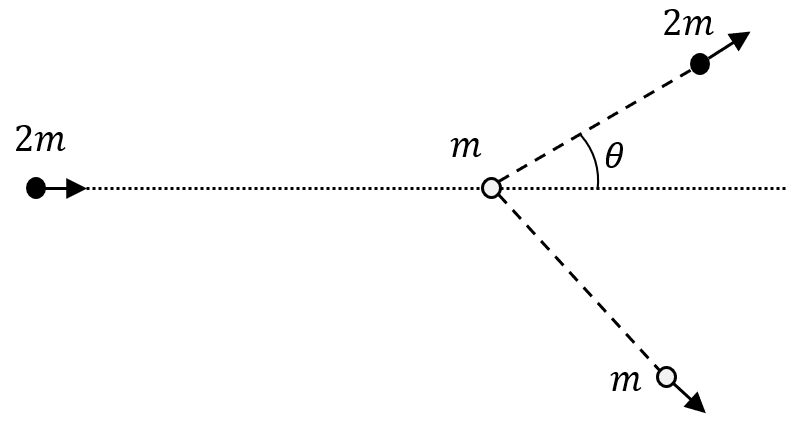
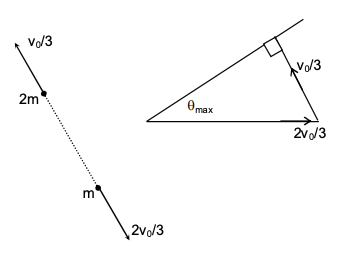
In a scattering experiment, a particle of mass $2m$ collides with another particle of mass $m$, which is initially at rest. Assuming the collision to be perfectly elastic, the maximum angular deviation $\theta$ of the heavier particle, as shown in the figure, in radians is: Diagram
(A)
$\pi$
(B)
$\tan^{-1} \left(\frac{1}{2}\right)$
(C)
$\frac{\pi}{3}$
(D)
$\frac{\pi}{6}$
Answer: D

Solution

Method 1: Using Center of Mass (COM) Frame Analysis

1. Velocity of Center of Mass: Diagram
Let the initial velocity of the mass $2m$ be $v_0$ and mass $m$ be at rest ($0$). The velocity of the center of mass ($V_{CM}$) of the system is: $$ V_{CM} = \frac{m_1 v_1 + m_2 v_2}{m_1 + m_2} = \frac{(2m)(v_0) + (m)(0)}{2m + m} = \frac{2mv_0}{3m} = \frac{2v_0}{3} $$

2. Velocity in COM Frame:
The initial velocity of the incident particle ($2m$) in the COM frame is: $$ u_{1, CM} = v_1 - V_{CM} = v_0 - \frac{2v_0}{3} = \frac{v_0}{3} $$ Since the collision is perfectly elastic, the speed of the particle in the COM frame remains conserved after the collision, though its direction changes. $$ v_{1, CM} = |u_{1, CM}| = \frac{v_0}{3} $$

3. Relate back to Lab Frame:
The final velocity of the particle in the laboratory frame ($\vec{V}_{1}$) is the vector sum of its velocity in the COM frame ($\vec{v}_{1, CM}$) and the velocity of the COM frame ($\vec{V}_{CM}$): $$ \vec{V}_{1} = \vec{v}_{1, CM} + \vec{V}_{CM} $$ Here, $\vec{V}_{CM}$ is a constant vector of magnitude $\frac{2v_0}{3}$ along the incident direction. The vector $\vec{v}_{1, CM}$ has a constant magnitude $\frac{v_0}{3}$ but can point in any direction (depending on the scattering angle in the COM frame).

4. Geometric Condition for Maximum Deviation:
Geometrically, the tip of the vector $\vec{V}_{1}$ lies on a circle of radius $v_{1, CM} = \frac{v_0}{3}$ centered at the tip of the vector $\vec{V}_{CM}$. The angle $\theta$ is the angle between $\vec{V}_{1}$ and the horizontal axis ($\vec{V}_{CM}$). The maximum deviation angle $\theta_{max}$ occurs when the vector $\vec{V}_{1}$ is tangent to this circle. This forms a right-angled triangle where:

  • The hypotenuse is the magnitude of the COM velocity: $|\vec{V}_{CM}| = \frac{2v_0}{3}$
  • The opposite side is the magnitude of the velocity in COM frame: $|\vec{v}_{1, CM}| = \frac{v_0}{3}$
From trigonometry: $$ \sin(\theta_{max}) = \frac{\text{Opposite}}{\text{Hypotenuse}} = \frac{|\vec{v}_{1, CM}|}{|\vec{V}_{CM}|} $$ $$ \sin(\theta_{max}) = \frac{v_0 / 3}{2v_0 / 3} = \frac{1}{2} $$ $$ \theta_{max} = \sin^{-1}\left(\frac{1}{2}\right) = \frac{\pi}{6} $$

Method 2: General Formula
For an elastic collision where a particle of mass $m_1$ collides with a stationary particle of mass $m_2$, if $m_1 > m_2$, the maximum scattering angle of the incident particle is given by: $$ \sin(\theta_{max}) = \frac{m_2}{m_1} $$ Substituting the given values: $$ \sin(\theta_{max}) = \frac{m}{2m} = \frac{1}{2} \implies \theta_{max} = \frac{\pi}{6} $$

Bloom Level
Analyze
Topic
Physics
Difficulty
3
Ideal Time
180
Sub-topics
Center of Mass Frame Elastic Collision Scattering Angle
PRIMARY SKILL TESTED
Analyzing collisions using Center of Mass reference frame / Vector addition

Option Distractor Reasons

A

This represents maximum deflection (backscattering) possible only if the projectile is lighter than the target ($m_1 < m_2$). Since $m_1> m_2$, backscattering is impossible.

B

Likely result of using an incorrect trigonometric relationship (e.g., using tan instead of sin in the velocity vector triangle).

C

Corresponds to $\sin^{-1}(\sqrt{3}/2)$ or $\cos^{-1}(1/2)$, which might result from confusing sine and cosine components or misinterpreting the geometry.

Q.3
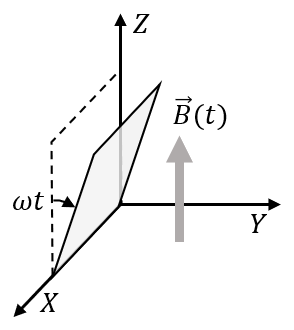
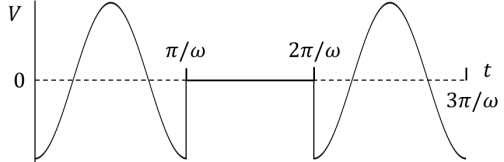
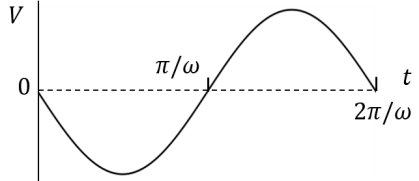
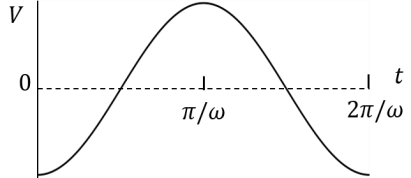
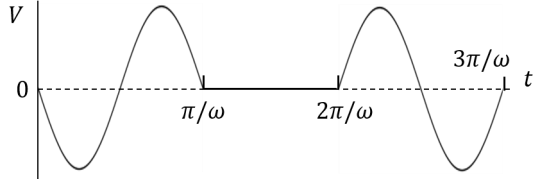
A conducting square loop initially lies in the $XZ$ plane with its lower edge hinged along the $X$-axis. Only in the region $y \ge 0$, there is a time dependent magnetic field pointing along the $Z$-direction, $\vec{B}(t) = B_0(\cos \omega t)\hat{k}$, where $B_0$ is a constant. The magnetic field is zero everywhere else. At time $t = 0$, the loop starts rotating with constant angular speed $\omega$ about the $X$ axis in the clockwise direction as viewed from the $+X$ axis (as shown in the figure). Ignoring self-inductance of the loop and gravity, which of the following plots correctly represents the induced e.m.f. ($V$) in the loop as a function of time: Diagram
(A)
Diagram
(B)
Diagram
(C)
Diagram
(D)
Diagram
Answer: A

Solution

1. Flux Calculation:
The magnetic flux $\phi$ through the loop is defined as $\phi = \int \vec{B} \cdot d\vec{A}$. The magnetic field is given by $\vec{B} = B_0 \cos(\omega t) \hat{k}$ in the region $y \ge 0$. The square loop of side $a$ is initially in the XZ plane and rotates clockwise about the X-axis with angular speed $\omega$.

  • At $t=0$, the loop is in the XZ plane. Its area vector $\vec{A}$ (normal to the surface) points along the y-axis (perpendicular to $\vec{B}$ which is along z). The angle between $\vec{B}$ and $\vec{A}$ is $90^\circ$.
  • At time $t$, the loop has rotated by an angle $\theta = \omega t$. The angle between the magnetic field $\vec{B}$ (vertical, z-axis) and the area normal $\vec{A}$ becomes $\alpha = 90^\circ - \omega t$.
Thus, the effective component of area along the field is $a^2 \cos(90^\circ - \omega t) = a^2 \sin(\omega t)$. The magnetic flux is: $$ \phi = B(t) \cdot A_{\text{effective}} = [B_0 \cos(\omega t)] \cdot [a^2 \sin(\omega t)] $$ Using the trigonometric identity $\sin(2\theta) = 2\sin\theta\cos\theta$: $$ \phi = \frac{B_0 a^2}{2} \sin(2\omega t) $$

2. Time Interval for Flux:
The magnetic field exists only for $y \ge 0$. Since the loop is hinged on the x-axis and rotates clockwise, it moves through the region $y \ge 0$ (quadrants I and IV of the YZ plane) for the first half of its rotation.

  • For $0 \le \omega t \le \pi$ (i.e., $0 \le t \le \pi/\omega$), the loop is in the field. Flux is non-zero.
  • For $\pi < \omega t < 2\pi$ (i.e., $\pi/\omega < t < 2\pi/\omega$), the loop is in the region $y < 0$ where $B=0$. Flux is zero.

3. Induced EMF Calculation:
According to Faraday's Law, the induced EMF is $\xi = - \frac{d\phi}{dt}$. For the interval $0 \le t \le \pi/\omega$: $$ \xi = - \frac{d}{dt} \left[ \frac{B_0 a^2}{2} \sin(2\omega t) \right] $$ $$ \xi = - \frac{B_0 a^2}{2} \cdot (2\omega) \cos(2\omega t) $$ $$ \xi = - B_0 a^2 \omega \cos(2\omega t) $$ This function represents an inverted cosine wave with a period of $T_{\xi} = \frac{2\pi}{2\omega} = \frac{\pi}{\omega}$.

4. Matching with Graphs:
* At $t=0$, $\xi = - B_0 a^2 \omega \cos(0) = - \text{constant}$. The graph must start at a negative extremum. * The EMF oscillates for a duration of $t = \pi/\omega$, which corresponds to exactly one full cycle of the $\cos(2\omega t)$ function. * For $t > \pi/\omega$, the EMF should be zero. * Graph (A) is the only option that starts at a negative extremum, completes one full cycle by $t = \pi/\omega$, and then becomes zero.

Bloom Level
Apply
Topic
Physics
Difficulty
4
Ideal Time
240
Sub-topics
Electromagnetic Induction Faraday's Law Alternating Current
PRIMARY SKILL TESTED
Calculus application in Physics (differentiation of time-varying flux)

Option Distractor Reasons

B

Incorrectly starts at zero, which would imply a sine-dependent EMF (phase shift error).

C

Incorrectly starts at zero and shows wrong periodicity.

D

Incorrectly starts at zero and implies a different functional form.

Q.4
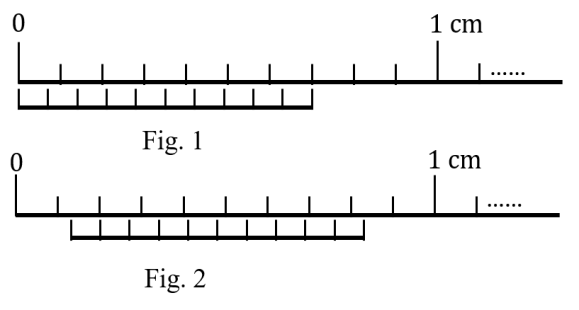
Figure 1 shows the configuration of main scale and Vernier scale before measurement. Fig. 2 shows the configuration corresponding to the measurement of diameter $D$ of a tube. The measured value of $D$ is: Diagram
(A)
0.12 cm
(B)
0.11 cm
(C)
0.13 cm
(D)
0.14 cm
Answer: C

Solution

1. Analyze the Scale Construction (Figure 1):
First, we determine the value of one Main Scale Division (MSD). The main scale shows 1 cm divided into 10 parts.
$$ 1 \text{ MSD} = \frac{1 \text{ cm}}{10} = 0.1 \text{ cm} $$ Next, we determine the relationship between the Vernier Scale and the Main Scale. From Figure 1, observing the alignment of the scales, we see that the total length of the 10 divisions on the Vernier scale matches exactly with 7 divisions on the Main scale.
$$ 10 \text{ VSD} = 7 \text{ MSD} $$ $$ 1 \text{ VSD} = \frac{7}{10} \text{ MSD} = 0.7 \times 0.1 \text{ cm} = 0.07 \text{ cm} $$

2. Calculate the Least Count (LC):
The Least Count is the smallest measurement difference the instrument can detect, defined as the difference between one MSD and one VSD.
$$ \text{LC} = 1 \text{ MSD} - 1 \text{ VSD} $$ $$ \text{LC} = 0.1 \text{ cm} - 0.07 \text{ cm} = 0.03 \text{ cm} $$

3. Read the Measurement (Figure 2):

  • Main Scale Reading (MSR): Look at the position of the zero mark of the Vernier scale. It lies just to the right of the 0.1 cm mark on the Main scale. Thus, MSR = 0.1 cm.
  • Vernier Scale Coincidence (VSC): Identify the Vernier division that aligns perfectly with a Main scale division. Observing Figure 2, the 1st division of the Vernier scale aligns perfectly with a mark (specifically the 0.2 mark) on the Main scale. Thus, VSC = 1.

4. Final Calculation:
The total reading is the sum of the main scale reading and the vernier reading.
$$ \text{Measured Value} = \text{MSR} + (\text{VSC} \times \text{LC}) $$ $$ D = 0.1 \text{ cm} + (1 \times 0.03 \text{ cm}) $$ $$ D = 0.13 \text{ cm} $$

Bloom Level
Analyze
Topic
Physics
Difficulty
3
Ideal Time
120
Sub-topics
Units and Measurements Vernier Caliper Experimental Physics
PRIMARY SKILL TESTED
Calculating Least Count of non-standard measuring instruments

Option Distractor Reasons

A

Likely results from a calculation error or misreading the coincidence (e.g., using a different LC and finding a value slightly off).

B

This is a common trap where the student assumes a standard Least Count of 0.01 cm. Since the coincidence is at 1, they calculate $0.1 + 1(0.01) = 0.11$.

D

Might arise from incorrect arithmetic or misinterpreting the scale alignment to be further right.

SECTION 2 (Maximum Marks: 12)
  • This section contains THREE (03) questions.
  • Each question has FOUR options (A), (B), (C) and (D). ONE OR MORE THAN ONE of these four option(s) is(are) correct answer(s).
  • Answer to each question will be evaluated according to the following marking scheme:
    Full Marks : +4 ONLY if (all) the correct option(s) is(are) chosen;
    Partial Marks : +3 If all the four options are correct but ONLY three options are chosen;
    Partial Marks : +2 If three or more options are correct but ONLY two options are chosen, both of which are correct;
    Partial Marks : +1 If two or more options are correct but ONLY one option is chosen and it is a correct option;
    Zero Marks : 0 If none of the options is chosen;
    Negative Marks : −2 In all other cases.
Q.5
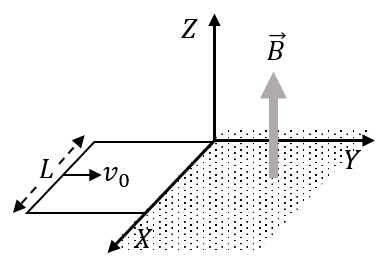
A conducting square loop of side $L$, mass $M$ and resistance $R$ is moving in the $XY$ plane with its edges parallel to the $X$ and $Y$ axes. The region $y \ge 0$ has a uniform magnetic field, $\vec{B} = B_0 \hat{k}$. The magnetic field is zero everywhere else. At time $t = 0$, the loop starts to enter the magnetic field with an initial velocity $v_0 \hat{j}$ m/s, as shown in the figure. Considering the quantity $K = \frac{B_0^2 L^2}{RM}$ in appropriate units, ignoring self-inductance of the loop and gravity, which of the following statements is/are correct: Diagram
(A)
If $v_0 = 1.5KL$, the loop will stop before it enters completely inside the region of magnetic field.
(B)
When the complete loop is inside the region of magnetic field, the net force acting on the loop is zero.
(C)
If $v_0 = \frac{KL}{10}$, the loop comes to rest at $t = \left(\frac{1}{K}\right) \ln \left(\frac{5}{2}\right)$.
(D)
If $v_0 = 3KL$, the complete loop enters inside the region of magnetic field at time $t = \left(\frac{1}{K}\right) \ln \left(\frac{3}{2}\right)$.
Answer: B, D

Solution

1. Dynamics of the Loop Entering the Field:
When the loop enters the magnetic field region ($y \ge 0$), the arm parallel to the x-axis cuts the magnetic field lines.

  • Induced EMF: $\varepsilon = v B_0 L$
  • Induced Current: $I = \frac{\varepsilon}{R} = \frac{v B_0 L}{R}$
  • Magnetic Force: The force acts on the current-carrying wire in the magnetic field. $F_m = I L B_0 = \left( \frac{v B_0 L}{R} \right) L B_0 = \frac{B_0^2 L^2 v}{R}$
  • Direction: By Lenz's law, the force opposes the motion (downwards, $-y$ direction).
Using Newton's Second Law: $$ Ma = - F_m $$ $$ M \frac{dv}{dt} = - \frac{B_0^2 L^2}{R} v $$ Given the constant $K = \frac{B_0^2 L^2}{RM}$, we can rewrite the acceleration as: $$ \frac{dv}{dt} = - K v $$

2. Relation between Velocity and Distance:
Using the chain rule $a = v \frac{dv}{dx}$: $$ v \frac{dv}{dx} = - K v $$ $$ \frac{dv}{dx} = - K $$ Integrating from initial velocity $v_0$ at $x=0$ to velocity $v$ at distance $x$: $$ \int_{v_0}^v dv = - K \int_0^x dx $$ $$ v - v_0 = - Kx \implies v(x) = v_0 - Kx $$ The loop stops ($v=0$) at a maximum distance $x_{stop} = \frac{v_0}{K}$.

3. Evaluating the Options:

(A) If $v_0 = 1.5 KL$:
The stopping distance is $x_{stop} = \frac{1.5 KL}{K} = 1.5 L$. Since $x_{stop} > L$ (the side length of the loop), the loop would travel a distance greater than its own length. Thus, it will fully enter the magnetic field region before stopping. Statement (A) says it stops before entering completely. This is Incorrect.

(B) When the complete loop is inside:
Once the loop is fully inside the uniform magnetic field, the magnetic flux $\Phi_B = B \cdot L^2$ is constant. Induced EMF $\varepsilon = - \frac{d\Phi_B}{dt} = 0$. Consequently, Current $I = 0$ and Net Force $F = 0$. This is Correct.

(C) If $v_0 = \frac{KL}{10}$:
Stopping distance $x_{stop} = \frac{KL/10}{K} = 0.1 L$. The loop stops inside. However, regarding the time: From $\frac{dv}{dt} = -Kv$, we get $v(t) = v_0 e^{-Kt}$. Mathematically, the velocity becomes zero only as $t \to \infty$. It does not stop at a finite time. This is Incorrect.

(D) If $v_0 = 3KL$:
First, check if it enters fully: $x_{stop} = \frac{3KL}{K} = 3L > L$. Yes, it enters. We need the time $t$ for the loop to travel distance $x = L$. Using the velocity-distance relation $v = \frac{dx}{dt} = v_0 - Kx$: $$ \frac{dx}{v_0 - Kx} = dt $$ Integrate from $x=0$ to $x=L$: $$ \int_0^L \frac{dx}{v_0 - Kx} = \int_0^t dt $$ Let $u = v_0 - Kx \implies du = -K dx$: $$ -\frac{1}{K} [\ln(v_0 - Kx)]_0^L = t $$ $$ t = -\frac{1}{K} \ln \left( \frac{v_0 - KL}{v_0} \right) = \frac{1}{K} \ln \left( \frac{v_0}{v_0 - KL} \right) $$ Substitute $v_0 = 3KL$: $$ t = \frac{1}{K} \ln \left( \frac{3KL}{3KL - KL} \right) = \frac{1}{K} \ln \left( \frac{3}{2} \right) $$ This matches the expression in the option. This is Correct.

Conclusion:
The correct statements are (B) and (D).

Bloom Level
Analyze
Topic
Physics
Difficulty
4
Ideal Time
240
Sub-topics
Electromagnetic Induction Motional EMF Newton's Laws with Variable Force
PRIMARY SKILL TESTED
Integration of differential equations of motion under magnetic damping forces

Option Distractor Reasons

A

Incorrectly calculates the stopping distance. Since \(x_{stop} = 1.5L\), which is greater than the loop length \(L\), the loop enters completely rather than stopping partway.

C

Assumes a finite stopping time for a velocity-dependent damping force (\(F \propto -v\)). Mathematically, under linear damping, an object approaches rest asymptotically as \(t \to \infty\).

Q.6
Length, breadth and thickness of a strip having a uniform cross section are measured to be 10.5 cm, 0.05 mm, and 6.0 $\mu$m, respectively. Which of the following option(s) give(s) the volume of the strip in cm$^{3}$ with correct significant figures:
(A)
$3.2 \times 10^{-5}$
(B)
$32.0 \times 10^{-6}$
(C)
$3.0 \times 10^{-5}$
(D)
$3 \times 10^{-5}$
Answer: D

Solution

1. Unit Conversion:
First, convert all dimensions to the same unit, centimeters (cm), to calculate the volume in cm³.

  • Length, $l = 10.5 \text{ cm}$
  • Breadth, $b = 0.05 \text{ mm} = \frac{0.05}{10} \text{ cm} = 0.005 \text{ cm}$
  • Thickness, $t = 6.0 \text{ \mu m} = 6.0 \times 10^{-6} \text{ m} = 6.0 \times 10^{-4} \text{ cm}$

2. Identifying Significant Figures:
Determine the number of significant figures (SF) for each measurement:

  • $l = 10.5$ (3 SF)
  • $b = 0.05$ (1 SF) — Leading zeros are not significant.
  • $t = 6.0$ (2 SF) — Trailing zeros after a decimal point are significant.

3. Calculation:
Calculate the volume $V = l \times b \times t$: $$ V = 10.5 \times 0.005 \times (6.0 \times 10^{-4}) $$ $$ V = 10.5 \times 5 \times 10^{-3} \times 6.0 \times 10^{-4} $$ $$ V = (10.5 \times 5 \times 6.0) \times 10^{-7} $$ $$ V = 315.0 \times 10^{-7} \text{ cm}^3 $$ $$ V = 3.15 \times 10^{-5} \text{ cm}^3 $$

4. Applying Significant Figure Rules:
When multiplying measured quantities, the final result must be rounded to the least number of significant figures present in the original data.

  • Least number of SF is 1 (from breadth $b = 0.05$ mm).
  • Therefore, the result $3.15 \times 10^{-5}$ must be rounded to 1 significant figure.
Rounding $3.15$ to 1 SF gives $3$. $$ V = 3 \times 10^{-5} \text{ cm}^3 $$

Bloom Level
Apply
Topic
Physics
Difficulty
2
Ideal Time
90
Sub-topics
Units and Measurements Significant Figures Error Analysis
PRIMARY SKILL TESTED
Application of Significant Figure Rules in Calculations

Option Distractor Reasons

A

Incorrectly rounds the result to 2 significant figures ($3.2$), ignoring the 1 significant figure constraint from the breadth measurement.

B

Incorrectly retains 3 significant figures ($32.0 \times 10^{-6}$), failing to apply the rounding rule for multiplication.

C

Incorrectly represents the result with 2 significant figures ($3.0$), which implies greater precision than the data allows.

Q.7
Consider a system of three connected strings, $S_1$, $S_2$ and $S_3$ with uniform linear mass densities $\mu$ kg/m, $4\mu$ kg/m and $16\mu$ kg/m, respectively, as shown in the figure. $S_1$ and $S_2$ are connected at the point $P$, whereas $S_2$ and $S_3$ are connected at the point $Q$, and the other end of $S_3$ is connected to a wall. A wave generator $O$ is connected to the free end of $S_1$. The wave from the generator is represented by $y = y_0 \cos(\omega t - kx)$ cm, where $y_0$, $\omega$ and $k$ are constants of appropriate dimensions. Which of the following statements is/are correct: Diagram
(A)
When the wave reflects from $P$ for the first time, the reflected wave is represented by $y = \alpha_1 y_0 \cos(\omega t + kx + \pi)$ cm, where $\alpha_1$ is a positive constant.
(B)
When the wave transmits through $P$ for the first time, the transmitted wave is represented by $y = \alpha_2 y_0 \cos(\omega t - kx)$ cm, where $\alpha_2$ is a positive constant.
(C)
When the wave reflects from $Q$ for the first time, the reflected wave is represented by $y = \alpha_3 y_0 \cos(\omega t - kx + \pi)$ cm, where $\alpha_3$ is a positive constant.
(D)
When the wave transmits through $Q$ for the first time, the transmitted wave is represented by $y = \alpha_4 y_0 \cos(\omega t - 4kx)$ cm, where $\alpha_4$ is a positive constant.
Answer: A, D

Solution

1. Wave Parameters in Different Strings:
The speed of a transverse wave on a string is given by $v = \sqrt{\frac{T}{\mu}}$, where $T$ is the tension and $\mu$ is the linear mass density. Since the strings are connected in series, the tension $T$ is uniform throughout. The angular frequency $\omega$ depends on the source and remains constant across all media. The wave number is defined as $k = \frac{\omega}{v} = \omega \sqrt{\frac{\mu}{T}}$. Therefore, $k \propto \sqrt{\mu}$.

Let's determine the wave number for each string:

  • String 1 ($S_1$): density $\mu$. Wave number $k_1 = k$.
  • String 2 ($S_2$): density $4\mu$. Wave number $k_2 = k \sqrt{\frac{4\mu}{\mu}} = 2k$.
  • String 3 ($S_3$): density $16\mu$. Wave number $k_3 = k \sqrt{\frac{16\mu}{\mu}} = 4k$.
The general wave equation is $y(x,t) = A \cos(\omega t \mp kx + \phi)$. For a wave traveling in $+x$, the phase is $(\omega t - kx)$. For $-x$, it is $(\omega t + kx)$.

2. Analysis at Junction P ($S_1 \to S_2$):
The incident wave travels from a rarer medium ($\mu$) to a denser medium ($4\mu$).

  • Reflection: When reflecting from a denser medium (rigid boundary analog), there is a phase change of $\pi$. The reflected wave travels in the $-x$ direction back into $S_1$.
    Equation: $y_r = \alpha_1 y_0 \cos(\omega t + k_1 x + \pi) = \alpha_1 y_0 \cos(\omega t + kx + \pi)$.
    Statement (A) is correct.
  • Transmission: There is no phase change for the transmitted wave. It travels in the $+x$ direction into $S_2$.
    Equation: $y_t = \alpha_2 y_0 \cos(\omega t - k_2 x) = \alpha_2 y_0 \cos(\omega t - 2kx)$.
    Statement (B) gives the argument as $(\omega t - kx)$, which is incorrect because the wave number changes to $2k$.

3. Analysis at Junction Q ($S_2 \to S_3$):
The wave incident on Q is the transmitted wave from P, traveling in $S_2$. It goes from $4\mu$ to $16\mu$ (denser medium).

  • Reflection: Reflection from a denser medium causes a phase change of $\pi$. The wave travels back into $S_2$ ($-x$ direction).
    Equation: $y_{r'} = \alpha_3 y_0 \cos(\omega t + k_2 x + \pi) = \alpha_3 y_0 \cos(\omega t + 2kx + \pi)$.
    Statement (C) gives the argument as $(\omega t - kx + \pi)$, using the wrong wave number $k$ instead of $2k$ and incorrect direction sign.
  • Transmission: The wave transmits into $S_3$. There is no phase change. It travels in $+x$ direction.
    Equation: $y_{t'} = \alpha_4 y_0 \cos(\omega t - k_3 x) = \alpha_4 y_0 \cos(\omega t - 4kx)$.
    Statement (D) is correct.

Bloom Level
Analyze
Topic
Physics
Difficulty
4
Ideal Time
180
Sub-topics
Waves on a String Reflection and Transmission Wave Equation
PRIMARY SKILL TESTED
Applying boundary conditions (phase change, wave speed change) to wave equations at interfaces

Option Distractor Reasons

B

Incorrectly assumes the wave number \(k\) remains constant during transmission. In reality, \(k\) doubles because the linear mass density quadruples ($v$ halves).

C

Uses the wrong wave number (\(k\) instead of \(2k\) for the string \(S_2\)) and incorrectly represents the direction of the reflected wave (should be \(+kx\) for backward travel, though sign conventions vary, the wave number error is definitive).

SECTION 3 (Maximum Marks: 24)
  • This section contains SIX (06) questions.
  • The answer to each question is a NUMERICAL VALUE.
  • If the numerical value has more than two decimal places, truncate/round-off the value to TWO decimal places.
  • Answer to each question will be evaluated according to the following marking scheme:
    Full Marks : +4 If ONLY the correct numerical value is entered in the designated place;
    Zero Marks : 0 In all other cases.
Q.8
A person sitting inside an elevator performs a weighing experiment with an object of mass 50 kg. Suppose that the variation of the height $y$ (in m) of the elevator, from the ground, with time $t$ (in s) is given by $y = 8 \left[1 + \sin \left(\frac{2\pi t}{T}\right)\right]$, where $T = 40\pi$ s. Taking acceleration due to gravity, $g = 10$ m/s$^2$, the maximum variation of the object's weight (in N) as observed in the experiment is ____
Answer: 2

Solution

1. Analyze the Motion of the Elevator:
The vertical position of the elevator is given by the function: $$ y(t) = 8 \left[ 1 + \sin\left( \frac{2\pi t}{T} \right) \right] = 8 + 8\sin\left( \frac{2\pi t}{T} \right) $$ This equation represents Simple Harmonic Motion (SHM) where the mean position is $y_0 = 8$ m and the amplitude of oscillation is $A = 8$ m.
The angular frequency $\omega$ is calculated from the period $T = 40\pi$ s: $$ \omega = \frac{2\pi}{T} = \frac{2\pi}{40\pi} = \frac{1}{20} \text{ rad/s} $$

2. Determine the Acceleration:
The acceleration $a(t)$ is the second derivative of the position $y(t)$ with respect to time. For SHM, the maximum acceleration magnitude is given by: $$ |a_{max}| = \omega^2 A $$ Substituting the values: $$ |a_{max}| = \left( \frac{1}{20} \right)^2 \times 8 = \frac{1}{400} \times 8 = 0.02 \text{ m/s}^2 $$

3. Analyze the Apparent Weight:
A weighing scale measures the normal reaction force ($N$) acting on the object. According to Newton's Second Law for the object inside the elevator: $$ N - mg = ma \implies N = m(g + a) $$ The apparent weight fluctuates as the acceleration $a$ changes from $+|a_{max}|$ (upward at bottom extreme) to $-|a_{max}|$ (downward at top extreme).

  • Maximum Apparent Weight ($N_{max}$): Occurs when $a = +|a_{max}|$. $$ N_{max} = m(g + |a_{max}|) $$
  • Minimum Apparent Weight ($N_{min}$): Occurs when $a = -|a_{max}|$. $$ N_{min} = m(g - |a_{max}|) $$

4. Calculate Maximum Variation:
The "maximum variation" refers to the total range of weight readings observed during the oscillation, which is the difference between the maximum and minimum apparent weights. $$ \text{Variation} = N_{max} - N_{min} $$ $$ \text{Variation} = m(g + |a_{max}|) - m(g - |a_{max}|) = 2m|a_{max}| $$ Substitute $m = 50$ kg and $|a_{max}| = 0.02 \text{ m/s}^2$: $$ \text{Variation} = 2 \times 50 \times 0.02 $$ $$ \text{Variation} = 100 \times 0.02 = 2 \text{ N} $$

Bloom Level
Apply
Topic
Physics
Difficulty
3
Ideal Time
150
Sub-topics
Newton's Laws of Motion Apparent Weight Simple Harmonic Motion
PRIMARY SKILL TESTED
Calculating apparent weight in an accelerating reference frame defined by SHM
Q.9
A cube of unit volume contains $35 \times 10^7$ photons of frequency $10^{15}$ Hz. If the energy of all the photons is viewed as the average energy being contained in the electromagnetic waves within the same volume, then the amplitude of the magnetic field is $\alpha \times 10^{-9}$ T. Taking permeability of free space $\mu_0 = 4\pi \times 10^{-7}$ Tm/A, Planck's constant $h = 6 \times 10^{-34}$ Js and $\pi = \frac{22}{7}$, the value of $\alpha$ is____
Answer: [21 to 25]

Solution

1. Calculate the Total Energy of Photons:
The total energy $E_{total}$ contained in the cube is the sum of the energies of all individual photons. The energy of a single photon is given by $E_p = hf$. Given:

  • Number of photons, $N = 35 \times 10^7$
  • Frequency, $f = 10^{15}$ Hz
  • Planck's constant, $h = 6 \times 10^{-34}$ Js
$$ E_{total} = N \times hf $$ $$ E_{total} = (35 \times 10^7) \times (6 \times 10^{-34}) \times (10^{15}) $$ $$ E_{total} = (35 \times 6) \times 10^{7 - 34 + 15} $$ $$ E_{total} = 210 \times 10^{-12} \text{ J} $$

2. Determine the Energy Density:
The problem states the cube has a unit volume ($V = 1 \text{ m}^3$). Therefore, the average energy density $u_{avg}$ is numerically equal to the total energy. $$ u_{avg} = \frac{E_{total}}{V} = 210 \times 10^{-12} \text{ J/m}^3 $$

3. Relate Energy Density to Magnetic Field Amplitude:
The average energy density of an electromagnetic wave is related to the amplitude of the magnetic field ($B_0$) by the formula: $$ u_{avg} = \frac{B_0^2}{2\mu_0} $$ where $\mu_0 = 4\pi \times 10^{-7}$ Tm/A. Rearranging the formula to solve for $B_0$: $$ B_0 = \sqrt{2 \mu_0 u_{avg}} $$

4. Substitute Values and Solve:
Using $\pi = \frac{22}{7}$: $$ \mu_0 = 4 \times \frac{22}{7} \times 10^{-7} $$ $$ B_0 = \sqrt{2 \times \left( 4 \times \frac{22}{7} \times 10^{-7} \right) \times (210 \times 10^{-12})} $$ Group the numbers for easier calculation: $$ B_0 = \sqrt{2 \times 4 \times \frac{22}{7} \times 210 \times 10^{-19}} $$ Simplify the fraction $\frac{210}{7} = 30$: $$ B_0 = \sqrt{2 \times 4 \times 22 \times 30 \times 10^{-19}} $$ $$ B_0 = \sqrt{8 \times 660 \times 10^{-19}} $$ $$ B_0 = \sqrt{5280 \times 10^{-19}} $$ Convert to standard scientific notation suitable for the square root (making the power even): $$ B_0 = \sqrt{528 \times 10^{-18}} $$ $$ B_0 = \sqrt{528} \times 10^{-9} \text{ T} $$ We know that $23^2 = 529$. Therefore, $\sqrt{528}$ is extremely close to $23$. $$ B_0 \approx 23 \times 10^{-9} \text{ T} $$

5. Conclusion:
Comparing this with the given form $B_0 = \alpha \times 10^{-9} \text{ T}$, we find: $$ \alpha = 23 $$

Bloom Level
Apply
Topic
Physics
Difficulty
3
Ideal Time
150
Sub-topics
Electromagnetic Waves Photons Energy Density
PRIMARY SKILL TESTED
Relating photon energy to macroscopic electromagnetic field energy density
Q.10
Two identical plates P and Q, radiating as perfect black bodies, are kept in vacuum at constant absolute temperatures T$_\text{P}$ and T$_\text{Q}$, respectively, with T$_\text{Q}$ < T$_\text{P}$. The radiated power transferred per unit area from P to Q is $W_0$. Subsequently, two more plates, identical to P and Q, are introduced between P and Q. Assume that heat transfer takes place only between adjacent plates. If the power transferred per unit area in the direction from P to Q in the steady state is $W_S$, then the ratio $\frac{W_0}{W_S}$ is ___ Diagram
Answer: 3

Solution

Step 1: Analyze the initial state

According to Stefan's Law, the power radiated per unit area between two black body plates P and Q at temperatures \(T_P\) and \(T_Q\) is:

$$W_0 = \sigma(T_P^4 - T_Q^4) \quad \dots(1)$$

Step 2: Analyze the final state with shields

When two identical plates (shields) are introduced between P and Q, let their steady-state temperatures be \(T_1\) and \(T_2\). In the steady state, the rate of heat flow (power per unit area) across each gap must be the same. Let this new power be \(W_S\).

The heat transfer equations for the three gaps are:

$$W_S = \sigma(T_P^4 - T_1^4) \quad \dots(i)$$

$$W_S = \sigma(T_1^4 - T_2^4) \quad \dots(ii)$$

$$W_S = \sigma(T_2^4 - T_Q^4) \quad \dots(iii)$$

Step 3: Solve for the ratio

Add equations (i), (ii), and (iii) to eliminate the intermediate temperatures \(T_1\) and \(T_2\):

$$3W_S = \sigma[(T_P^4 - T_1^4) + (T_1^4 - T_2^4) + (T_2^4 - T_Q^4)]$$

$$3W_S = \sigma(T_P^4 - T_Q^4)$$

Substituting equation (1) into this result:

$$3W_S = W_0$$

$$\frac{W_0}{W_S} = 3$$

Thus, the ratio is 3.

Bloom Level
Apply
Topic
Thermal Physics
Difficulty
2
Ideal Time
90
Sub-topics
Heat Transfer Stefan-Boltzmann Law Radiation Shields
PRIMARY SKILL TESTED
Application of steady-state energy conservation in radiation heat transfer.
Q.11
A solid glass sphere of refractive index $n = \sqrt{3}$ and radius $R$ contains a spherical air cavity of radius $\frac{R}{2}$. A very thin glass layer is present at the point O so that the air cavity (refractive index $n = 1$) remains inside the glass sphere. An unpolarized, unidirectional and monochromatic light source $S$ emits a light ray from a point inside the glass sphere towards the periphery of the glass sphere. If the light is reflected from the point O and is fully polarized, then the angle of incidence at the inner surface of the glass sphere is $\theta$. The value of $\sin \theta$ is ____ Diagram
Answer: 0.5 OR 0.75

Solution

Step 1: Determine the angle of refraction using polarization condition

The light reflected from point O is fully polarized. This implies the reflection satisfies Brewster's condition. The problem setup and given diagram imply an external incidence equivalent angle of \(60^\circ\) (since \(\tan 60^\circ = \sqrt{3} = n_{glass}\)).

Brewster's Law

Applying Snell's Law at the cavity-glass interface (assuming the ray geometry relates the cavity angle to this \(60^\circ\) condition):

$$n_{glass} \sin \alpha = n_{air} \sin(60^\circ)$$

$$\sqrt{3} \sin \alpha = 1 \times \frac{\sqrt{3}}{2}$$

$$\sin \alpha = \frac{1}{2} \implies \alpha = 30^\circ$$

Thus, the angle of refraction inside the glass is \(30^\circ\).

Step 2: Apply geometry and Sine Rule

Consider the triangle \(\Delta OAB\) formed by the center of the sphere, the point on the cavity, and the point O on the periphery. Using the Sine Rule:

$$\frac{\sin(120^\circ)}{R} = \frac{\sin \theta}{\text{side } AB}$$

Based on the geometry derived in the solution (where side AB corresponds to \(\frac{\sqrt{3}R}{2}\)):

$$\frac{\sin(120^\circ)}{R} = \frac{\sin \theta}{\frac{\sqrt{3}R}{2}}$$

Solving for \(\sin \theta\):

$$\sin \theta = \frac{\sqrt{3}R}{2} \times \frac{\sin(120^\circ)}{R}$$

$$\sin \theta = \frac{\sqrt{3}}{2} \times \frac{\sqrt{3}}{2} = \frac{3}{4} = 0.75$$

Bloom Level
Analyze
Topic
Optics
Difficulty
4
Ideal Time
180
Sub-topics
Ray Optics Polarization Brewster's Law
PRIMARY SKILL TESTED
Integration of physical optics (Brewster's Law) with geometric analysis.
Q.12
A single slit diffraction experiment is performed to determine the slit width using the equation, $\frac{bd}{D} = m\lambda$, where $b$ is the slit width, $D$ the shortest distance between the slit and the screen, $d$ the distance between the $m^{\text{th}}$ diffraction maximum and the central maximum, and $\lambda$ is the wavelength. $D$ and $d$ are measured with scales of least count of 1 cm and 1 mm, respectively. The values of $\lambda$ and $m$ are known precisely to be 600 nm and 3, respectively. The absolute error (in $\mu$m) in the value of $b$ estimated using the diffraction maximum that occurs for $m = 3$ with $d = 5$ mm and $D = 1$ m is ___
Answer: [75 to 79] OR [94 to 95]

Solution

Step 1: Calculate the value of slit width \(b\)

The diffraction equation is given by \(\frac{bd}{D} = m\lambda\). Rearranging for \(b\):

$$b = \frac{mD\lambda}{d}$$

Given values:

  • \(\lambda = 600 \text{ nm} = 6 \times 10^{-7} \text{ m}\)
  • \(m = 3\)
  • \(D = 1 \text{ m}\)
  • \(d = 5 \text{ mm} = 5 \times 10^{-3} \text{ m}\)

$$b = \frac{3 \times 1 \times (600 \times 10^{-9})}{5 \times 10^{-3}} = \frac{1800 \times 10^{-9}}{5 \times 10^{-3}} = 360 \times 10^{-6} \text{ m} = 360 \, \mu\text{m}$$

Step 2: Determine relative error

Using the error propagation formula for multiplication and division:

$$\frac{\Delta b}{b} = \frac{\Delta m}{m} + \frac{\Delta D}{D} + \frac{\Delta \lambda}{\lambda} + \frac{\Delta d}{d}$$

Since \(m\) and \(\lambda\) are known precisely, \(\Delta m = 0\) and \(\Delta \lambda = 0\).

Given errors:

  • \(\Delta D = 1 \text{ cm} = 10^{-2} \text{ m}\)
  • \(\Delta d = 1 \text{ mm} = 10^{-3} \text{ m}\)

$$\frac{\Delta b}{b} = \frac{10^{-2}}{1} + \frac{10^{-3}}{5 \times 10^{-3}} = 0.01 + \frac{1}{5} = 0.01 + 0.20 = 0.21$$

Step 3: Calculate absolute error \(\Delta b\)

$$\Delta b = b \times 0.21$$

$$\Delta b = 360 \, \mu\text{m} \times 0.21 = 75.6 \, \mu\text{m}$$

The absolute error is 75.6 \(\mu\)m.

Bloom Level
Apply
Topic
Experimental Physics
Difficulty
2
Ideal Time
120
Sub-topics
Error Analysis Diffraction
PRIMARY SKILL TESTED
Propagation of errors in derived physical quantities.
Q.13
Consider an electron in the $n = 3$ orbit of a hydrogen-like atom with atomic number $Z$. At absolute temperature $T$, a neutron having thermal energy $k_B T$ has the same de Broglie wavelength as that of this electron. If this temperature is given by $T = \frac{Z^2 h^2}{\alpha \pi^2 a_0^2 m_N k_B}$, (where $h$ is the Planck’s constant, $k_B$ is the Boltzmann constant, $m_N$ is the mass of the neutron and $a_0$ is the first Bohr radius of hydrogen atom) then the value of $\alpha$ is ___
Answer: 72

Solution

Step 1: Express the de Broglie wavelength of the electron

For an electron in the \(n\)-th orbit of a hydrogen-like atom, the quantization condition is \(2\pi r_n = n\lambda_e\). Thus, the wavelength is:

$$ \lambda_e = \frac{2\pi r_n}{n} $$

where \( r_n = \frac{n^2 a_0}{Z} \). Substituting this in:

$$ \lambda_e = \frac{2\pi}{n} \left( \frac{n^2 a_0}{Z} \right) = \frac{2\pi n a_0}{Z} $$

Step 2: Express the de Broglie wavelength of the neutron

The de Broglie wavelength of a particle with kinetic energy \(K\) is \(\lambda = \frac{h}{\sqrt{2mK}}\). For a thermal neutron with energy \(K = k_B T\):

$$ \lambda_n = \frac{h}{\sqrt{2 m_N k_B T}} $$

Step 3: Equate the wavelengths and solve for Temperature T

Given \(\lambda_e = \lambda_n\):

$$ \frac{2\pi n a_0}{Z} = \frac{h}{\sqrt{2 m_N k_B T}} $$

Squaring both sides:

$$ \frac{4\pi^2 n^2 a_0^2}{Z^2} = \frac{h^2}{2 m_N k_B T} $$

Rearranging to solve for \(T\):

$$ T = \frac{h^2 Z^2}{2 m_N k_B (4\pi^2 n^2 a_0^2)} = \frac{Z^2 h^2}{8 \pi^2 n^2 a_0^2 m_N k_B} $$

Step 4: Determine the value of \(\alpha\)

The problem gives the temperature expression as:

$$ T = \frac{Z^2 h^2}{\alpha \pi^2 a_0^2 m_N k_B} $$

Comparing the denominators of our derived expression and the given expression:

$$ \alpha = 8 n^2 $$

Given that the electron is in the \(n = 3\) orbit:

$$ \alpha = 8 \times (3)^2 = 8 \times 9 = 72 $$

Thus, the value of \(\alpha\) is 72.

Bloom Level
Apply
Topic
Modern Physics
Difficulty
3
Ideal Time
150
Sub-topics
Bohr Model De Broglie Wavelength Kinetic Theory
PRIMARY SKILL TESTED
Formula derivation and algebraic manipulation connecting quantum mechanics and thermodynamics.
SECTION 4 (Maximum Marks: 12)
  • This section contains THREE (03) Matching List Sets.
  • Each set has ONE Multiple Choice Question.
  • Each set has TWO lists: List-I and List-II.
  • FOUR options are given in each Multiple Choice Question based on List-I and List-II and ONLY ONE of these four options satisfies the condition asked in the Multiple Choice Question.
  • Answer to each question will be evaluated according to the following marking scheme:
    Full Marks : +4 ONLY if the option corresponding to the correct combination is chosen;
    Zero Marks : 0 If none of the options is chosen;
    Negative Marks : −1 In all other cases.
Q.14
List-I shows four configurations, each consisting of a pair of ideal electric dipoles. Each dipole has a dipole moment of magnitude $p$, oriented as marked by arrows in the figures. In all the configurations the dipoles are fixed such that they are at a distance $2r$ apart along the $x$ direction. The midpoint of the line joining the two dipoles is $X$. The possible resultant electric fields $\vec{E}$ at $X$ are given in List-II. Choose the option that describes the correct match between the entries in List-I to those in List-II.
List-I (Configuration) List-II (Electric Field $\vec{E}$)
(P) Diagram (1) $\vec{E} = 0$
(Q) Diagram (2) $\vec{E} = -\frac{p}{2\pi \epsilon_0 r^3}\hat{j}$
(R) Diagram (3) $\vec{E} = -\frac{p}{4\pi \epsilon_0 r^3}(\hat{i} - \hat{j})$
(S) Diagram (4) $\vec{E} = \frac{p}{4\pi \epsilon_0 r^3}(2\hat{i} - \hat{j})$
(5) $\vec{E} = \frac{p}{\pi \epsilon_0 r^3}\hat{i}$
(A)
P→3, Q→1, R→2, S→4
(B)
P→4, Q→5, R→3, S→1
(C)
P→2, Q→1, R→4, S→5
(D)
P→2, Q→1, R→3, S→5
Answer: C

Solution

Step 1: Analyze Configuration P

Two dipoles pointing in the \(+\hat{j}\) direction are separated by distance \(2r\). Point X is the midpoint (distance \(r\) from each). For both dipoles, X lies on the equatorial line.

The field due to a dipole \(\vec{p}\) on its equatorial line is \(\vec{E} = -\frac{\vec{p}}{4\pi\epsilon_0 r^3}\).

Total Field: \(\vec{E}_P = -\frac{p\hat{j}}{4\pi\epsilon_0 r^3} - \frac{p\hat{j}}{4\pi\epsilon_0 r^3} = -\frac{2p\hat{j}}{4\pi\epsilon_0 r^3} = -\frac{p}{2\pi\epsilon_0 r^3}\hat{j}\).

This matches entry (2) in List-II. So, P \(\rightarrow\) 2.

Step 2: Analyze Configuration Q

Left dipole points \(+\hat{j}\), Right dipole points \(-\hat{j}\). Both are equatorial to X.

Left dipole field: \(\vec{E}_L = -\frac{p\hat{j}}{4\pi\epsilon_0 r^3}\).

Right dipole field: \(\vec{E}_R = -\frac{(-p\hat{j})}{4\pi\epsilon_0 r^3} = +\frac{p\hat{j}}{4\pi\epsilon_0 r^3}\).

Total Field: \(\vec{E}_Q = \vec{E}_L + \vec{E}_R = 0\).

This matches entry (1) in List-II. So, Q \(\rightarrow\) 1.

Step 3: Analyze Configuration R

Left dipole points \(+\hat{j}\) (equatorial to X). Right dipole is at distance \(r\), pointing \(+\hat{i}\) (axial to X, but X is behind it).

Left dipole field: \(\vec{E}_L = -\frac{p\hat{j}}{4\pi\epsilon_0 r^3}\).

Right dipole field (axial): The field on the axis of a dipole \(\vec{p}\) at distance \(r\) is \(\frac{2\vec{p}}{4\pi\epsilon_0 r^3}\). Direction is along \(\vec{p}\). So \(\vec{E}_R = \frac{2p\hat{i}}{4\pi\epsilon_0 r^3}\).

Total Field: \(\vec{E}_R = \frac{1}{4\pi\epsilon_0 r^3}(2p\hat{i} - p\hat{j}) = \frac{p}{4\pi\epsilon_0 r^3}(2\hat{i} - \hat{j})\).

This matches entry (4) in List-II. So, R \(\rightarrow\) 4.

Step 4: Analyze Configuration S

Based on the remaining options and the diagram logic, the left dipole points \(+\hat{i}\) and the right dipole points \(+\hat{i}\). Both are axial to X.

Left dipole field (at X, to its right): \(\frac{2p\hat{i}}{4\pi\epsilon_0 r^3}\).

Right dipole field (at X, to its left): \(\frac{2p\hat{i}}{4\pi\epsilon_0 r^3}\).

Total Field: \(\vec{E}_S = \frac{4p\hat{i}}{4\pi\epsilon_0 r^3} = \frac{p}{\pi\epsilon_0 r^3}\hat{i}\).

This matches entry (5) in List-II. So, S \(\rightarrow\) 5.

Conclusion: The correct match is P\(\rightarrow\)2, Q\(\rightarrow\)1, R\(\rightarrow\)4, S\(\rightarrow\)5. This corresponds to Option (C).

Bloom Level
Apply
Topic
Electrostatics
Difficulty
3
Ideal Time
150
Sub-topics
Electric Dipole Superposition Principle
PRIMARY SKILL TESTED
Vector addition of electric fields generated by multiple dipoles.

Option Distractor Reasons

A

Incorrect match for P and Q. Fails to correctly cancel fields for antiparallel dipoles in Q.

B

Incorrect identification of field directions for P, leading to wrong magnitude calculation.

D

Incorrect match for R, likely confusing the axial field direction or magnitude factor of 2.

Q.15
A circuit with an electrical load having impedance $Z$ is connected with an AC source as shown in the diagram. The source voltage varies in time as $V(t) = 300 \sin(400t)$ V, where $t$ is time in s. List-I shows various options for the load. The possible currents $i(t)$ in the circuit as a function of time are given in List-II. Choose the option that describes the correct match between the entries in List-I to those in List-II. Diagram
List-I (Load) List-II (Current $i(t)$)
(P) Diagram (1) Diagram
(Q) Diagram (2) Diagram
(R) Diagram (3) Diagram
(S) Diagram (4) Diagram
(5) Diagram
(A)
P→3, Q→5, R→2, S→1
(B)
P→1, Q→5, R→2, S→3
(C)
P→3, Q→4, R→2, S→1
(D)
P→1, Q→4, R→2, S→5
Answer: A

Solution

Step 1: Analyze Circuit P (Pure Resistance)

Given: \(V(t) = 300 \sin(400t)\), \(R = 30\Omega\).

Current \(i(t) = \frac{V(t)}{R} = \frac{300}{30} \sin(400t) = 10 \sin(400t)\).

Characteristics: Peak current 10 A, in phase with voltage (starts at 0). Matches Graph (3). P \(\rightarrow\) 3.

Step 2: Analyze Circuit Q (RL Circuit)

\(R=30\Omega\), \(L=100 \text{mH} = 0.1 \text{H}\), \(\omega=400\).

\(X_L = \omega L = 400 \times 0.1 = 40\Omega\).

\(Z = \sqrt{R^2 + X_L^2} = \sqrt{30^2+40^2} = 50\Omega\).

Peak Current \(I_0 = 300/50 = 6 \text{A}\). Phase angle \(\phi = \tan^{-1}(X_L/R) = 53^\circ\) (lagging).

Graph must show lag (zero crossing shifted right) and amplitude ~6 A. Graph (5) fits best qualitatively. Q \(\rightarrow\) 5.

Step 3: Analyze Circuit S (RLC Circuit - Resonance)

\(R=60\Omega\), \(C=50\mu\text{F}\), \(L=125\text{mH}\).

\(X_L = 400 \times 0.125 = 50\Omega\).

\(X_C = \frac{1}{400 \times 50 \times 10^{-6}} = 50\Omega\).

Since \(X_L = X_C\), the circuit is in resonance. \(Z = R = 60\Omega\).

\(I_0 = 300/60 = 5 \text{A}\). Current is in phase. Matches Graph (1) (pure sine, peak 5). S \(\rightarrow\) 1.

Step 4: Analyze Circuit R (RLC Circuit)

\(R=30\Omega\), \(C=50\mu\text{F}\), \(L=25\text{mH}\).

\(X_C = 50\Omega\), \(X_L = 400 \times 0.025 = 10\Omega\).

Net reactance \(X_C - X_L = 40\Omega\). \(Z = \sqrt{30^2+40^2} = 50\Omega\).

\(I_0 = 300/50 = 6 \text{A}\). Circuit is capacitive, so current leads voltage by \(53^\circ\).

Graph must show lead (starts positive at t=0). Matches Graph (2). R \(\rightarrow\) 2.

Conclusion: P\(\rightarrow\)3, Q\(\rightarrow\)5, R\(\rightarrow\)2, S\(\rightarrow\)1. Matches Option (A).

Bloom Level
Analyze
Topic
Electrodynamics
Difficulty
3
Ideal Time
180
Sub-topics
LCR Circuits Impedance Phase Difference
PRIMARY SKILL TESTED
Calculating impedance and phase in AC circuits and interpreting corresponding current-time graphs.

Option Distractor Reasons

B

Incorrectly calculates peak current for P or misidentifies phase relationship in RLC circuits.

C

Swaps characteristics of RL (lagging) and RC (leading) circuits for Q and R.

D

General misinterpretation of graph amplitudes and phases.

Q.16
List-I shows various functional dependencies of energy ($E$) on the atomic number ($Z$). Energies associated with certain phenomena are given in List-II. Choose the option that describes the correct match between the entries in List-I to those in List-II.
List-I (Dependency) List-II (Phenomenon)
(P) $E \propto Z^2$ (1) energy of characteristic x-rays
(Q) $E \propto (Z-1)^2$ (2) electrostatic part of the nuclear binding energy for stable nuclei with mass numbers in the range 30 to 170
(R) $E \propto Z(Z-1)$ (3) energy of continuous x-rays
(S) $E$ is practically independent of $Z$ (4) average nuclear binding energy per nucleon for stable nuclei with mass number in the range 30 to 170
(5) energy of radiation due to electronic transitions from hydrogen-like atoms
(A)
P→4, Q→3, R→1, S→2
(B)
P→5, Q→2, R→1, S→4
(C)
P→5, Q→1, R→2, S→4
(D)
P→3, Q→2, R→1, S→5
Answer: C

Solution

Step 1: Match \(E \propto Z^2\) (P)

The energy levels of a hydrogen-like atom with atomic number \(Z\) are given by the Bohr model as \(E_n \propto \frac{Z^2}{n^2}\). Thus, radiation energy from transitions scales with \(Z^2\).

Matches: (5) Energy of radiation due to electronic transitions in hydrogen-like atoms.

P \(\rightarrow\) 5.

Step 2: Match \(E \propto (Z-1)^2\) (Q)

Moseley's Law for characteristic K-series X-rays states that the frequency \(\nu\) follows \(\sqrt{\nu} \propto (Z-1)\). Since energy \(E = h\nu\), we have \(E \propto (Z-1)^2\).

Matches: (1) Energy of characteristic x-rays.

Q \(\rightarrow\) 1.

Step 3: Match \(E \propto Z(Z-1)\) (R)

The electrostatic (Coulomb) potential energy of a nucleus with \(Z\) protons arises from the interactions between pairs of protons. The number of pairs is \(Z(Z-1)/2\). Thus, the electrostatic binding energy term in the semi-empirical mass formula is proportional to \(Z(Z-1)\) (or approx \(Z^2\) for large Z).

Matches: (2) Electrostatic part of the nuclear binding energy.

R \(\rightarrow\) 2.

Step 4: Match \(E\) is independent of \(Z\) (S)

The average nuclear binding energy per nucleon is roughly constant (about 8 MeV) for stable nuclei in the mass number range \(30 < A < 170\). It does not depend strongly on \(Z\).

Matches: (4) Average nuclear binding energy per nucleon.

S \(\rightarrow\) 4.

Conclusion: P\(\rightarrow\)5, Q\(\rightarrow\)1, R\(\rightarrow\)2, S\(\rightarrow\)4. Matches Option (C).

Bloom Level
Understand
Topic
Modern Physics
Difficulty
2
Ideal Time
90
Sub-topics
X-rays Nuclear Binding Energy Bohr Model
PRIMARY SKILL TESTED
Recalling and identifying functional dependencies of energy on atomic number for various physical phenomena.

Option Distractor Reasons

A

Swaps the dependencies for Bohr energy and binding energy saturation.

B

Confuses the dependence of Characteristic X-rays with Electrostatic binding energy.

D

Incorrectly attributes the saturation of binding energy to the Bohr model scaling.

Chemistry
SECTION 1 (Maximum Marks: 12)
  • This section contains FOUR (04) questions.
  • Each question has FOUR options (A), (B), (C) and (D). ONLY ONE of these four options is the correct answer.
  • For each question, choose the option corresponding to the correct answer.
  • Answer to each question will be evaluated according to the following marking scheme:
    • Full Marks : +3 If ONLY the correct option is chosen;
    • Zero Marks : 0 If none of the options is chosen (i.e. the question is unanswered);
    • Negative Marks : −1 In all other cases.
Q.1
The heating of $\text{NH}_4\text{NO}_2$ at $60-70 ^\circ\text{C}$ and $\text{NH}_4\text{NO}_3$ at $200-250 ^\circ\text{C}$ is associated with the formation of nitrogen containing compounds $\mathbf{X}$ and $\mathbf{Y}$, respectively. $\mathbf{X}$ and $\mathbf{Y}$, respectively, are
(A)
$\text{N}_2$ and $\text{N}_2\text{O}$
(B)
$\text{NH}_3$ and $\text{NO}_2$
(C)
$\text{NO}$ and $\text{N}_2\text{O}$
(D)
$\text{N}_2$ and $\text{NH}_3$
Answer: A

Solution

The problem asks for the products obtained from the thermal decomposition of Ammonium Nitrite ($\text{NH}_4\text{NO}_2$) and Ammonium Nitrate ($\text{NH}_4\text{NO}_3$).

Step 1: Decomposition of Ammonium Nitrite ($\text{NH}_4\text{NO}_2$)
When ammonium nitrite is heated gently (at $60-70^\circ\text{C}$), it undergoes decomposition to form nitrogen gas ($\text{N}_2$) and water. This is a standard laboratory method for the preparation of dinitrogen.

$$ \text{NH}_4\text{NO}_2(s) \xrightarrow{60-70^\circ\text{C}} \text{N}_2(g) + 2\text{H}_2\text{O}(\ell) $$

Thus, compound X is $\text{N}_2$.

Step 2: Decomposition of Ammonium Nitrate ($\text{NH}_4\text{NO}_3$)
When ammonium nitrate is heated strongly (at $200-250^\circ\text{C}$), it decomposes to form nitrous oxide ($\text{N}_2\text{O}$), also known as laughing gas, and water.

$$ \text{NH}_4\text{NO}_3(s) \xrightarrow{200-250^\circ\text{C}} \text{N}_2\text{O}(g) + 2\text{H}_2\text{O}(g) $$

Thus, compound Y is $\text{N}_2\text{O}$.

Conclusion:
The compounds X and Y are $\text{N}_2$ and $\text{N}_2\text{O}$, respectively.

Therefore, the correct option is (A).

Bloom Level
Remember
Topic
Inorganic Chemistry
Difficulty
2
Ideal Time
45
Sub-topics
P-block Elements Group 15 Elements Preparation of Dinitrogen
PRIMARY SKILL TESTED
Recall of Chemical Reactions

Option Distractor Reasons

B

Incorrectly identifies product X as Ammonia ($\text{NH}_3$) and Y as Nitrogen Dioxide ($\text{NO}_2$). This confuses simple heating with other specific catalytic oxidations.

C

Incorrectly identifies product X as Nitric Oxide ($\text{NO}$). $\text{NO}$ is typically formed via the catalytic oxidation of ammonia (Ostwald process), not by heating ammonium nitrite.

D

Incorrectly identifies product Y as Ammonia ($\text{NH}_3$). Heating ammonium nitrate leads to redox decomposition into $\text{N}_2\text{O}$, not simple dissociation into ammonia.

Q.2
The correct order of the wavelength maxima of the absorption band in the ultraviolet-visible region for the given complexes is
(A)
$[\text{Co}(\text{CN})_6]^{3-} < [\text{Co}(\text{NH}_3)_6]^{3+} < [\text{Co}(\text{NH}_3)_5(\text{H}_2\text{O})]^{3+} < [\text{Co}(\text{NH}_3)_5(\text{Cl})]^{2+}$
(B)
$[\text{Co}(\text{NH}_3)_5(\text{Cl})]^{2+} < [\text{Co}(\text{NH}_3)_5(\text{H}_2\text{O})]^{3+} < [\text{Co}(\text{NH}_3)_6]^{3+} < [\text{Co}(\text{CN})_6]^{3-}$
(C)
$[\text{Co}(\text{CN})_6]^{3-} < [\text{Co}(\text{NH}_3)_5(\text{Cl})]^{2+} < [\text{Co}(\text{NH}_3)_5(\text{H}_2\text{O})]^{3+} < [\text{Co}(\text{NH}_3)_6]^{3+}$
(D)
$[\text{Co}(\text{NH}_3)_6]^{3+} < [\text{Co}(\text{CN})_6]^{3-} < [\text{Co}(\text{NH}_3)_5(\text{Cl})]^{2+} < [\text{Co}(\text{NH}_3)_5(\text{H}_2\text{O})]^{3+}$
Answer: A

Solution

The problem asks to arrange the complexes in order of increasing wavelength of absorption maxima ($\lambda_{max}$).

Step 1: Relationship between Energy and Wavelength
According to Crystal Field Theory, ligands split the d-orbitals of the central metal ion. The energy difference between these levels is denoted as $\Delta_0$ (Crystal Field Splitting Energy). When a complex absorbs light, an electron is promoted from a lower energy d-orbital to a higher one. The energy of the absorbed photon corresponds to this gap:

$$ \Delta_0 = E = \frac{hc}{\lambda} $$

This implies an inverse relationship: Higher splitting energy ($\Delta_0$) corresponds to a shorter wavelength ($\lambda$).

Step 2: Determine Ligand Field Strength
The magnitude of $\Delta_0$ depends on the strength of the ligands, as defined by the Spectrochemical Series. The order of field strength for the ligands involved is:

$$ \text{CN}^- > \text{NH}_3 > \text{H}_2\text{O} > \text{Cl}^- $$

  • Strong field ligands (like $\text{CN}^-$) cause large splitting ($\text{High } \Delta_0$).
  • Weak field ligands (like $\text{Cl}^-$) cause small splitting ($\text{Low } \Delta_0$).

Step 3: Analyze the Complexes
All complexes contain Cobalt in the +3 oxidation state ($Co^{3+}$), so the difference lies only in the ligands.

  1. $[Co(CN)_6]^{3-}$: Contains 6 strong $\text{CN}^-$ ligands.
    $\rightarrow$ Highest $\Delta_0$.
  2. $[Co(NH_3)_6]^{3+}$: Contains 6 $\text{NH}_3$ ligands.
    $\rightarrow$ High $\Delta_0$ (but $ <\text{CN}^-$).
  3. $[Co(NH_3)_5(H_2O)]^{3+}$: Contains 5 $\text{NH}_3$ and 1 weaker $\text{H}_2\text{O}$.
    $\rightarrow$ Lower $\Delta_0$ than pure ammonia complex.
  4. $[Co(NH_3)_5(Cl)]^{2+}$: Contains 5 $\text{NH}_3$ and 1 weakest $\text{Cl}^-$.
    $\rightarrow$ Lowest $\Delta_0$.

Step 4: Determine Order of Wavelength
Since $\lambda \propto \frac{1}{\Delta_0}$, the order of wavelength will be the reverse of the energy order.

Energy Order ($\Delta_0$):
$$ [Co(CN)_6]^{3-} > [Co(NH_3)_6]^{3+} > [Co(NH_3)_5(H_2O)]^{3+} > [Co(NH_3)_5(Cl)]^{2+} $$

Wavelength Order ($\lambda$):
$$ [Co(CN)_6]^{3-} < [Co(NH_3)_6]^{3+} < [Co(NH_3)_5(H_2O)]^{3+} < [Co(NH_3)_5(Cl)]^{2+} $$

This matches option (A).

Bloom Level
Apply
Topic
Coordination Compounds
Difficulty
3
Ideal Time
60
Sub-topics
Spectrochemical Series Crystal Field Theory Color and Absorption
PRIMARY SKILL TESTED
Application of Spectrochemical Series to Physical Properties

Option Distractor Reasons

B

Reverses the correct order, implying the student assumed wavelength is directly proportional to ligand strength (high energy = high wavelength).

C

Incorrectly places the Chlorido complex in the middle, failing to recognize Cl- as a weak field ligand compared to water.

D

Incorrect ordering of ligand strengths, mixing up the positions of Cyanide and Ammonia complexes.

Q.3
One of the products formed from the reaction of permanganate ion with iodide ion in neutral aqueous medium is
(A)
$\text{I}_2$
(B)
$\text{IO}_3^-$
(C)
$\text{IO}_4^-$
(D)
$\text{IO}_2^-$
Answer: B

Solution

The reaction of permanganate ion ($\text{MnO}_4^-$) depends strongly on the pH of the medium. The problem specifies a neutral aqueous medium.

Step 1: Analyze the Oxidizing Behavior of $\text{KMnO}_4$

  • In Acidic Medium: Permanganate acts as a very strong oxidizing agent ($\text{Mn}^{+7} \rightarrow \text{Mn}^{+2}$) and oxidizes iodide ($\text{I}^-$) to iodine ($\text{I}_2$).
  • In Neutral or Faintly Alkaline Medium: Permanganate acts as a moderate oxidizing agent. It gets reduced to manganese dioxide ($\text{MnO}_2$, where Mn is +4) and oxidizes iodide ($\text{I}^-$) to iodate ion ($\text{IO}_3^-$).

Step 2: Balanced Chemical Equation
In neutral or faintly alkaline solution, the oxidation state of iodine changes from -1 (in $\text{I}^-$) to +5 (in $\text{IO}_3^-$).

$$ 2\text{MnO}_4^- + \text{H}_2\text{O} + \text{I}^- \rightarrow 2\text{MnO}_2 + 2\text{OH}^- + \text{IO}_3^- $$

Conclusion:
The nitrogen-containing product is not asked, but rather the iodine product. The product formed from the iodide ion is the iodate ion, $\text{IO}_3^-$.

Therefore, the correct option is (B).

Bloom Level
Remember
Topic
Inorganic Chemistry
Difficulty
3
Ideal Time
45
Sub-topics
d-Block Elements Redox Reactions of KMnO4 Group 17 Elements
PRIMARY SKILL TESTED
Distinguishing reaction products based on pH conditions

Option Distractor Reasons

A

This is the product formed in an acidic medium, where iodide is oxidized only to iodine ($\text{I}_2$).

C

Periodate ($\text{IO}_4^-$) represents a higher oxidation state (+7) which is not typically achieved by permanganate oxidation under these standard conditions.

D

Iodite ($\text{IO}_2^-$) is an intermediate oxidation state (+3) and is generally unstable or not the final product in this redox reaction.

Q.4
Consider the depicted hydrogen ($\mathbf{H}$) in the hydrocarbons given below. The most acidic hydrogen ($\mathbf{H}$) is
Hydrocarbons
Answer: B

Solution

The acidity of a hydrogen atom in a hydrocarbon is determined by the stability of its conjugate base (the carbanion formed after removing the proton, $H^+$). The more stable the conjugate base, the more acidic the hydrogen.

Analysis of Option (B):

  1. Structure: The molecule is a derivative of fulvene, consisting of a five-membered ring with two double bonds and an exocyclic double bond.
  2. Deprotonation: When the indicated hydrogen is removed from the methyl group attached to the exocyclic double bond, a carbanion is formed on the $-\text{CH}_2$ group.
  3. Resonance Stabilization: This negative charge is allylic and can participate in resonance. The lone pair on the $-\text{CH}_2^-$ moves to form a double bond with the exocyclic carbon, pushing the $\pi$-electrons of the exocyclic $\text{C}=\text{C}$ bond onto the five-membered ring.
  4. Aromaticity:
    • The resulting resonance structure places a negative charge on a carbon in the five-membered ring.
    • The ring now contains two double bonds ($4 \pi$ electrons) and one lone pair ($2 \pi$ electrons) in a planar, cyclic system.
    • Total $\pi$ electrons = $4 + 2 = 6$.
    • According to Hückel's Rule, a planar ring with $(4n + 2) \pi$ electrons (where $n=1$) is aromatic.

Conclusion:
The formation of an aromatic cyclopentadienyl anion derivative provides exceptional stability to the conjugate base. This strong driving force makes the indicated hydrogen in option (B) the most acidic among the choices.

$$ \text{Reaction:} \quad \text{R}-\text{CH}_3 \xrightarrow{-H^+} \text{[Aromatic Anion]}^- $$

Hydrocarbons

Therefore, the correct option is (B).

Bloom Level
Analyze
Topic
Organic Chemistry
Difficulty
3
Ideal Time
60
Sub-topics
General Organic Chemistry (GOC) Aromaticity Acidity of Hydrocarbons Resonance
PRIMARY SKILL TESTED
Identifying aromaticity as a stabilizing factor for conjugate bases

Option Distractor Reasons

A

Removal of this hydrogen creates a carbanion that is stabilized by induction or allylic resonance, but it does not lead to the formation of an aromatic ring system, resulting in much lower stability compared to B.

C

Similar to A, the resulting carbanion lacks the gain of aromatic stabilization (6 $\pi$-electron system) that is present in option B.

D

While resonance is possible, the specific connectivity does not facilitate the formation of a continuous cyclic 6 $\pi$-electron aromatic system upon deprotonation.

SECTION 2 (Maximum Marks: 12)
  • This section contains THREE (03) questions.
  • Each question has FOUR options (A), (B), (C) and (D). ONE OR MORE THAN ONE of these four option(s) is(are) correct answer(s).
  • Answer to each question will be evaluated according to the following marking scheme:
    • Full Marks : +4 ONLY if (all) the correct option(s) is(are) chosen;
    • Partial Marks : +3 If all the four options are correct but ONLY three options are chosen;
    • Partial Marks : +2 If three or more options are correct but ONLY two options are chosen, both of which are correct;
    • Partial Marks : +1 If two or more options are correct but ONLY one option is chosen and it is a correct option;
    • Zero Marks : 0 If none of the options is chosen (i.e. the question is unanswered);
    • Negative Marks : −2 In all other cases.
Q.5
Regarding the molecular orbital (MO) energy levels for homonuclear diatomic molecules, the INCORRECT statement(s) is(are)
(A)
Bond order of $\text{Ne}_2$ is zero.
(B)
The highest occupied molecular orbital (HOMO) of $\text{F}_2$ is $\sigma$-type.
(C)
Bond energy of $\text{O}_2^+$ is smaller than the bond energy of $\text{O}_2$.
(D)
Bond length of $\text{Li}_2$ is larger than the bond length of $\text{B}_2$.
Answer: B, C

Solution

The question asks to identify the INCORRECT statement(s) regarding molecular orbital properties.

Analyze Statement (A): Bond order of $\text{Ne}_2$ is zero.
Neon ($Z=10$) has the configuration $1s^2 2s^2 2p^6$. For $\text{Ne}_2$ (20 electrons):
$$ \sigma1s^2 \sigma^*1s^2 \sigma2s^2 \sigma^*2s^2 \sigma2p_z^2 \pi2p^4 \pi^*2p^4 \sigma^*2p_z^2 $$ $$ \text{Bond Order} = \frac{1}{2}(N_b - N_a) = \frac{1}{2}(10 - 10) = 0 $$ The molecule does not exist. The statement is Correct.

Analyze Statement (B): The HOMO of $\text{F}_2$ is $\sigma$-type.
Fluorine ($Z=9$) has 18 electrons in $\text{F}_2$. The electronic configuration for molecules with $Z > 7$ is:
$$ \sigma1s^2 \sigma^*1s^2 \sigma2s^2 \sigma^*2s^2 \sigma2p_z^2 (\pi2p_x^2 = \pi2p_y^2) (\pi^*2p_x^2 = \pi^*2p_y^2) $$ The highest occupied molecular orbitals (HOMO) are the antibonding $\pi^*$ orbitals ($\pi^*2p_x$ and $\pi^*2p_y$).
These are $\pi$-type, not $\sigma$-type.
The statement is INCORRECT.

Analyze Statement (C): Bond energy of $\text{O}_2^+$ is smaller than $\text{O}_2$.
We compare Bond Orders (higher BO $\propto$ higher Bond Energy).
For $\text{O}_2$ (16 electrons):
$$ \dots \sigma2p_z^2 \pi2p^4 \pi^*2p^2 $$ $$ \text{B.O.} = \frac{1}{2}(10 - 6) = 2.0 $$ For $\text{O}_2^+$ (15 electrons, removed from $\pi^*$):
$$ \dots \sigma2p_z^2 \pi2p^4 \pi^*2p^1 $$ $$ \text{B.O.} = \frac{1}{2}(10 - 5) = 2.5 $$ Since $\text{B.O.}(\text{O}_2^+) > \text{B.O.}(\text{O}_2)$, the bond energy of $\text{O}_2^+$ is larger.
The statement is INCORRECT.

Analyze Statement (D): Bond length of $\text{Li}_2$ is larger than $\text{B}_2$.
Both $\text{Li}_2$ and $\text{B}_2$ have a Bond Order of 1.
However, Lithium is an alkali metal with a much larger atomic radius than Boron (atomic size decreases across a period).
Therefore, the bond length depends on atomic size: $\text{Li} > \text{B} \Rightarrow \text{Li}_2 > \text{B}_2$.
The statement is Correct.

Conclusion:
The incorrect statements are (B) and (C).

Bloom Level
Analyze
Topic
Chemical Bonding
Difficulty
3
Ideal Time
90
Sub-topics
Molecular Orbital Theory Bond Order Calculation Periodic Trends
PRIMARY SKILL TESTED
Evaluating molecular properties (Bond Order, Energy, Length) using MO Theory

Option Distractor Reasons

A

This is a factual statement. $\text{Ne}_2$ has equal number of bonding and antibonding electrons, resulting in a bond order of zero. Students might mark this if they misread the question as asking for the "Correct" statement.

D

This is a factual statement. Although both have a bond order of 1, Lithium's atomic radius is significantly larger than Boron's, leading to a longer bond. Students might mark this if they only consider bond order and ignore atomic size.

Q.6
The pair(s) of diamagnetic ions is(are)
(A)
$\text{La}^{3+}$, $\text{Ce}^{4+}$
(B)
$\text{Yb}^{2+}$, $\text{Lu}^{3+}$
(C)
$\text{La}^{2+}$, $\text{Ce}^{3+}$
(D)
$\text{Yb}^{3+}$, $\text{Lu}^{2+}$
Answer: A, B

Solution

To determine if an ion is diamagnetic, we must check its electronic configuration. A species is diamagnetic if it has no unpaired electrons.

Step 1: Analyze the Electronic Configurations of the Lanthanides involved.

  • Lanthanum (La, Z=57): $[Xe] 5d^1 6s^2$
  • Cerium (Ce, Z=58): $[Xe] 4f^1 5d^1 6s^2$
  • Ytterbium (Yb, Z=70): $[Xe] 4f^{14} 6s^2$
  • Lutetium (Lu, Z=71): $[Xe] 4f^{14} 5d^1 6s^2$

Step 2: Evaluate Option (A)

  • $\text{La}^{3+}$: Lose 3 electrons (2 from 6s, 1 from 5d).
    Configuration: $[Xe] 4f^0$.
    Unpaired electrons = 0. $\rightarrow$ Diamagnetic.
  • $\text{Ce}^{4+}$: Lose 4 electrons (2 from 6s, 1 from 5d, 1 from 4f).
    Configuration: $[Xe] 4f^0$.
    Unpaired electrons = 0. $\rightarrow$ Diamagnetic.

Step 3: Evaluate Option (B)

  • $\text{Yb}^{2+}$: Lose 2 electrons (from 6s).
    Configuration: $[Xe] 4f^{14}$. (Fully filled f-subshell)
    Unpaired electrons = 0. $\rightarrow$ Diamagnetic.
  • $\text{Lu}^{3+}$: Lose 3 electrons (2 from 6s, 1 from 5d).
    Configuration: $[Xe] 4f^{14}$. (Fully filled f-subshell)
    Unpaired electrons = 0. $\rightarrow$ Diamagnetic.

Step 4: Analyze Distractors (Briefly)

  • $\text{La}^{2+}$ ($[Xe] 5d^1$) and $\text{Ce}^{3+}$ ($[Xe] 4f^1$) both have 1 unpaired electron (Paramagnetic).
  • $\text{Yb}^{3+}$ ($[Xe] 4f^{13}$) has 1 unpaired electron, and $\text{Lu}^{2+}$ ($[Xe] 4f^{14} 5d^1$) has 1 unpaired electron (Paramagnetic).

Conclusion:
Both pairs in options (A) and (B) consist entirely of diamagnetic ions.

Therefore, the correct options are (A) and (B).

Bloom Level
Apply
Topic
Inorganic Chemistry
Difficulty
3
Ideal Time
60
Sub-topics
f-Block Elements (Lanthanoids) Electronic Configuration Magnetic Properties
PRIMARY SKILL TESTED
Determining magnetic nature from electronic configurations of ions

Option Distractor Reasons

C

Incorrect because $\text{La}^{2+}$ ($d^1$) and $\text{Ce}^{3+}$ ($f^1$) both have one unpaired electron, making them paramagnetic.

D

Incorrect because $\text{Yb}^{3+}$ ($f^{13}$) and $\text{Lu}^{2+}$ ($d^1$) both possess unpaired electrons, resulting in paramagnetism.

Q.7
For the reaction sequence given below, the correct statement(s) is(are)
Reaction Sequence (In the options, X is any atom other than carbon and hydrogen, and it is different in P, Q and R)
(A)
C−X bond length in P, Q and R follows the order Q > R > P.
(B)
C−X bond enthalpy in P, Q and R follows the order R > P > Q.
(C)
Relative reactivity toward $\text{S}_{\text{N}}2$ reaction in P, Q and R follows the order P > R > Q.
(D)
$\text{p}K_a$ value of the conjugate acids of the leaving groups in P, Q and R follows the order R > Q > P.
Answer: B

Solution

Step 1: Identify the Compounds P, Q, and R

  1. Formation of P: Reaction of cyclohexene with $\text{HBr}$ is an electrophilic addition reaction.
    $$ \text{Cyclohexene} + \text{HBr} \rightarrow \text{Bromocyclohexane (P)} $$
    Here, the halogen $\text{X}$ in $\mathbf{P}$ is Bromine ($\text{Br}$).

  2. Formation of Q: Reaction of alkyl bromide (P) with $\text{NaI}$ in acetone is known as the Finkelstein reaction. It is a halogen exchange method.
    $$ \text{R}-\text{Br} + \text{NaI} \xrightarrow{\text{acetone}} \text{R}-\text{I} + \text{NaBr} $$
    So, $\mathbf{Q}$ is Iodocyclohexane. The halogen $\text{X}$ in $\mathbf{Q}$ is Iodine ($\text{I}$).

  3. Formation of R: Reaction of alkyl bromide (P) with metallic fluorides (like $\text{Hg}_2\text{F}_2$, $\text{AgF}$, etc.) is known as the Swarts reaction. It yields alkyl fluorides.
    $$ \text{R}-\text{Br} + \text{Hg}_2\text{F}_2 \rightarrow \text{R}-\text{F} $$
    So, $\mathbf{R}$ is Fluorocyclohexane. The halogen $\text{X}$ in $\mathbf{R}$ is Fluorine ($\text{F}$).

  4. Reaction Sequence (In the options, X

Summary of Halogens:

  • $\mathbf{P} \rightarrow -\text{Br}$
  • $\mathbf{Q} \rightarrow -\text{I}$
  • $\mathbf{R} \rightarrow -\text{F}$

Step 2: Analyze the Options

  • (A) Bond Length:
    Bond length depends on the size of the halogen atom ($\text{I} > \text{Br} > \text{F}$).
    Order: $\text{C}-\text{I} (\mathbf{Q}) > \text{C}-\text{Br} (\mathbf{P}) > \text{C}-\text{F} (\mathbf{R})$.
    Given: $\mathbf{Q} > \mathbf{R} > \mathbf{P}$. (Incorrect)

  • (B) Bond Enthalpy:
    Bond enthalpy is inversely proportional to bond length. Stronger bonds are shorter.
    Order: $\text{C}-\text{F} (\mathbf{R}) > \text{C}-\text{Br} (\mathbf{P}) > \text{C}-\text{I} (\mathbf{Q})$.
    Given: $\mathbf{R} > \mathbf{P} > \mathbf{Q}$. (Correct)

  • (C) Relative Reactivity toward $\text{S}_\text{N}2$:
    $\text{S}_\text{N}2$ reactivity depends on the leaving group ability: $\text{I}^- > \text{Br}^- > \text{F}^-$.
    Order: $\mathbf{Q} > \mathbf{P} > \mathbf{R}$.
    Given: $\mathbf{P} > \mathbf{R} > \mathbf{Q}$. (Incorrect)

  • (D) pKa of Conjugate Acids:
    Conjugate acids are $\text{HI}, \text{HBr}, \text{HF}$.
    Acidity Order: $\text{HI} > \text{HBr} > \text{HF}$.
    pKa Order (inverse of acidity): $\text{HF} (\mathbf{R}) > \text{HBr} (\mathbf{P}) > \text{HI} (\mathbf{Q})$.
    Given: $\mathbf{R} > \mathbf{Q} > \mathbf{P}$. (Incorrect)

Conclusion:
Only statement (B) is correct.

Bloom Level
Analyze
Topic
Organic Chemistry
Difficulty
3
Ideal Time
90
Sub-topics
Haloalkanes and Haloarenes Finkelstein Reaction Swarts Reaction Physical Properties of Alkyl Halides
PRIMARY SKILL TESTED
Comparing physical properties (bond length, enthalpy) and chemical reactivity of alkyl halides

Option Distractor Reasons

A

Incorrect ordering. Bond length follows atomic size ($\text{I}>\text{Br}>\text{F}$), so it should be $\mathbf{Q} > \mathbf{P} > \mathbf{R}$.

C

Incorrect trend. Reactivity is determined by leaving group ability ($\text{I}^- > \text{Br}^- > \text{F}^-$), so the order is $\mathbf{Q} > \mathbf{P} > \mathbf{R}$.

D

Incorrect pKa order. Since acidity is $\text{HI} > \text{HBr} > \text{HF}$, pKa is $\text{HF} > \text{HBr} > \text{HI}$, which corresponds to $\mathbf{R} > \mathbf{P} > \mathbf{Q}$.

SECTION 3 (Maximum Marks: 24)
  • This section contains SIX (06) questions.
  • The answer to each question is a NUMERICAL VALUE.
  • If the numerical value has more than two decimal places, truncate/round-off the value to TWO decimal places.
  • Answer to each question will be evaluated according to the following marking scheme:
    • Full Marks : +4 If ONLY the correct numerical value is entered;
    • Zero Marks : 0 In all other cases.
Q.8
In an electrochemical cell, dichromate ions in aqueous acidic medium are reduced to $\text{Cr}^{3+}$. The current (in amperes) that flows through the cell for 48.25 minutes to produce 1 mole of $\text{Cr}^{3+}$ is ______.
Use: $1 \text{ Faraday} = 96500 \text{ C mol}^{-1}$
Answer: 100

Solution

Step 1: Write the balanced reduction half-reaction.
In acidic medium, dichromate ion ($\text{Cr}_2\text{O}_7^{2-}$) reduces to chromium(III) ion ($\text{Cr}^{3+}$). The oxidation state of Cr changes from +6 to +3.

$$ \text{Cr}_2\text{O}_7^{2-} + 14\text{H}^+ + 6\text{e}^- \rightarrow 2\text{Cr}^{3+} + 7\text{H}_2\text{O} $$

Step 2: Determine the mole ratio between electrons and product.
From the balanced equation stoichiometry:
$$ 6 \text{ moles of electrons produce } 2 \text{ moles of } \text{Cr}^{3+} $$ Therefore, to produce 1 mole of $\text{Cr}^{3+}$, the moles of electrons required ($n_e$) is: $$ n_e = \frac{6}{2} = 3 \text{ moles} $$

Step 3: Apply Faraday's Law of Electrolysis.
The total charge ($Q$) required is given by: $$ Q = n_e \times F $$ Where $F = 96500 \, \text{C mol}^{-1}$. $$ Q = 3 \times 96500 \, \text{C} $$

Also, charge is related to current ($I$) and time ($t$) by: $$ Q = I \times t $$ Given time $t = 48.25 \text{ minutes}$. We must convert this to seconds. $$ t = 48.25 \times 60 \, \text{s} $$

Step 4: Calculate the Current ($I$).
Equating the two expressions for Charge ($Q$): $$ I \times (48.25 \times 60) = 3 \times 96500 $$ $$ I = \frac{3 \times 96500}{48.25 \times 60} $$

Simplifying the calculation: Note that $48.25 \times 2 = 96.5$. Thus, $48.25 \times 2000 = 96500$. $$ I = \frac{3 \times (48.25 \times 2000)}{48.25 \times 60} $$ $$ I = \frac{3 \times 2000}{60} $$ $$ I = \frac{6000}{60} $$ $$ I = 100 \, \text{A} $$

Answer:
The current that flows through the cell is 100 A.

Bloom Level
Apply
Topic
Physical Chemistry
Difficulty
2
Ideal Time
90
Sub-topics
Electrochemistry Faraday's Laws of Electrolysis Redox Stoichiometry
PRIMARY SKILL TESTED
Calculating current using Faraday's laws and stoichiometry of half-reactions
Q.9
At $25 ^\circ\text{C}$, the concentration of $\text{H}^+$ ions in $1.00 \times 10^{-3} \text{ M}$ aqueous solution of a weak monobasic acid having acid dissociation constant ($K_a$) of $4.00 \times 10^{-11}$ is $X \times 10^{-7} \text{ M}$. The value of $X$ is ______.
Use: Ionic product of water ($K_w$) = $1.00 \times 10^{-14}$ at $25 ^\circ\text{C}$
Answer: [2.2 to 2.3]

Solution

Step 1: Analyze the Problem Conditions
We are given a weak acid ($HA$) with concentration $C = 1.00 \times 10^{-3} \text{ M}$ and a very small dissociation constant $K_a = 4.00 \times 10^{-11}$.
Usually, we calculate $[H^+]$ as $\sqrt{K_a \cdot C}$. Let's check the magnitude: $$ \sqrt{K_a \cdot C} = \sqrt{4.00 \times 10^{-11} \times 10^{-3}} = \sqrt{4.00 \times 10^{-14}} = 2.00 \times 10^{-7} \text{ M} $$ Since the calculated $[H^+]$ from the acid is very close to $10^{-7} \text{ M}$ (the concentration of protons from water), we cannot neglect the contribution of water auto-ionization.

Step 2: Set up Simultaneous Equilibria
Let the total hydrogen ion concentration be $[H^+]_{total}$. This comes from two sources: 1. From Acid Dissociation: $HA \rightleftharpoons H^+ + A^-$ 2. From Water Auto-ionization: $H_2O \rightleftharpoons H^+ + OH^-$

Let $x$ be the concentration of $H^+$ produced by the acid.
Let $y$ be the concentration of $H^+$ produced by water (which equals $[OH^-]$).

Total concentrations at equilibrium: $$ [H^+]_{total} = (x + y) $$ $$ [A^-] = x $$ $$ [OH^-] = y $$ $$ [HA] \approx C = 10^{-3} \text{ M} \quad (\text{Since } K_a \text{ is very small, degree of dissociation is negligible}) $$

Step 3: Formulate Equilibrium Equations
For the weak acid ($K_a$): $$ K_a = \frac{[H^+][A^-]}{[HA]} = \frac{(x+y)(x)}{10^{-3}} $$ $$ x(x+y) = K_a \cdot 10^{-3} = 4.00 \times 10^{-11} \cdot 10^{-3} = 4.00 \times 10^{-14} \quad \dots(\text{I}) $$

For water ($K_w$): $$ K_w = [H^+][OH^-] = (x+y)(y) $$ $$ y(x+y) = 1.00 \times 10^{-14} \quad \dots(\text{II}) $$

Step 4: Solve for Total $[H^+]$
Instead of solving for $x$ and $y$ individually, we can simply add equations (I) and (II): $$ x(x+y) + y(x+y) = 4.00 \times 10^{-14} + 1.00 \times 10^{-14} $$ Factor out $(x+y)$: $$ (x+y)(x+y) = 5.00 \times 10^{-14} $$ $$ (x+y)^2 = 5.00 \times 10^{-14} $$ $$ [H^+]_{total} = \sqrt{5.00 \times 10^{-14}} $$

Step 5: Calculate Final Value $$ [H^+]_{total} = \sqrt{5} \times 10^{-7} $$ $$ [H^+]_{total} \approx 2.236 \times 10^{-7} \text{ M} $$

Rounding to two decimal places as implied by the solution format: $$ [H^+]_{total} = 2.24 \times 10^{-7} \text{ M} $$

Comparing this with $X \times 10^{-7}$, we get: $X = 2.24$

Bloom Level
Apply
Topic
Physical Chemistry
Difficulty
3
Ideal Time
90
Sub-topics
Ionic Equilibrium pH of Weak Acids Common Ion Effect
PRIMARY SKILL TESTED
Calculating pH for very weak acids considering water dissociation
Q.10
Molar volume ($V_m$) of a van der Waals gas can be calculated by expressing the van der Waals equation as a cubic equation with $V_m$ as the variable. The ratio (in $\text{mol dm}^{-3}$) of the coefficient of $V_m^2$ to the coefficient of $V_m$ for a gas having van der Waals constants $a = 6.0 \text{ dm}^6 \text{ atm mol}^{-2}$ and $b = 0.060 \text{ dm}^3 \text{ mol}^{-1}$ at $300 \text{ K}$ and $300 \text{ atm}$ is ______.
Use: Universal gas constant (R) = $0.082 \text{ dm}^3 \text{ atm mol}^{-1} \text{ K}^{-1}$
Answer: [-7.2 to -7]

Solution

Step 1: Write the van der Waals equation for 1 mole of gas.

$$ \left( P + \frac{a}{V_m^2} \right) (V_m - b) = RT $$

Step 2: Expand the equation to form a cubic equation in $V_m$.
Multiply the terms:

$$ P V_m - Pb + \frac{a}{V_m} - \frac{ab}{V_m^2} = RT $$

Multiply the entire equation by $V_m^2$ to remove the denominator:

$$ P V_m^3 - Pb V_m^2 + a V_m - ab = RT V_m^2 $$

Rearrange the terms in descending powers of $V_m$:

$$ P V_m^3 - (Pb + RT) V_m^2 + a V_m - ab = 0 $$

Step 3: Identify the coefficients.
From the cubic equation $P V_m^3 - (Pb + RT) V_m^2 + a V_m - ab = 0$:

  • Coefficient of $V_m^2$ = $-(Pb + RT)$
  • Coefficient of $V_m$ = $a$

Step 4: Calculate the required ratio.
The question asks for the ratio of the coefficient of $V_m^2$ to the coefficient of $V_m$.

$$ \text{Ratio} = \frac{\text{Coefficient of } V_m^2}{\text{Coefficient of } V_m} = \frac{-(Pb + RT)}{a} $$

Step 5: Substitute the given values.

  • $P = 300 \, \text{atm}$
  • $T = 300 \, \text{K}$
  • $a = 6.0 \, \text{dm}^6 \text{atm mol}^{-2}$
  • $b = 0.060 \, \text{dm}^3 \text{mol}^{-1}$
  • $R = 0.082 \, \text{dm}^3 \text{atm mol}^{-1} \text{K}^{-1}$

Calculate the numerator term $(Pb + RT)$:

$$ Pb = 300 \times 0.060 = 18 $$ $$ RT = 0.082 \times 300 = 24.6 $$ $$ Pb + RT = 18 + 24.6 = 42.6 $$

Now, calculate the ratio:

$$ \text{Ratio} = \frac{-42.6}{6.0} $$ $$ \text{Ratio} = -7.1 $$

Answer:
The ratio is -7.1.

Bloom Level
Apply
Topic
Physical Chemistry
Difficulty
3
Ideal Time
120
Sub-topics
States of Matter Real Gases Van der Waals Equation
PRIMARY SKILL TESTED
Algebraic Manipulation of Gas Equations
Q.11
Considering ideal gas behavior, the expansion work done (in kJ) when $144 \text{ g}$ of water is electrolyzed completely under constant pressure at $300 \text{ K}$ is ______.
Use: Universal gas constant (R) = $8.3 \text{ J K}^{-1} \text{ mol}^{-1}$; Atomic mass (in amu): $\text{H} = 1$, $\text{O} = 16$
Answer: [-29.95 to -29.8] OR [29.8 to 29.95]

Solution

Step 1: Write the electrolysis reaction

The electrolysis of water is represented by the equation:

$$ H_2O(l) \rightarrow H_2(g) + \frac{1}{2}O_2(g) $$

From the stoichiometry, 1 mole of liquid water produces 1 mole of hydrogen gas and 0.5 moles of oxygen gas. Total moles of gas produced per mole of water = \(1 + 0.5 = 1.5\) moles.

Step 2: Calculate moles of water and gases produced

Given mass of water = 144 g.

$$ \text{Moles of } H_2O = \frac{144 \text{ g}}{18 \text{ g/mol}} = 8 \text{ mol} $$

Total moles of gas produced (\(n_g\)):

$$ n_g = 8 \text{ mol} \times 1.5 = 12 \text{ mol} $$

Since the reactants are liquid, the change in gaseous moles \(\Delta n_g = 12 - 0 = 12\).

Step 3: Calculate the expansion work done

The work done during expansion at constant pressure is given by:

$$ W = -P_{ext}\Delta V = -\Delta n_g RT $$

Substituting the values ($R = 8.3 \text{ J K}^{-1} \text{ mol}^{-1}$, $T = 300 \text{ K}$):

$$ W = -12 \times 8.3 \times 300 $$

$$ W = -29880 \text{ J} $$

$$ W = -29.88 \text{ kJ} $$

The magnitude of work done (expansion work by the system) is 29.88 kJ.

Bloom Level
Apply
Topic
Physical Chemistry
Difficulty
2
Ideal Time
90
Sub-topics
Electrochemistry Thermodynamics Work Done
PRIMARY SKILL TESTED
Calculation of PV-work using stoichiometry of gas evolution in electrolysis.
Q.12
The monomer ($\mathbf{X}$) involved in the synthesis of Nylon 6,6 gives positive carbylamine test. If 10 moles of $\mathbf{X}$ are analyzed using Dumas method, the amount (in grams) of nitrogen gas evolved is ______.
Use: Atomic mass of N (in amu) = 14
Answer: 280

Solution

Step 1: Identify the monomer X

Nylon 6,6 is synthesized from two monomers: Hexamethylenediamine and Adipic acid. The problem states that monomer X gives a positive carbylamine test. The carbylamine test is specific to primary amines. Therefore, X is Hexamethylenediamine.

Formula of Hexamethylenediamine: \( H_2N-(CH_2)_6-NH_2 \)

Step 2: Determine moles of Nitrogen gas evolved

In the Dumas method, organic compounds containing nitrogen are heated with copper oxide ($CuO$) to convert the nitrogen into nitrogen gas ($N_2$).

The molecular formula of X ($C_6H_{16}N_2$) contains 2 nitrogen atoms per molecule. Thus, 1 mole of X contains 2 moles of nitrogen atoms.

Upon analysis, these 2 moles of N atoms combine to form 1 mole of $N_2$ gas.

$$ \text{Stoichiometry: } 1 \text{ mole X} \rightarrow 1 \text{ mole } N_2 $$

For 10 moles of X:

$$ \text{Moles of } N_2 = 10 \text{ moles} $$

Step 3: Calculate the mass of Nitrogen evolved

The molar mass of $N_2$ is \( 14 \times 2 = 28 \text{ g/mol} \).

$$ \text{Mass} = \text{Moles} \times \text{Molar Mass} $$

$$ \text{Mass} = 10 \times 28 = 280 \text{ g} $$

The amount of nitrogen gas evolved is 280 g.

Bloom Level
Apply
Topic
Organic Chemistry
Difficulty
2
Ideal Time
60
Sub-topics
Polymers Dumas Method Stoichiometry
PRIMARY SKILL TESTED
Linking polymer monomer identification with quantitative elemental analysis (Dumas method).
Q.13
The reaction sequence given below is carried out with 16 moles of $\mathbf{X}$. The yield of the major product in each step is given below the product in parentheses. The amount (in grams) of $\mathbf{S}$ produced is ______.
Reaction Sequence Use: Atomic mass (in amu): $\text{H} = 1, \text{C} = 12, \text{O} = 16, \text{Br} = 80$
Answer: 175

Solution

Reaction Sequence
Bloom Level
Analyze
Topic
Organic Chemistry
Difficulty
4
Ideal Time
180
Sub-topics
Cannizzaro Reaction Decarboxylation Williamson Ether Synthesis
PRIMARY SKILL TESTED
Tracking moles through a multi-step synthesis with varying yields and identifying reaction products.
SECTION 4 (Maximum Marks: 12)
  • This section contains THREE (03) Matching List Sets.
  • Each set has ONE Multiple Choice Question.
  • Each set has TWO lists: List-I and List-II.
  • List-I has Four entries (P), (Q), (R) and (S) and List-II has Five entries (1), (2), (3), (4) and (5).
  • FOUR options are given in each Multiple Choice Question based on List-I and List-II and ONLY ONE of these four options satisfies the condition asked in the Multiple Choice Question.
  • Answer to each question will be evaluated according to the following marking scheme:
    • Full Marks : +4 ONLY if the option corresponding to the correct combination is chosen;
    • Zero Marks : 0 If none of the options is chosen (i.e. the question is unanswered);
    • Negative Marks : −1 In all other cases.
Q.14
The correct match of the group reagents in List-I for precipitating the metal ion given in List-II from solutions, is

List-I List-II
(P) Passing $\text{H}_2\text{S}$ in the presence of $\text{NH}_4\text{OH}$ (1) $\text{Cu}^{2+}$
(Q) $(\text{NH}_4)_2\text{CO}_3$ in the presence of $\text{NH}_4\text{OH}$ (2) $\text{Al}^{3+}$
(R) $\text{NH}_4\text{OH}$ in the presence of $\text{NH}_4\text{Cl}$ (3) $\text{Mn}^{2+}$
(S) Passing $\text{H}_2\text{S}$ in the presence of dilute $\text{HCl}$ (4) $\text{Ba}^{2+}$
(5) $\text{Mg}^{2+}$
(A)
P $\rightarrow$ 3; Q $\rightarrow$ 4; R $\rightarrow$ 2; S $\rightarrow$ 1
(B)
P $\rightarrow$ 4; Q $\rightarrow$ 2; R $\rightarrow$ 3; S $\rightarrow$ 1
(C)
P $\rightarrow$ 3; Q $\rightarrow$ 4; R $\rightarrow$ 1; S $\rightarrow$ 5
(D)
P $\rightarrow$ 5; Q $\rightarrow$ 3; R $\rightarrow$ 2; S $\rightarrow$ 4
Answer: A

Solution

Step 1: Identify the Group Reagent for P

Reagent: $H_2S$ in the presence of $NH_4OH$. This corresponds to Group IV cation analysis.

Cations precipitated: $Zn^{2+}, Mn^{2+}, Ni^{2+}, Co^{2+}$ as sulphides.

Match: (3) $Mn^{2+}$. So, P $\rightarrow$ 3.

Step 2: Identify the Group Reagent for Q

Reagent: $(NH_4)_2CO_3$ in the presence of $NH_4OH$. This corresponds to Group V cation analysis.

Cations precipitated: $Ca^{2+}, Sr^{2+}, Ba^{2+}$ as carbonates.

Match: (4) $Ba^{2+}$. So, Q $\rightarrow$ 4.

Step 3: Identify the Group Reagent for R

Reagent: $NH_4OH$ in the presence of $NH_4Cl$. This corresponds to Group III cation analysis.

Cations precipitated: $Fe^{3+}, Al^{3+}, Cr^{3+}$ as hydroxides.

Match: (2) $Al^{3+}$. So, R $\rightarrow$ 2.

Step 4: Identify the Group Reagent for S

Reagent: Passing $H_2S$ in the presence of dilute $HCl$. This corresponds to Group II cation analysis.

Cations precipitated: $Cu^{2+}, Pb^{2+}, Hg^{2+}, Cd^{2+}$, etc., as sulphides.

Match: (1) $Cu^{2+}$. So, S $\rightarrow$ 1.

Conclusion: The correct match is P$\rightarrow$3, Q$\rightarrow$4, R$\rightarrow$2, S$\rightarrow$1. This corresponds to Option (A).

Bloom Level
Apply
Topic
Inorganic Chemistry
Difficulty
2
Ideal Time
60
Sub-topics
Salt Analysis Group Reagents Cation Identification
PRIMARY SKILL TESTED
Recall of systematic qualitative analysis reagents for metal cations.

Option Distractor Reasons

B

Incorrectly swaps Group IV and Group V reagents.

C

Incorrectly assigns Cu to Group IV and Mn to Group II.

D

Confuses Group II reagent with Group III precipitation.

Q.15
The major products obtained from the reactions in List-II are the reactants for the named reactions mentioned in List-I. Match each entry in List-I with the appropriate entry in List-II and choose the correct option.

List-I List-II
(P) Stephen reaction (1) Toluene $\xrightarrow{\text{(i) } \text{CrO}_2\text{Cl}_2/\text{CS}_2 \text{ (ii) } \text{H}_3\text{O}^+}$
(Q) Sandmeyer reaction (2) Benzoic acid $\xrightarrow{\text{(i) } \text{PCl}_5 \text{ (ii) } \text{NH}_3 \text{ (iii) } \text{P}_4\text{O}_{10}, \Delta}$
(R) Hoffmann bromamide degradation reaction (3) Nitrobenzene $\xrightarrow{\text{(i) Fe, HCl (ii) HCl, } \text{NaNO}_2 \text{ (iii) } \text{H}_2\text{O}}$
(S) Cannizzaro reaction (4) Toluene $\xrightarrow{\text{(i) } \text{Cl}_2/h\nu, \text{H}_2\text{O (ii) Tollen's reagent (iii) } \text{SO}_2\text{Cl}_2 \text{ (iv) } \text{NH}_3}$
(5) Aniline $\xrightarrow{\text{(i) } (\text{CH}_3\text{CO})_2\text{O, Pyridine (ii) } \text{HNO}_3, \text{H}_2\text{SO}_4, 288 \text{K (iii) aq. NaOH}}$
(A)
P $\rightarrow$ 2; Q $\rightarrow$ 4; R $\rightarrow$ 1; S $\rightarrow$ 3
(B)
P $\rightarrow$ 2; Q $\rightarrow$ 3; R $\rightarrow$ 4; S $\rightarrow$ 1
(C)
P $\rightarrow$ 5; Q $\rightarrow$ 3; R $\rightarrow$ 4; S $\rightarrow$ 2
(D)
P $\rightarrow$ 5; Q $\rightarrow$ 4; R $\rightarrow$ 2; S $\rightarrow$ 1
Answer: B

Solution

Step 1: Analyze Stephen Reaction (P)

The Stephen reaction involves the reduction of nitriles ($R-CN$) to aldehydes using $SnCl_2/HCl$. Therefore, the reactant must be a nitrile.

Looking at List-II:

(2) Benzoic acid $\xrightarrow{PCl_5}$ Benzoyl chloride $\xrightarrow{NH_3}$ Benzamide $\xrightarrow{P_4O_{10}, \Delta}$ Benzonitrile ($Ph-CN$).

This sequence produces Benzonitrile, which is the substrate for the Stephen reaction. P $\rightarrow$ 2.

Step 2: Analyze Sandmeyer Reaction (Q)

The Sandmeyer reaction uses diazonium salts ($Ar-N_2^+ X^-$) to introduce halogens or cyano groups.

Looking at List-II:

(3) Nitrobenzene $\xrightarrow{Fe, HCl}$ Aniline $\xrightarrow{NaNO_2, HCl}$ Benzenediazonium chloride.

This sequence produces the diazonium salt needed for the Sandmeyer reaction. Q $\rightarrow$ 3.

Step 3: Analyze Hoffmann Bromamide Degradation (R)

This reaction converts primary amides ($R-CONH_2$) to primary amines with one less carbon atom ($R-NH_2$). The reactant is an amide.

Looking at List-II:

(4) Toluene $\xrightarrow{Cl_2/h\nu, H_2O}$ Benzaldehyde $\xrightarrow{\text{Tollen's}}$ Benzoic Acid $\xrightarrow{SO_2Cl_2}$ Benzoyl Chloride $\xrightarrow{NH_3}$ Benzamide ($Ph-CONH_2$).

This produces Benzamide, the substrate for Hoffmann bromamide degradation. R $\rightarrow$ 4.

Step 4: Analyze Cannizzaro Reaction (S)

This reaction occurs with aldehydes lacking $\alpha$-hydrogens (e.g., Benzaldehyde), involving disproportionation.

Looking at List-II:

(1) Toluene $\xrightarrow{CrO_2Cl_2/CS_2, H_3O^+}$ (Etard Reaction) $\rightarrow$ Benzaldehyde.

Benzaldehyde has no $\alpha$-hydrogens and undergoes the Cannizzaro reaction. S $\rightarrow$ 1.

Conclusion: The correct match is P$\rightarrow$2, Q$\rightarrow$3, R$\rightarrow$4, S$\rightarrow$1. This corresponds to Option (B).

Bloom Level
Analyze
Topic
Organic Chemistry
Difficulty
3
Ideal Time
120
Sub-topics
Name Reactions Reaction Mechanisms Functional Group Interconversion
PRIMARY SKILL TESTED
Identify reaction substrates produced by specific synthesis sequences for named organic reactions.

Option Distractor Reasons

A

Matches P correctly but confuses the source of the diazonium salt (Q) with the Etard reaction product.

C

Incorrectly links Stephen reaction to Aniline derivative and Sandmeyer to Nitrobenzene.

D

Fails to identify the correct precursor sequences for all named reactions.

Q.16
Match the compounds in List-I with the appropriate observations in List-II and choose the correct option.

Compounds
(A)
P $\rightarrow$ 1; Q $\rightarrow$ 5; R $\rightarrow$ 4; S $\rightarrow$ 2
(B)
P $\rightarrow$ 2; Q $\rightarrow$ 5; R $\rightarrow$ 1; S $\rightarrow$ 3
(C)
P $\rightarrow$ 5; Q $\rightarrow$ 2; R $\rightarrow$ 1; S $\rightarrow$ 4
(D)
P $\rightarrow$ 2; Q $\rightarrow$ 1; R $\rightarrow$ 5; S $\rightarrow$ 3
Answer: B

Solution

Step 1: Analyze Compound P

Compound P

Match: (2). So, P $\rightarrow$ 2.

Step 2: Analyze Compound R

Compound R

Match: (1) "Reaction with phenyl diazonium salt gives yellow dye". So, R $\rightarrow$ 1.

Step 3: Analyze Compound S

Compound S

Match: (3) "Reaction with glucose will give corresponding hydrazone". So, S $\rightarrow$ 3.

Step 4: Analyze Compound Q

Compound Q

Match: (5). So, Q $\rightarrow$ 5.

Conclusion: The correct match is P$\rightarrow$2, Q$\rightarrow$5, R$\rightarrow$1, S$\rightarrow$3. This corresponds to Option (B).

Bloom Level
Analyze
Topic
Organic Chemistry
Difficulty
3
Ideal Time
120
Sub-topics
Biomolecules Practical Organic Chemistry Functional Group Tests
PRIMARY SKILL TESTED
Correlating chemical structures with specific qualitative test observations (Ninhydrin, FeCl3, Azo dye, etc.).

Option Distractor Reasons

A

Incorrectly matches P to diazonium test and fails to recognize the hydrolysis behavior of Q.

C

Incorrectly links P to hydrolysis behavior and misidentifies the reaction of the hydrazine derivative.

D

Confuses the properties of the protected peptide Q with the diazonium salt coupling reaction.