JEE ADVANCED 2025 Paper-2

Mathematics
SECTION 1 (Maximum Marks: 12)
  • This section contains FOUR (04) questions.
  • Each question has FOUR options (A), (B), (C) and (D). ONLY ONE of these four options is the correct answer.
  • For each question, choose the option corresponding to the correct answer.
  • Answer to each question will be evaluated according to the following marking scheme:
    • Full Marks : +3 If ONLY the correct option is chosen;
    • Zero Marks : 0 If none of the options is chosen (i.e. the question is unanswered);
    • Negative Marks : −1 In all other cases.
Q.1
Let $x_0$ be the real number such that $e^{x_0} + x_0 = 0$. For a given real number $\alpha$, define $$ g(x) = \frac{3xe^x + 3x - \alpha e^x - \alpha x}{3(e^x + 1)} $$ for all real numbers $x$.
Then which one of the following statements is TRUE?
(A)
For $\alpha = 2$, $\displaystyle \lim_{x \to x_0} \left| \frac{g(x) + e^{x_0}}{x - x_0} \right| = 0$
(B)
For $\alpha = 2$, $\displaystyle \lim_{x \to x_0} \left| \frac{g(x) + e^{x_0}}{x - x_0} \right| = 1$
(C)
For $\alpha = 3$, $\displaystyle \lim_{x \to x_0} \left| \frac{g(x) + e^{x_0}}{x - x_0} \right| = 0$
(D)
For $\alpha = 3$, $\displaystyle \lim_{x \to x_0} \left| \frac{g(x) + e^{x_0}}{x - x_0} \right| = \frac{2}{3}$
Answer: C

Solution

Given the condition $e^{x_0} + x_0 = 0$, we have $e^{x_0} = -x_0$.

We need to find $\alpha$ such that the limit exists and evaluate it. Let's test the option $\alpha = 3$.

The function is defined as:

$$g(x) = \frac{3xe^x + 3x - \alpha e^x - \alpha x}{3(e^x + 1)}$$

Substitute $\alpha = 3$:

$$g(x) = \frac{3xe^x + 3x - 3e^x - 3x}{3(e^x + 1)} = \frac{3xe^x - 3e^x}{3(e^x + 1)} = \frac{3e^x(x - 1)}{3(e^x + 1)} = \frac{e^x(x - 1)}{e^x + 1}$$

Now, substitute this simplified $g(x)$ into the limit expression:

$$L = \lim_{x \to x_0} \left| \frac{g(x) + e^{x_0}}{x - x_0} \right| = \lim_{x \to x_0} \left| \frac{\frac{e^x(x - 1)}{e^x + 1} + e^{x_0}}{x - x_0} \right|$$

Combine terms in the numerator:

$$L = \lim_{x \to x_0} \left| \frac{e^x(x - 1) + e^{x_0}(e^x + 1)}{(e^x + 1)(x - x_0)} \right|$$

Let the numerator function be $N(x) = e^x(x - 1) + e^{x_0}(e^x + 1)$.

Substitute $e^{x_0} = -x_0$ into $N(x)$:

$$N(x) = e^x(x - 1) - x_0(e^x + 1) = xe^x - e^x - x_0e^x - x_0$$

Check if $N(x_0) = 0$ to apply L'Hopital's Rule:

$$N(x_0) = x_0e^{x_0} - e^{x_0} - x_0e^{x_0} - x_0 = -(e^{x_0} + x_0) = 0$$

The denominator $D(x) = (e^x + 1)(x - x_0)$ also approaches 0 as $x \to x_0$. Thus, we have a $0/0$ form. Apply L'Hopital's Rule:

Differentiate the numerator with respect to $x$:

$$N'(x) = \frac{d}{dx}(xe^x - e^x - x_0e^x - x_0) = (e^x + xe^x) - e^x - x_0e^x = xe^x - x_0e^x = e^x(x - x_0)$$

Differentiate the denominator:

$$D'(x) = \frac{d}{dx}((e^x + 1)(x - x_0)) = e^x(x - x_0) + (e^x + 1)(1)$$

Now evaluate the limit ratio at $x = x_0$:

$$L = \left| \frac{N'(x_0)}{D'(x_0)} \right| = \left| \frac{e^{x_0}(x_0 - x_0)}{e^{x_0}(x_0 - x_0) + (e^{x_0} + 1)} \right| = \left| \frac{0}{0 + e^{x_0} + 1} \right| = 0$$

Since the limit is 0 for $\alpha = 3$, statement (C) is TRUE.

Bloom Level
Evaluate
Topic
Calculus
Difficulty
4
Ideal Time
180
Sub-topics
Limits L'Hopital's Rule Differentiation
PRIMARY SKILL TESTED
Applying L'Hopital's rule and algebraic manipulation to evaluate indeterminate limits.

Option Distractor Reasons

A

Incorrect assumption that \(\alpha=2\) simplifies the function appropriately, likely leading to a non-zero limit or undefined expression.

B

Similar to option A, testing \(\alpha=2\) leads to an incorrect conclusion.

D

Incorrect evaluation of the limit for \(\alpha=3\). This might happen if there is a calculation error in applying L'Hopital's rule or substitution.
Q.2
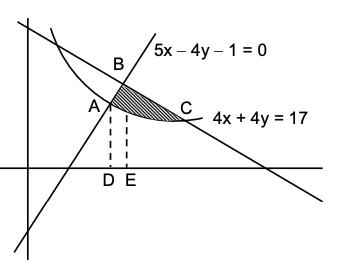
Let $\mathbb{R}$ denote the set of all real numbers. Then the area of the region $$ \left\{ (x, y) \in \mathbb{R} \times \mathbb{R} : x > 0, y > \frac{1}{x}, 5x - 4y - 1 > 0, 4x + 4y - 17 < 0 \right\} $$ is
(A)
$\frac{17}{16} - \log_e 4$
(B)
$\frac{33}{8} - \log_e 4$
(C)
$\frac{57}{8} - \log_e 4$
(D)
$\frac{17}{2} - \log_e 4$
Answer: B

Solution

We are asked to find the area of the region $R$ defined by the inequalities:

Region R
  1. $x > 0$
  2. $y > \frac{1}{x}$ (Region above the hyperbola $xy=1$)
  3. $5x - 4y - 1 > 0 \implies 4y < 5x - 1 \implies y < \frac{5x-1}{4}$ (Region below Line 1)
  4. $4x + 4y - 17 < 0 \implies 4y < 17 - 4x \implies y < \frac{17-4x}{4}$ (Region below Line 2)

Step 1: Find Intersection Points

  • Intersection of Line 1 and Hyperbola ($y = 1/x$):
    $\frac{5x - 1}{4} = \frac{1}{x} \implies 5x^2 - x - 4 = 0 \implies (5x + 4)(x - 1) = 0$. Since $x > 0$, we get $x = 1$.
    Point A: $(1, 1)$.
  • Intersection of Line 1 and Line 2:
    $\frac{5x - 1}{4} = \frac{17 - 4x}{4} \implies 5x - 1 = 17 - 4x \implies 9x = 18 \implies x = 2$.
    $y = \frac{5(2) - 1}{4} = \frac{9}{4}$.
    Point B: $(2, 9/4)$.
  • Intersection of Line 2 and Hyperbola ($y = 1/x$):
    $\frac{17 - 4x}{4} = \frac{1}{x} \implies 17x - 4x^2 = 4 \implies 4x^2 - 17x + 4 = 0 \implies (4x - 1)(x - 4) = 0$.
    For the region defined by $x > 0$, the relevant intersection is $x = 4$ (looking at the geometry relative to point B).
    Point C: $(4, 1/4)$.

Step 2: Set up the Integral
The area is bounded below by the hyperbola and above by the two lines. The boundary changes from Line 1 to Line 2 at $x = 2$.

$$Area = \int_{1}^{2} \left( y_{Line1} - y_{hyp} \right) dx + \int_{2}^{4} \left( y_{Line2} - y_{hyp} \right) dx$$ $$Area = \int_{1}^{2} \left( \frac{5x - 1}{4} - \frac{1}{x} \right) dx + \int_{2}^{4} \left( \frac{17 - 4x}{4} - \frac{1}{x} \right) dx$$

Step 3: Evaluate the Integral
Part 1:

$$\int_{1}^{2} \left( \frac{5}{4}x - \frac{1}{4} - \frac{1}{x} \right) dx = \left[ \frac{5x^2}{8} - \frac{x}{4} - \ln x \right]_{1}^{2}$$ $$= \left( \frac{20}{8} - \frac{2}{4} - \ln 2 \right) - \left( \frac{5}{8} - \frac{1}{4} - 0 \right)$$ $$= (2.5 - 0.5 - \ln 2) - (0.625 - 0.25) = 2 - \ln 2 - 0.375 = 1.625 - \ln 2$$

Part 2:

$$\int_{2}^{4} \left( \frac{17}{4} - x - \frac{1}{x} \right) dx = \left[ \frac{17x}{4} - \frac{x^2}{2} - \ln x \right]_{2}^{4}$$ $$= \left( 17 - 8 - \ln 4 \right) - \left( \frac{34}{4} - 2 - \ln 2 \right)$$ $$= (9 - 2\ln 2) - (8.5 - 2 - \ln 2) = 9 - 6.5 - \ln 2 = 2.5 - \ln 2$$

Step 4: Total Area

$$Total Area = (1.625 - \ln 2) + (2.5 - \ln 2) = 4.125 - 2\ln 2$$ $$4.125 = \frac{33}{8} \quad \text{and} \quad 2\ln 2 = \ln(2^2) = \ln 4 = \log_e 4$$ $$Area = \frac{33}{8} - \log_e 4$$
Bloom Level
Analyze
Topic
Calculus
Difficulty
3
Ideal Time
150
Sub-topics
Area Under Curve Definite Integrals Coordinate Geometry
PRIMARY SKILL TESTED
Calculating the area of a region bounded by multiple curves using definite integration.

Option Distractor Reasons

A

Likely results from an arithmetic error during the evaluation of the definite integral fractions.

C

Incorrect integration limits or misidentification of intersection points leading to a different area value.

D

Possible result of using a simpler geometric approximation (like a triangle) and neglecting the curvature of the hyperbola properly.

Q.3
The total number of real solutions of the equation $$ \theta = \tan^{-1}(2 \tan \theta) - \frac{1}{2} \sin^{-1} \left( \frac{6 \tan \theta}{9 + \tan^2 \theta} \right) $$ is
(Here, the inverse trigonometric functions $\sin^{-1} x$ and $\tan^{-1} x$ assume values in $[-\frac{\pi}{2}, \frac{\pi}{2}]$ and $(-\frac{\pi}{2}, \frac{\pi}{2})$, respectively.)
(A)
1
(B)
2
(C)
3
(D)
5
Answer: C

Solution

We are given the equation:

$$\theta = \tan^{-1}(2\tan\theta) - \frac{1}{2}\sin^{-1}\left( \frac{6\tan\theta}{9 + \tan^2\theta} \right)$$

Let $t = \tan\theta$. The equation becomes:

$$\theta = \tan^{-1}(2t) - \frac{1}{2}\sin^{-1}\left( \frac{6t}{9 + t^2} \right)$$

Simplify the argument of the inverse sine function:

$$\frac{6t}{9 + t^2} = \frac{6t}{9(1 + t^2/9)} = \frac{\frac{2t}{3}}{1 + \left(\frac{t}{3}\right)^2} = \frac{2(t/3)}{1 + (t/3)^2}$$

Recall the identity $\sin^{-1}\left( \frac{2x}{1+x^2} \right) = 2\tan^{-1}x$ for $|x| \le 1$.
Let $x = t/3$. If $|t/3| \le 1$ (i.e., $|\tan\theta| \le 3$), then:

$$\frac{1}{2}\sin^{-1}\left( \frac{6t}{9 + t^2} \right) = \frac{1}{2} \cdot 2\tan^{-1}\left(\frac{t}{3}\right) = \tan^{-1}\left(\frac{\tan\theta}{3}\right)$$

Substitute this back into the original equation:

$$\theta = \tan^{-1}(2\tan\theta) - \tan^{-1}\left(\frac{\tan\theta}{3}\right)$$

Apply tangent to both sides:

$$\tan\theta = \tan\left( \tan^{-1}(2\tan\theta) - \tan^{-1}\left(\frac{\tan\theta}{3}\right) \right)$$

Using the formula $\tan(A - B) = \frac{\tan A - \tan B}{1 + \tan A \tan B}$:

$$t = \frac{2t - \frac{t}{3}}{1 + 2t \cdot \frac{t}{3}}$$ $$t = \frac{\frac{5t}{3}}{1 + \frac{2t^2}{3}} = \frac{5t}{3 + 2t^2}$$ $$t(3 + 2t^2) = 5t$$ $$3t + 2t^3 - 5t = 0$$ $$2t^3 - 2t = 0 \implies 2t(t^2 - 1) = 0$$

The solutions for $t$ are $t = 0$, $t = 1$, and $t = -1$.
All these values satisfy the condition $|t| \le 3$ assumed for the inverse sine identity.

Now, find $\theta$ in the range $(-\pi/2, \pi/2)$ corresponding to these values:

  • $t = 0 \implies \tan\theta = 0 \implies \theta = 0$
  • $t = 1 \implies \tan\theta = 1 \implies \theta = \pi/4$
  • $t = -1 \implies \tan\theta = -1 \implies \theta = -\pi/4$

Therefore, there are 3 real solutions.

(Note: For $|t| > 3$, substitution gives no solutions, as shown by contradiction in algebraic steps.)

Bloom Level
Analyze
Topic
Trigonometry
Difficulty
3
Ideal Time
150
Sub-topics
Inverse Trigonometric Functions Trigonometric Equations
PRIMARY SKILL TESTED
Simplifying inverse trigonometric expressions and solving resulting algebraic equations.

Option Distractor Reasons

A

Only identifying the trivial solution \(\theta=0\) and missing the non-zero solutions.

B

Finding only the solutions \(\theta = \pm \pi/4\) and overlooking the solution at the origin.

D

Incorrectly including extraneous solutions or miscounting the number of roots.

Q.4
Let $S$ denote the locus of the point of intersection of the pair of lines $$ 4x - 3y = 12\alpha $$ $$ 4\alpha x + 3\alpha y = 12 $$ where $\alpha$ varies over the set of non-zero real numbers. Let $T$ be the tangent to $S$ passing through the points $(p, 0)$ and $(0, q)$, $q > 0$, and parallel to the line $4x - \frac{3}{\sqrt{2}}y = 0$.

Then the value of $pq$ is
(A)
$-6\sqrt{2}$
(B)
$-3\sqrt{2}$
(C)
$-9\sqrt{2}$
(D)
$-12\sqrt{2}$
Answer: A

Solution

Step 1: Determine the Locus S

We are given the pair of lines:

  1. $4x - 3y = 12\alpha$
  2. $4\alpha x + 3\alpha y = 12 \implies 4x + 3y = \frac{12}{\alpha}$

To find the locus of the intersection, we eliminate the parameter $\alpha$ by multiplying the two equations:

$$(4x - 3y)(4x + 3y) = (12\alpha) \cdot \left(\frac{12}{\alpha}\right)$$ $$16x^2 - 9y^2 = 144$$

Dividing by 144, we get the equation of a hyperbola:

$$\frac{x^2}{9} - \frac{y^2}{16} = 1$$

Here, $a^2 = 9$ and $b^2 = 16$.

Step 2: Find the Equation of the Tangent T

The tangent $T$ is parallel to the line $4x - \frac{3}{\sqrt{2}}y = 0$. The slope $m$ of this line is:

$$m = \frac{4}{3/\sqrt{2}} = \frac{4\sqrt{2}}{3}$$

The equation of a tangent to the hyperbola $\frac{x^2}{a^2} - \frac{y^2}{b^2} = 1$ with slope $m$ is given by:

$$y = mx \pm \sqrt{a^2m^2 - b^2}$$

Substitute the values:

$$a^2m^2 - b^2 = 9\left(\frac{4\sqrt{2}}{3}\right)^2 - 16 = 9\left(\frac{32}{9}\right) - 16 = 32 - 16 = 16$$

Thus, the tangent equations are:

$$y = \frac{4\sqrt{2}}{3}x \pm \sqrt{16} \implies y = \frac{4\sqrt{2}}{3}x \pm 4$$

The tangent passes through $(0, q)$ with $q > 0$. Therefore, the y-intercept must be positive. We choose the $+$ sign:

$$y = \frac{4\sqrt{2}}{3}x + 4$$

Step 3: Find Coordinates p and q

  • y-intercept (set x=0): $y = 4$. Since the point is $(0, q)$, we have $q = 4$.
  • x-intercept (set y=0): The point is $(p, 0)$.
$$0 = \frac{4\sqrt{2}}{3}p + 4 \implies \frac{4\sqrt{2}}{3}p = -4 \implies p = -\frac{3}{\sqrt{2}} = -\frac{3\sqrt{2}}{2}$$

Step 4: Calculate pq

$$pq = \left( -\frac{3\sqrt{2}}{2} \right)(4) = -6\sqrt{2}$$
Bloom Level
Apply
Topic
Coordinate Geometry
Difficulty
3
Ideal Time
150
Sub-topics
Hyperbola Locus Tangents
PRIMARY SKILL TESTED
Finding the locus of intersection of variable lines and applying tangent properties of a hyperbola.

Option Distractor Reasons

B

May arise from a calculation error in determining the slope or intercept value.

C

Could result from using the incorrect sign for the y-intercept or miscalculating the term \(a^2m^2 - b^2\).

D

Likely stems from a double-negative error when multiplying the coordinates.

SECTION 2 (Maximum Marks: 16)
  • This section contains FOUR (04) questions.
  • Each question has FOUR options (A), (B), (C) and (D). ONE OR MORE THAN ONE of these four option(s) is(are) correct answer(s).
  • For each question, choose the option(s) corresponding to (all) the correct answer(s).
  • Answer to each question will be evaluated according to the following marking scheme:
    • Full Marks : +4 ONLY if (all) the correct option(s) is(are) chosen;
    • Partial Marks : +3 If all the four options are correct but ONLY three options are chosen;
    • Partial Marks : +2 If three or more options are correct but ONLY two options are chosen, both of which are correct;
    • Partial Marks : +1 If two or more options are correct but ONLY one option is chosen and it is a correct option;
    • Zero Marks : 0 If none of the options is chosen (i.e. the question is unanswered);
    • Negative Marks : −2 In all other cases.
Q.5
Let $I = \begin{pmatrix} 1 & 0 \\ 0 & 1 \end{pmatrix}$ and $P = \begin{pmatrix} 2 & 0 \\ 0 & 3 \end{pmatrix}$. Let $Q = \begin{pmatrix} x & y \\ z & 4 \end{pmatrix}$ for some non-zero real numbers $x$, $y$, and $z$, for which there is a $2 \times 2$ matrix $R$ with all entries being non-zero real numbers, such that $$ QR = RP $$ Then which of the following statements is (are) TRUE?
(A)
The determinant of $Q - 2I$ is zero
(B)
The determinant of $Q - 6I$ is 12
(C)
The determinant of $Q - 3I$ is 15
(D)
$yz = 2$
Answer: A, B

Solution

Step 1: Set up the Matrix Equations
We are given matrices $I = \begin{pmatrix} 1 & 0 \\ 0 & 1 \end{pmatrix}$, $P = \begin{pmatrix} 2 & 0 \\ 0 & 3 \end{pmatrix}$, and $Q = \begin{pmatrix} x & y \\ z & 4 \end{pmatrix}$.
We are given that $QR = RP$ for a $2 \times 2$ matrix $R = \begin{pmatrix} a & b \\ c & d \end{pmatrix}$ with non-zero entries.

Step 2: Expand the Matrix Multiplication
Calculate $QR$:

$$QR = \begin{pmatrix} x & y \\ z & 4 \end{pmatrix} \begin{pmatrix} a & b \\ c & d \end{pmatrix} = \begin{pmatrix} xa+yc & xb+yd \\ za+4c & zb+4d \end{pmatrix}$$

Calculate $RP$:

$$RP = \begin{pmatrix} a & b \\ c & d \end{pmatrix} \begin{pmatrix} 2 & 0 \\ 0 & 3 \end{pmatrix} = \begin{pmatrix} 2a & 3b \\ 2c & 3d \end{pmatrix}$$

Step 3: Solve for Relationships between Variables
Equate corresponding elements:

  1. $xa + yc = 2a \implies (x-2)a + yc = 0$
  2. $xb + yd = 3b \implies (x-3)b + yd = 0$
  3. $za + 4c = 2c \implies za = -2c \implies \frac{c}{a} = -\frac{z}{2}$ (Since $a \neq 0$)
  4. $zb + 4d = 3d \implies zb = -d \implies \frac{d}{b} = -z$ (Since $b \neq 0$)

Substitute $c = -za/2$ into equation (1):

$$(x-2)a + y(-\frac{za}{2}) = 0$$

Dividing by $a$ (since $a \neq 0$):

$$x - 2 - \frac{yz}{2} = 0 \implies 2x - 4 - yz = 0 \quad \dots(\text{i})$$

Substitute $d = -zb$ into equation (2):

$$(x-3)b + y(-zb) = 0$$

Dividing by $b$ (since $b \neq 0$):

$$x - 3 - yz = 0 \implies yz = x - 3 \quad \dots(\text{ii})$$

Step 4: Solve for x, y, z
Substitute (ii) into (i):

$$2x - 4 - (x - 3) = 0 \implies x - 1 = 0 \implies x = 1$$

Then from (ii):

$$yz = 1 - 3 = -2$$

So, we have $x = 1$ and $yz = -2$. The matrix $Q$ is $\begin{pmatrix} 1 & y \\ z & 4 \end{pmatrix}$.

Step 5: Evaluate the Options

  • Option (A): Determinant of $Q - 2I$

    $$Q - 2I = \begin{pmatrix} 1-2 & y \\ z & 4-2 \end{pmatrix} = \begin{pmatrix} -1 & y \\ z & 2 \end{pmatrix}$$ $$|Q - 2I| = (-1)(2) - yz = -2 - (-2) = 0$$

    This statement is TRUE.

  • Option (B): Determinant of $Q - 6I$

    $$Q - 6I = \begin{pmatrix} 1-6 & y \\ z & 4-6 \end{pmatrix} = \begin{pmatrix} -5 & y \\ z & -2 \end{pmatrix}$$ $$|Q - 6I| = (-5)(-2) - yz = 10 - (-2) = 12$$

    This statement is TRUE.

  • Option (C): Determinant of $Q - 3I$

    $$|Q - 3I| = \begin{vmatrix} -2 & y \\ z & 1 \end{vmatrix} = -2 - yz = 0$$

    The option claims it is 15. This is FALSE.

  • Option (D): $yz = 2$
    We found $yz = -2$. This statement is FALSE.

Bloom Level
Analyze
Topic
Linear Algebra
Difficulty
4
Ideal Time
180
Sub-topics
Matrices Determinants System of Equations
PRIMARY SKILL TESTED
Solving matrix equations element-wise to determine variable relationships and evaluating determinants.

Option Distractor Reasons

C

Incorrect calculation of the determinant value, possibly by assuming an incorrect value for yz.

D

Sign error when solving the system of linear equations, leading to \(yz=2\) instead of \(-2\).

Q.6
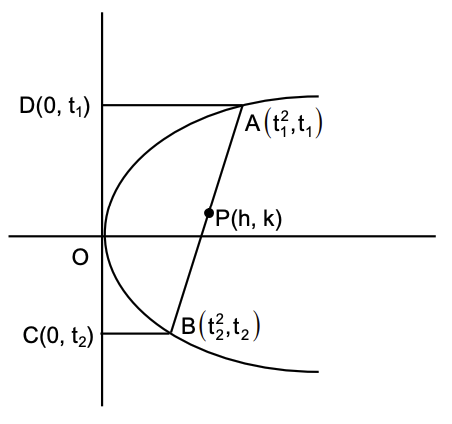
Let $S$ denote the locus of the mid-points of those chords of the parabola $y^2 = x$, such that the area of the region enclosed between the parabola and the chord is $\frac{4}{3}$. Let $\mathcal{R}$ denote the region lying in the first quadrant, enclosed by the parabola $y^2 = x$, the curve $S$, and the lines $x = 1$ and $x = 4$.

Then which of the following statements is (are) TRUE?
(A)
$(4, \sqrt{3}) \in S$
(B)
$(5, \sqrt{2}) \in S$
(C)
Area of $\mathcal{R}$ is $\frac{14}{3} - 2\sqrt{3}$
(D)
Area of $\mathcal{R}$ is $\frac{14}{3} - \sqrt{3}$
Answer: A, C

Solution

Step 1: Determine the Locus S
Let the midpoint of a chord of the parabola $y^2 = x$ be $(h, k)$. The equation of the chord with midpoint $(h, k)$ is given by $T = S_1$:

Chord Equation $$yk - \frac{1}{2}(x + h) = k^2 - h$$ $$2yk - x - h = 2k^2 - 2h \implies x = 2yk - (2k^2 - h)$$
To find the area enclosed by the parabola and this chord, we can use the standard formula for the area of a segment of a parabola cut by a chord. The area is given by:

$$Area = \frac{1}{6a} |y_2 - y_1|^3$$

For $y^2 = x$, $4a = 1 \implies a = 1/4$. The intersection points' y-coordinates $y_1, y_2$ are roots of substituting line into curve: $y^2 = 2yk - 2k^2 + h \implies y^2 - 2ky + (2k^2 - h) = 0$. The difference of roots is:

$$|y_1 - y_2| = \frac{\sqrt{D}}{1} = \sqrt{(-2k)^2 - 4(1)(2k^2 - h)} = \sqrt{4k^2 - 8k^2 + 4h} = \sqrt{4(h - k^2)} = 2\sqrt{h - k^2}$$

Substituting into the area formula:

$$\frac{4}{3} = \frac{1}{6(1/4)} (2\sqrt{h - k^2})^3 = \frac{4}{6} \cdot 8 (h - k^2)^{3/2} = \frac{16}{3} (h - k^2)^{3/2}$$

Wait, standard formula check: Area $= \frac{(y_2-y_1)^3}{6}$? No, it's $\frac{1}{6} |coefficient \ of \ y^2 \ in \ x-eq| \dots$ Using integration: Area $= \int_{y_1}^{y_2} (x_{line} - x_{parabola}) dy = \frac{1}{6}(1)(y_2-y_1)^3$. So,

$$\frac{4}{3} = \frac{1}{6} (2\sqrt{h - k^2})^3 = \frac{8}{6} (h - k^2)^{3/2} = \frac{4}{3} (h - k^2)^{3/2}$$ $$(h - k^2)^{3/2} = 1 \implies h - k^2 = 1 \implies h = k^2 + 1$$

Replacing $(h, k)$ with $(x, y)$, the locus $S$ is $x = y^2 + 1$ or $y^2 = x - 1$.

Step 2: Check Points on S

  • Option A: $(4, \sqrt{3})$. Substitute: $(\sqrt{3})^2 = 3$. $x - 1 = 4 - 1 = 3$. LHS = RHS. TRUE.
  • Option B: $(5, \sqrt{2})$. Substitute: $(\sqrt{2})^2 = 2$. $x - 1 = 5 - 1 = 4$. $2 \neq 4$. FALSE.

Step 3: Calculate Area of Region R
Region R is in the first quadrant, bounded by $y^2 = x$ (upper curve, $y = \sqrt{x}$), $y^2 = x - 1$ (lower curve, $y = \sqrt{x-1}$), $x = 1$, and $x = 4$.

$$Area(R) = \int_{1}^{4} (\sqrt{x} - \sqrt{x-1}) dx$$ $$= \int_{1}^{4} x^{1/2} dx - \int_{1}^{4} (x-1)^{1/2} dx$$ $$= \left[ \frac{2}{3}x^{3/2} \right]_{1}^{4} - \left[ \frac{2}{3}(x-1)^{3/2} \right]_{1}^{4}$$ $$= \frac{2}{3} \left( 4^{3/2} - 1^{3/2} \right) - \frac{2}{3} \left( (3)^{3/2} - 0^{3/2} \right)$$ $$= \frac{2}{3} (8 - 1) - \frac{2}{3} (3\sqrt{3})$$ $$= \frac{14}{3} - 2\sqrt{3}$$

This matches Option C.

Bloom Level
Analyze
Topic
Calculus
Difficulty
4
Ideal Time
200
Sub-topics
Parabola Locus Area Under Curve
PRIMARY SKILL TESTED
Combining locus finding with property of chords and evaluating definite integrals for area.

Option Distractor Reasons

B

The point coordinates do not satisfy the derived locus equation \(y^2 = x-1\).

D

A calculation error in the final step of the integration, resulting in the wrong coefficient for the radical term.

Q.7
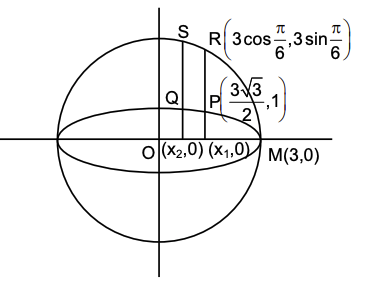
Let $P(x_1, y_1)$ and $Q(x_2, y_2)$ be two distinct points on the ellipse $$ \frac{x^2}{9} + \frac{y^2}{4} = 1 $$ such that $y_1 > 0$, and $y_2 > 0$. Let $C$ denote the circle $x^2 + y^2 = 9$, and $M$ be the point $(3, 0)$.

Suppose the line $x = x_1$ intersects $C$ at $R$, and the line $x = x_2$ intersects $C$ at $S$, such that the $y$-coordinates of $R$ and $S$ are positive. Let $\angle ROM = \frac{\pi}{6}$ and $\angle SOM = \frac{\pi}{3}$, where $O$ denotes the origin $(0, 0)$. Let $|XY|$ denote the length of the line segment $XY$.

Then which of the following statements is (are) TRUE?
(A)
The equation of the line joining $P$ and $Q$ is $2x + 3y = 3(1 + \sqrt{3})$
(B)
The equation of the line joining $P$ and $Q$ is $2x + y = 3(1 + \sqrt{3})$
(C)
If $N_2 = (x_2, 0)$, then $3|N_2 Q| = 2|N_2 S|$
(D)
If $N_1 = (x_1, 0)$, then $9|N_1 P| = 4|N_1 R|$
Answer: A, C

Solution

Step 1: Determine coordinates of points R and S on the circle.
The circle is $x^2 + y^2 = 9$ (radius 3). M is $(3, 0)$.
$\angle ROM = \pi/6$. The coordinates of R are $(3\cos(\pi/6), 3\sin(\pi/6)) = \left(\frac{3\sqrt{3}}{2}, \frac{3}{2}\right)$.
Since the line $x = x_1$ passes through R, $x_1 = \frac{3\sqrt{3}}{2}$.
$\angle SOM = \pi/3$. The coordinates of S are $(3\cos(\pi/3), 3\sin(\pi/3)) = \left(\frac{3}{2}, \frac{3\sqrt{3}}{2}\right)$.
Since the line $x = x_2$ passes through S, $x_2 = \frac{3}{2}$.

Points R and S

Step 2: Determine coordinates of points P and Q on the ellipse.
The ellipse is $\frac{x^2}{9} + \frac{y^2}{4} = 1$.
For P $(x_1, y_1)$ where $x_1 = \frac{3\sqrt{3}}{2}$ and $y_1 > 0$:

$$\frac{(3\sqrt{3}/2)^2}{9} + \frac{y_1^2}{4} = 1 \Rightarrow \frac{27/4}{9} + \frac{y_1^2}{4} = 1 \Rightarrow \frac{3}{4} + \frac{y_1^2}{4} = 1 \Rightarrow y_1^2 = 1 \Rightarrow y_1 = 1$$

So, $P = \left(\frac{3\sqrt{3}}{2}, 1\right)$.

For Q $(x_2, y_2)$ where $x_2 = \frac{3}{2}$ and $y_2 > 0$:

$$\frac{(3/2)^2}{9} + \frac{y_2^2}{4} = 1 \Rightarrow \frac{9/4}{9} + \frac{y_2^2}{4} = 1 \Rightarrow \frac{1}{4} + \frac{y_2^2}{4} = 1 \Rightarrow y_2^2 = 3 \Rightarrow y_2 = \sqrt{3}$$

So, $Q = \left(\frac{3}{2}, \sqrt{3}\right)$.

Step 3: Equation of line PQ.
Slope $m = \frac{\sqrt{3} - 1}{\frac{3}{2} - \frac{3\sqrt{3}}{2}} = \frac{\sqrt{3} - 1}{\frac{3}{2}(1 - \sqrt{3})} = \frac{-1(\sqrt{3} - 1)}{\frac{3}{2}(\sqrt{3} - 1)} = -\frac{2}{3}$.
Equation passing through P:

$$y - 1 = -\frac{2}{3}\left(x - \frac{3\sqrt{3}}{2}\right)$$ $$3y - 3 = -2x + 3\sqrt{3} \Rightarrow 2x + 3y = 3(1 + \sqrt{3})$$

This matches statement (A).

Step 4: Analyze Ratios.
$N_1$ is $(x_1, 0) = (\frac{3\sqrt{3}}{2}, 0)$ and $N_2$ is $(x_2, 0) = (\frac{3}{2}, 0)$.
Lengths:
$|N_1P| = y_1 = 1$.
$|N_1R| = y_R = \frac{3}{2}$.
$|N_2Q| = y_2 = \sqrt{3}$.
$|N_2S| = y_S = \frac{3\sqrt{3}}{2}$.

Check (C): $3|N_2Q| = 3\sqrt{3}$ and $2|N_2S| = 2(\frac{3\sqrt{3}}{2}) = 3\sqrt{3}$.
$3\sqrt{3} = 3\sqrt{3}$, so statement (C) is TRUE.

Check (D): $9|N_1P| = 9(1) = 9$ and $4|N_1R| = 4(\frac{3}{2}) = 6$.
$9 \neq 6$, so statement (D) is FALSE.

Bloom Level
Apply
Topic
Coordinate Geometry
Difficulty
3
Ideal Time
180
Sub-topics
Ellipse Straight Lines Circle
PRIMARY SKILL TESTED
Finding coordinates on curves using parametric angles and forming line equations.

Option Distractor Reasons

B

Incorrect slope calculation usually leads to this form of the line equation.

D

Ratio calculation error or confusing the y-coordinates of the circle and ellipse points.

Q.8
Let $\mathbb{R}$ denote the set of all real numbers. Let $f : \mathbb{R} \to \mathbb{R}$ be defined by $$ f(x) = \begin{cases} \frac{6x + \sin x}{2x + \sin x} & \text{if } x \neq 0, \\ \frac{7}{3} & \text{if } x = 0. \end{cases} $$ Then which of the following statements is (are) TRUE?
(A)
The point $x = 0$ is a point of local maxima of $f$
(B)
The point $x = 0$ is a point of local minima of $f$
(C)
Number of points of local maxima of $f$ in the interval $[\pi, 6\pi]$ is 3
(D)
Number of points of local minima of $f$ in the interval $[2\pi, 4\pi]$ is 1
Answer: B, C, D

Solution

Step 1: Differentiate the Function
Given $f(x) = \frac{6x + \sin x}{2x + \sin x}$. Using the quotient rule:

$$f'(x) = \frac{(6 + \cos x)(2x + \sin x) - (6x + \sin x)(2 + \cos x)}{(2x + \sin x)^2}$$

Simplifying the numerator:

$$Numerator = 12x + 6\sin x + 2x\cos x + \sin x\cos x - (12x + 6x\cos x + 2\sin x + \sin x\cos x)$$ $$= 4\sin x - 4x\cos x = 4\cos x (\tan x - x)$$ $$f'(x) = \frac{4\cos x(\tan x - x)}{(2x + \sin x)^2}$$

Step 2: Analyze Local Maxima/Minima at x = 0
For small $x > 0$: $\tan x > x \implies \tan x - x > 0$. Also $\cos x > 0$. So $f'(0^+) > 0$.
For small $x < 0$: $\tan x < x \implies \tan x - x < 0$. Also $\cos x> 0$. So $f'(0^-) < 0$.
Since $f'(x)$ changes from negative to positive, $x = 0$ is a point of local minima. Statement (B) is True.

Step 3: Analyze Critical Points in $[\pi, 6\pi]$
Critical points occur where $f'(x) = 0$, i.e., $\tan x = x$ (roots $\lambda_k$) or $\cos x = 0$ (no, because $\tan x$ would be undefined, but looking at the original simplified numerator $4(\sin x - x \cos x)$, roots are $\tan x = x$).
The roots of $\tan x = x$ occur in intervals $(k\pi, k\pi + \pi/2)$.
Let's check the sign change of $f'(x)$ around roots $\lambda_k$:

  • For odd $k$ (e.g., in $(\pi, 1.5\pi)$): $\cos x < 0$. $(\tan x - x)$ changes from $-$ to $+$. Product changes $+\to-$. Maxima.
  • For even $k$ (e.g., in $(2\pi, 2.5\pi)$): $\cos x > 0$. $(\tan x - x)$ changes from $-$ to $+$. Product changes $-\to+$. Minima.

Interval $[\pi, 6\pi]$ covers $k=1, 2, 3, 4, 5$.

  • $k=1, 3, 5$ correspond to Maxima (3 points).
  • $k=2, 4$ correspond to Minima (2 points).

Statement (C) claims 3 local maxima in $[\pi, 6\pi]$. This is TRUE.

Step 4: Analyze Interval $[2\pi, 4\pi]$
This interval covers $k=2$ and $k=3$.

  • $k=2$ is a local Minima.
  • $k=3$ is a local Maxima.

The number of local minima is 1. Statement (D) claims 1 local minima. This is TRUE.

Bloom Level
Analyze
Topic
Calculus
Difficulty
4
Ideal Time
200
Sub-topics
Derivatives Maxima and Minima Trigonometric Functions
PRIMARY SKILL TESTED
Analyzing the sign of the first derivative involving transcendental functions to identify local extrema.

Option Distractor Reasons

A

Incorrect first derivative test analysis at \(x=0\), interpreting the sign change as + to - instead of - to +.

C

Could be marked false if one fails to identify the alternating pattern of maxima and minima caused by the \(\cos x\) term.

D

Miscounting the roots in the specific interval.

SECTION 3 (Maximum Marks: 32)
  • This section contains EIGHT (08) questions.
  • The answer to each question is a NUMERICAL VALUE.
  • For each question, enter the correct numerical value of the answer.
  • If the numerical value has more than two decimal places, truncate/round-off the value to TWO decimal places.
  • Answer to each question will be evaluated according to the following marking scheme:
    • Full Marks : +4 If ONLY the correct numerical value is entered;
    • Zero Marks : 0 In all other cases.
Q.9
Let $y(x)$ be the solution of the differential equation $$ x^2 \frac{dy}{dx} + xy = x^2 + y^2, \quad x > \frac{1}{e} $$ satisfying $y(1) = 0$. Then the value of $2 \frac{(y(e))^2}{y(e^2)}$ is ___________.
Answer: [0.7 to 0.8]

Solution

Given the differential equation:

$$x^2 \frac{dy}{dx} + xy = x^2 + y^2$$

Divide by $x^2$:

$$\frac{dy}{dx} = \frac{x^2 + y^2 - xy}{x^2} = 1 + \left(\frac{y}{x}\right)^2 - \frac{y}{x}$$

This is a homogeneous equation. Let $y = vx$, so $\frac{dy}{dx} = v + x \frac{dv}{dx}$. Substitute into the equation:

$$v + x \frac{dv}{dx} = 1 + v^2 - v$$ $$x \frac{dv}{dx} = v^2 - 2v + 1 = (v - 1)^2$$

Separate variables:

$$\frac{dv}{(v - 1)^2} = \frac{dx}{x}$$

Integrate both sides:

$$-\frac{1}{v - 1} = \ln x + C$$

Substitute $v = y/x$ back:

$$-\frac{1}{y/x - 1} = \ln x + C \implies \frac{x}{x - y} = \ln x + C$$

Use the condition $y(1) = 0$:

$$\frac{1}{1 - 0} = \ln 1 + C \implies 1 = 0 + C \implies C = 1$$

So, the solution is:

$$\frac{x}{x - y} = \ln x + 1 \implies x - y = \frac{x}{\ln x + 1} \implies y = x - \frac{x}{\ln x + 1} = \frac{x \ln x}{\ln x + 1}$$

Now, compute $y(e)$ and $y(e^2)$:

$$y(e) = \frac{e \ln e}{1 + \ln e} = \frac{e(1)}{2} = \frac{e}{2}$$ $$y(e^2) = \frac{e^2 \ln(e^2)}{1 + \ln(e^2)} = \frac{e^2(2)}{1 + 2} = \frac{2e^2}{3}$$

Finally, calculate the required value:

$$2 \frac{(y(e))^2}{y(e^2)} = 2 \frac{(e/2)^2}{2e^2/3} = 2 \frac{e^2/4}{2e^2/3} = \frac{e^2/2}{2e^2/3} = \frac{e^2}{2} \cdot \frac{3}{2e^2} = \frac{3}{4} = 0.75$$
Bloom Level
Apply
Topic
Differential Equations
Difficulty
3
Ideal Time
150
Sub-topics
Homogeneous Differential Equations Variable Separation
PRIMARY SKILL TESTED
Solving homogeneous differential equations and evaluating the particular solution at specific points.
Q.10
Let $a_0, a_1, \dots, a_{23}$ be real numbers such that $$ \left(1 + \frac{2}{5}x\right)^{23} = \sum_{i=0}^{23} a_i x^i $$ for every real number $x$. Let $a_r$ be the largest among the numbers $a_j$ for $0 \le j \le 23$.
Then the value of $r$ is ___________.
Answer: 6

Solution

Step 1: Identify the general term

The given expansion is $(1 + \frac{2}{5}x)^{23} = \sum_{i=0}^{23} a_i x^i$.

Using the binomial theorem, the general term involving $x^r$ is given by:

$$T_{r+1} = \binom{23}{r} (1)^{23-r} \left(\frac{2}{5}x\right)^r = \binom{23}{r} \left(\frac{2}{5}\right)^r x^r$$

Thus, the coefficient $a_r$ is:

$$a_r = \binom{23}{r} \left(\frac{2}{5}\right)^r$$

Step 2: Determine the condition for the largest coefficient

We want to find $r$ such that $a_r$ is maximized. This is equivalent to finding the numerically greatest term in the expansion of $(1 + y)^{23}$ where $y = 2/5$.

Let's consider the ratio of consecutive coefficients:

$$\frac{a_r}{a_{r-1}} = \frac{\binom{23}{r} (2/5)^r}{\binom{23}{r-1} (2/5)^{r-1}} = \frac{23 - (r-1)}{r} \cdot \frac{2}{5} = \frac{24 - r}{r} \cdot \frac{2}{5}$$

For $a_r$ to be increasing ($a_r \ge a_{r-1}$), we need:

$$\frac{24 - r}{r} \cdot \frac{2}{5} \ge 1$$ $$2(24 - r) \ge 5r$$ $$48 - 2r \ge 5r$$ $$48 \ge 7r$$ $$r \le \frac{48}{7} \approx 6.85$$

Step 3: Identify the value of r

Since $r$ must be an integer, the coefficients increase for $r = 1, 2, \dots, 6$ and decrease for $r > 6$.

Specifically:

  • For $r=6$: $\frac{a_6}{a_5} \ge 1 \implies a_6 > a_5$.
  • For $r=7$: $\frac{a_7}{a_6} = \frac{24-7}{7} \cdot \frac{2}{5} = \frac{17}{7} \cdot \frac{2}{5} = \frac{34}{35} < 1 \implies a_7 < a_6$.

Therefore, the largest coefficient is $a_6$.

Value of $r = 6$.

Bloom Level
Apply
Topic
Algebra
Difficulty
3
Ideal Time
120
Sub-topics
Binomial Theorem Greatest Term
PRIMARY SKILL TESTED
Calculating the index of the numerically greatest term/coefficient in a binomial expansion.
Q.11
A factory has a total of three manufacturing units, $M_1, M_2$, and $M_3$, which produce bulbs independent of each other. The units $M_1, M_2$, and $M_3$ produce bulbs in the proportions of 2: 2: 1, respectively. It is known that 20% of the bulbs produced in the factory are defective. It is also known that, of all the bulbs produced by $M_1$, 15% are defective. Suppose that, if a randomly chosen bulb produced in the factory is found to be defective, the probability that it was produced by $M_2$ is $\frac{2}{5}$.

If a bulb is chosen randomly from the bulbs produced by $M_3$, then the probability that it is defective is ___________.
Answer: [0.27 to 0.33]

Solution

Step 1: Define Events and Probabilities

Let $E_1, E_2, E_3$ be the events that a bulb is produced by unit $M_1, M_2, M_3$ respectively.
Let $A$ be the event that a bulb is defective.

Given proportions: $2:2:1$.

  • $P(E_1) = \frac{2}{5}$, $P(E_2) = \frac{2}{5}$, $P(E_3) = \frac{1}{5}$.

Given defective information:

  • Total probability of defective bulb: $P(A) = 20\% = 0.2 = \frac{1}{5}$.
  • $M_1$ defective rate: $P(A|E_1) = 15\% = 0.15$.
  • Posterior probability for $M_2$: $P(E_2|A) = \frac{2}{5}$.

Step 2: Use Bayes' Theorem to find $P(A|E_2)$

$$P(E_2|A) = \frac{P(A|E_2)P(E_2)}{P(A)}$$ Substitute known values: $$\frac{2}{5} = \frac{P(A|E_2) \cdot \frac{2}{5}}{\frac{1}{5}}$$ $$\frac{2}{5} = 2 \cdot P(A|E_2)$$ $$P(A|E_2) = \frac{1}{5} = 0.2$$

Step 3: Use Total Probability Theorem to find $P(A|E_3)$

$$P(A) = P(A|E_1)P(E_1) + P(A|E_2)P(E_2) + P(A|E_3)P(E_3)$$ Substitute known values: $$0.2 = (0.15)\left(\frac{2}{5}\right) + (0.2)\left(\frac{2}{5}\right) + P(A|E_3)\left(\frac{1}{5}\right)$$ Multiply the entire equation by 5 to simplify: $$1.0 = 0.30 + 0.40 + P(A|E_3)$$ $$1.0 = 0.70 + P(A|E_3)$$ $$P(A|E_3) = 1.0 - 0.70 = 0.30$$

The probability that a bulb chosen from $M_3$ is defective is $0.30$.

Bloom Level
Analyze
Topic
Probability
Difficulty
3
Ideal Time
180
Sub-topics
Total Probability Theorem Bayes' Theorem
PRIMARY SKILL TESTED
Applying the law of total probability and Bayes' theorem to solve for unknown conditional probabilities.
Q.12
Consider the vectors $$ \vec{x} = \hat{i} + 2\hat{j} + 3\hat{k}, \quad \vec{y} = 2\hat{i} + 3\hat{j} + \hat{k}, \quad \text{and} \quad \vec{z} = 3\hat{i} + \hat{j} + 2\hat{k} .$$ For two distinct positive real numbers $\alpha$ and $\beta$, define $$ \vec{X} = \alpha\vec{x} + \beta\vec{y} - \vec{z}, \quad \vec{Y} = \alpha\vec{y} + \beta\vec{z} - \vec{x}, \quad \text{and} \quad \vec{Z} = \alpha\vec{z} + \beta\vec{x} - \vec{y} .$$ If the vectors $\vec{X}, \vec{Y}$, and $\vec{Z}$ lie in a plane, then the value of $\alpha + \beta - 3$ is ___________.
Answer: -2

Solution

Step 1: Check Linear Independence of Basis Vectors
Calculate the scalar triple product $[\vec{x} \vec{y} \vec{z}]$:

$$[\vec{x} \vec{y} \vec{z}] = \begin{vmatrix} 1 & 2 & 3 \\ 2 & 3 & 1 \\ 3 & 1 & 2 \end{vmatrix}$$ $$= 1(6 - 1) - 2(4 - 3) + 3(2 - 9)$$ $$= 1(5) - 2(1) + 3(-7)$$ $$= 5 - 2 - 21 = -18 \neq 0$$

Since the base vectors are linearly independent, the vectors $\vec{X}, \vec{Y}, \vec{Z}$ are coplanar if and only if the determinant of the transformation matrix is zero.

Step 2: Formulate the Coplanarity Condition
The vectors are defined as:

$$\vec{X} = \alpha \vec{x} + \beta \vec{y} - \vec{z}$$ $$\vec{Y} = -\vec{x} + \alpha \vec{y} + \beta \vec{z}$$ $$\vec{Z} = \beta \vec{x} - \vec{y} + \alpha \vec{z}$$

Wait, checking indices carefully from the question image:

$$\vec{Y} = \alpha\vec{y} + \beta\vec{z} - \vec{x}$$ $$\vec{Z} = \alpha\vec{z} + \beta\vec{x} - \vec{y}$$

Ordering coefficients for $(\vec{x}, \vec{y}, \vec{z})$:

  • Row 1 ($\vec{X}$): $\alpha, \beta, -1$
  • Row 2 ($\vec{Y}$): $-1, \alpha, \beta$
  • Row 3 ($\vec{Z}$): $\beta, -1, \alpha$

The determinant must be zero:

$$D = \begin{vmatrix} \alpha & \beta & -1 \\ -1 & \alpha & \beta \\ \beta & -1 & \alpha \end{vmatrix} = 0$$

Step 3: Expand the Determinant

$$D = \alpha(\alpha^2 - (-\beta)) - \beta(-\alpha - \beta^2) + (-1)(1 - \alpha\beta)$$ $$D = \alpha^3 + \alpha\beta + \alpha\beta + \beta^3 - 1 + \alpha\beta$$ $$D = \alpha^3 + \beta^3 - 1 + 3\alpha\beta = 0$$

Step 4: Solve for $\alpha$ and $\beta$
We use the algebraic identity: $a^3 + b^3 + c^3 - 3abc = (a+b+c)(a^2+b^2+c^2 - ab - bc - ca)$.
Here, let $a = \alpha$, $b = \beta$, and $c = -1$.
The equation becomes:

$$\alpha^3 + \beta^3 + (-1)^3 - 3(\alpha)(\beta)(-1) = 0$$ $$(\alpha + \beta - 1)(\alpha^2 + \beta^2 + 1 - \alpha\beta + \beta + \alpha) = 0$$

Since $\alpha, \beta$ are distinct positive real numbers, the second factor is:

$$\frac{1}{2}[(\alpha-\beta)^2 + (\alpha+1)^2 + (\beta+1)^2]$$

This term is strictly positive (greater than 0) because $\alpha, \beta > 0$.
Therefore, the only solution is:

$$\alpha + \beta - 1 = 0 \implies \alpha + \beta = 1$$

Step 5: Calculate Final Value
We need to find $\alpha + \beta - 3$.

$$\alpha + \beta - 3 = 1 - 3 = -2$$
Bloom Level
Apply
Topic
Vectors
Difficulty
3
Ideal Time
150
Sub-topics
Scalar Triple Product Coplanarity
PRIMARY SKILL TESTED
Using the scalar triple product to determine conditions for coplanarity and applying algebraic identities.
Q.13
For a non-zero complex number $z$, let $\text{arg}(z)$ denote the principal argument of $z$, with $-\pi < \text{arg}(z) \le \pi$. Let $\omega$ be the cube root of unity for which $0 < \text{arg}(\omega) < \pi$. Let $$ \alpha=\text{arg} \left( \sum_{n=1}^{2025} (-\omega)^n \right) $$ Then the value of $\frac{3\alpha}{\pi}$ is ___________.
Answer: -2

Solution

Step 1: Simplify the Summation
We need to evaluate the sum $S = \sum_{n=1}^{2025} (-\omega)^n$.
This is a geometric progression with first term $a = -\omega$, common ratio $r = -\omega$, and number of terms $N = 2025$.

$$S = \frac{a(r^N - 1)}{r - 1} = \frac{-\omega((-\omega)^{2025} - 1)}{-\omega - 1}$$

Since 2025 is an odd number, $(-\omega)^{2025} = -(\omega^{2025})$.
Since $\omega$ is a cube root of unity, $\omega^3 = 1$. Also, $2025$ is divisible by 3 ($2+0+2+5=9$).
So, $\omega^{2025} = (\omega^3)^{675} = 1^{675} = 1$.
Thus, $(-\omega)^{2025} = -1$.

Substitute this back into the sum:

$$S = \frac{-\omega(-1 - 1)}{-(1 + \omega)} = \frac{2\omega}{-(-\omega^2)} = \frac{2\omega}{\omega^2} = \frac{2}{\omega} = 2\omega^2$$

(Using the identity $1 + \omega + \omega^2 = 0 \implies 1 + \omega = -\omega^2$ and $\frac{1}{\omega} = \omega^2$)

Step 2: Determine the Argument
Given $\omega = e^{i2\pi/3} = -\frac{1}{2} + i\frac{\sqrt{3}}{2}$.
Then $\omega^2 = e^{i4\pi/3} = -\frac{1}{2} - i\frac{\sqrt{3}}{2}$.
So, $S = 2\omega^2 = 2\left(-\frac{1}{2} - i\frac{\sqrt{3}}{2}\right) = -1 - i\sqrt{3}$.

The complex number $z = -1 - i\sqrt{3}$ lies in the third quadrant (both real and imaginary parts are negative).
The principal argument $\alpha$ is given by:

$$\alpha = \arg(z) = -\pi + \tan^{-1}\left(\left|\frac{-\sqrt{3}}{-1}\right|\right) = -\pi + \frac{\pi}{3} = -\frac{2\pi}{3}$$

Step 3: Calculate the Final Value
We need to find the value of $\frac{3\alpha}{\pi}$.

$$\frac{3\alpha}{\pi} = \frac{3}{\pi} \left(-\frac{2\pi}{3}\right) = -2$$
Bloom Level
Apply
Topic
Complex Numbers
Difficulty
3
Ideal Time
150
Sub-topics
Geometric Progression Cube Roots of Unity Argument
PRIMARY SKILL TESTED
Summing a geometric series of complex numbers and finding the principal argument of the result.
Q.14
Let $\mathbb{R}$ denote the set of all real numbers. Let $f : \mathbb{R} \to \mathbb{R}$ and $g : \mathbb{R} \to (0, 4)$ be functions defined by $$ f(x) = \log_e(x^2 + 2x + 4), \quad \text{and} \quad g(x) = \frac{4}{1 + e^{-2x}} .$$ Define the composite function $f \circ g^{-1}$ by $(f \circ g^{-1})(x) = f(g^{-1}(x))$, where $g^{-1}$ is the inverse of the function $g$.

Then the value of the derivative of the composite function $f \circ g^{-1}$ at $x = 2$ is ___________.
Answer: [0.2 to 0.3]

Solution

Step 1: Understand the Goal
We need to find the derivative of the composite function $(f \circ g^{-1})(x)$ at $x = 2$. Let $h(x) = g^{-1}(x)$. We want to evaluate $\frac{d}{dx} f(h(x)) \big|_{x=2}$. Using the chain rule:

$$\frac{d}{dx} f(h(x)) = f'(h(x)) \cdot h'(x)$$

At $x=2$, this is $f'(h(2)) \cdot h'(2)$.

Step 2: Find $h(2)$
$h(2) = g^{-1}(2)$. Let $y = h(2)$, so $g(y) = 2$.

$$\frac{4}{1 + e^{-2y}} = 2 \implies 1 + e^{-2y} = 2 \implies e^{-2y} = 1 \implies -2y = 0 \implies y = 0$$

So, $h(2) = 0$.

Step 3: Find $h'(2)$
Since $h(x) = g^{-1}(x)$, the derivative of the inverse function is given by:

$$h'(x) = \frac{1}{g'(h(x))}$$ $$h'(2) = \frac{1}{g'(h(2))} = \frac{1}{g'(0)}$$

Compute $g'(x)$:

$$g(x) = 4(1 + e^{-2x})^{-1}$$ $$g'(x) = 4(-1)(1 + e^{-2x})^{-2} \cdot (e^{-2x}) \cdot (-2) = \frac{8e^{-2x}}{(1 + e^{-2x})^2}$$

Evaluate at $x=0$:

$$g'(0) = \frac{8e^0}{(1 + e^0)^2} = \frac{8(1)}{(1+1)^2} = \frac{8}{4} = 2$$

Thus, $h'(2) = \frac{1}{2}$.

Step 4: Find $f'(0)$
$f(x) = \log_e(x^2 + 2x + 4)$.

$$f'(x) = \frac{1}{x^2 + 2x + 4} \cdot (2x + 2)$$

Evaluate at $x = h(2) = 0$:

$$f'(0) = \frac{2(0) + 2}{0^2 + 2(0) + 4} = \frac{2}{4} = \frac{1}{2}$$

Step 5: Calculate the Final Result

$$\text{Derivative} = f'(0) \cdot h'(2) = \frac{1}{2} \cdot \frac{1}{2} = \frac{1}{4} = 0.25$$
Bloom Level
Analyze
Topic
Calculus
Difficulty
3
Ideal Time
180
Sub-topics
Chain Rule Inverse Functions Derivatives
PRIMARY SKILL TESTED
Applying the chain rule and the property of the derivative of an inverse function.
Q.15
Let $$ \alpha = \frac{1}{\sin 60^\circ \sin 61^\circ} + \frac{1}{\sin 62^\circ \sin 63^\circ} + \dots + \frac{1}{\sin 118^\circ \sin 119^\circ} .$$ Then the value of $$ \left( \frac{\text{cosec } 1^\circ}{\alpha} \right)^2 $$ is ___________.
Answer: 3

Solution

Step 1: Simplify the General Term
The given series is $\alpha = \sum \frac{1}{\sin(k^\circ)\sin(k+1)^\circ}$.
Using the difference identity for sine: $\sin(B - A) = \sin B \cos A - \cos B \sin A$.
We can write:

$$\frac{1}{\sin A \sin B} = \frac{\sin(B-A)}{\sin(B-A) \sin A \sin B} = \frac{1}{\sin(B-A)} \left( \frac{\sin B \cos A - \cos B \sin A}{\sin A \sin B} \right)$$ $$= \frac{1}{\sin(B-A)} (\cot A - \cot B)$$

Here, the difference between angles in the denominator is $(k+1) - k = 1^\circ$.
So each term becomes $\frac{1}{\sin 1^\circ} [\cot k^\circ - \cot(k+1)^\circ]$.

Step 2: Analyze the Series Terms
The series consists of terms like: $\frac{1}{\sin 60^\circ \sin 61^\circ} + \frac{1}{\sin 62^\circ \sin 63^\circ} + \dots + \frac{1}{\sin 118^\circ \sin 119^\circ}$.

This can be written as:

$$\alpha = \frac{1}{\sin 1^\circ} \left[ (\cot 60^\circ - \cot 61^\circ) + (\cot 62^\circ - \cot 63^\circ) + \dots + (\cot 118^\circ - \cot 119^\circ) \right]$$

Convert to tangent using $\cot \theta = \tan(90^\circ - \theta)$:

  • $\cot 60^\circ - \cot 61^\circ = \tan 30^\circ - \tan 29^\circ$
  • $\cot 62^\circ - \cot 63^\circ = \tan 28^\circ - \tan 27^\circ$
  • ...
  • $\cot 118^\circ - \cot 119^\circ = \tan(90^\circ-118^\circ) - \tan(90^\circ-119^\circ) = \tan(-28^\circ) - \tan(-29^\circ) = -\tan 28^\circ + \tan 29^\circ$.

Step 3: Sum the Series
The sum inside the bracket is:

$$S = (\tan 30^\circ - \tan 29^\circ) + (\tan 28^\circ - \tan 27^\circ) + \dots + (\tan 2^\circ - \tan 1^\circ) + (\tan 0^\circ - \tan(-1)^\circ) + \dots + (-\tan 28^\circ + \tan 29^\circ)$$

Notice the symmetry. For every positive tangent term like $-\tan 29^\circ$ in the first group, there is a corresponding $+\tan 29^\circ$ in the last group.
Specifically, the terms form a telescoping-like pattern where all intermediate terms cancel out perfectly.

  • $\tan 29^\circ$ cancels with $-\tan 29^\circ$.
  • $\tan 28^\circ$ cancels with $-\tan 28^\circ$.
  • ...

The only term that does not have a pair to cancel is the very first term, $\tan 30^\circ$, because the sequence wraps around zero symmetrically.
Thus, the sum inside the bracket is simply $\tan 30^\circ$.

$$\alpha = \frac{1}{\sin 1^\circ} (\tan 30^\circ) = \frac{1}{\sqrt{3} \sin 1^\circ}$$

Step 4: Calculate the Final Value
We need to find $\left( \frac{\text{cosec } 1^\circ}{\alpha} \right)^2$.

$$\frac{\text{cosec } 1^\circ}{\alpha} = \frac{1/\sin 1^\circ}{1/(\sqrt{3}\sin 1^\circ)} = \sqrt{3}$$ $$\left( \sqrt{3} \right)^2 = 3$$
Bloom Level
Analyze
Topic
Trigonometry
Difficulty
4
Ideal Time
200
Sub-topics
Trigonometric Series Telescoping Sum Identities
PRIMARY SKILL TESTED
Transforming trigonometric products into differences to create a telescoping series.
Q.16
If $$ \alpha = \int_{1/2}^2 \frac{\tan^{-1} x}{2x^2 - 3x + 2} \, dx ,$$ then the value of $\sqrt{7} \tan \left( \frac{2\alpha\sqrt{7}}{\pi} \right)$ is ___________.
(Here, the inverse trigonometric function $\tan^{-1} x$ assumes values in $(-\frac{\pi}{2}, \frac{\pi}{2})$.)
Answer: 21

Solution

Step 1: Apply Substitution to the Integral
Let the given integral be: $$ \alpha = \int_{1/2}^{2} \frac{\tan^{-1}x}{2x^2 - 3x + 2} dx $$ Substitute $x = \frac{1}{t}$, which implies $dx = -\frac{1}{t^2} dt$.
The limits change as follows: when $x = 1/2, t = 2$ and when $x = 2, t = 1/2$. $$ \alpha = \int_{2}^{1/2} \frac{\tan^{-1}(1/t)}{2(1/t)^2 - 3(1/t) + 2} \left(-\frac{1}{t^2}\right) dt $$ Simplify the denominator and the differential term: $$ \alpha = \int_{2}^{1/2} \frac{\cot^{-1}t}{\frac{2 - 3t + 2t^2}{t^2}} \left(-\frac{1}{t^2}\right) dt = \int_{1/2}^{2} \frac{\cot^{-1}t}{2t^2 - 3t + 2} dt $$ Since the variable of integration is a dummy variable, we can write: $$ \alpha = \int_{1/2}^{2} \frac{\cot^{-1}x}{2x^2 - 3x + 2} dx $$

Step 2: Add the Two Expressions for $\alpha$
Adding the original integral and the transformed integral: $$ 2\alpha = \int_{1/2}^{2} \frac{\tan^{-1}x + \cot^{-1}x}{2x^2 - 3x + 2} dx $$ Using the identity $\tan^{-1}x + \cot^{-1}x = \frac{\pi}{2}$ for $x > 0$: $$ 2\alpha = \frac{\pi}{2} \int_{1/2}^{2} \frac{1}{2x^2 - 3x + 2} dx $$ Factor out 2 from the denominator: $$ 2\alpha = \frac{\pi}{4} \int_{1/2}^{2} \frac{1}{x^2 - \frac{3}{2}x + 1} dx $$

Step 3: Evaluate the Integral
Complete the square in the denominator: $$ x^2 - \frac{3}{2}x + 1 = \left(x - \frac{3}{4}\right)^2 + 1 - \frac{9}{16} = \left(x - \frac{3}{4}\right)^2 + \frac{7}{16} = \left(x - \frac{3}{4}\right)^2 + \left(\frac{\sqrt{7}}{4}\right)^2 $$ Substitute this back into the integral expression: $$ 2\alpha = \frac{\pi}{4} \int_{1/2}^{2} \frac{dx}{\left(x - \frac{3}{4}\right)^2 + \left(\frac{\sqrt{7}}{4}\right)^2} $$ Using the standard integral $\int \frac{dx}{x^2 + a^2} = \frac{1}{a} \tan^{-1}\left(\frac{x}{a}\right)$: $$ 2\alpha = \frac{\pi}{4} \cdot \frac{1}{\sqrt{7}/4} \left[ \tan^{-1}\left(\frac{x - 3/4}{\sqrt{7}/4}\right) \right]_{1/2}^{2} $$ $$ 2\alpha = \frac{\pi}{\sqrt{7}} \left[ \tan^{-1}\left(\frac{4x - 3}{\sqrt{7}}\right) \right]_{1/2}^{2} $$ Apply limits: $$ 2\alpha = \frac{\pi}{\sqrt{7}} \left( \tan^{-1}\left(\frac{8 - 3}{\sqrt{7}}\right) - \tan^{-1}\left(\frac{2 - 3}{\sqrt{7}}\right) \right) $$ $$ 2\alpha = \frac{\pi}{\sqrt{7}} \left( \tan^{-1}\left(\frac{5}{\sqrt{7}}\right) - \tan^{-1}\left(\frac{-1}{\sqrt{7}}\right) \right) $$ Since $\tan^{-1}(-x) = -\tan^{-1}x$: $$ 2\alpha = \frac{\pi}{\sqrt{7}} \left( \tan^{-1}\left(\frac{5}{\sqrt{7}}\right) + \tan^{-1}\left(\frac{1}{\sqrt{7}}\right) \right) $$

Step 4: Simplify the Trigonometric Expression
Rearrange the equation to isolate the term required for the final answer: $$ \frac{2\alpha\sqrt{7}}{\pi} = \tan^{-1}\left(\frac{5}{\sqrt{7}}\right) + \tan^{-1}\left(\frac{1}{\sqrt{7}}\right) $$ Apply the sum formula $\tan^{-1}A + \tan^{-1}B = \tan^{-1}\left(\frac{A+B}{1-AB}\right)$: $$ A = \frac{5}{\sqrt{7}}, \quad B = \frac{1}{\sqrt{7}} $$ $$ A + B = \frac{6}{\sqrt{7}} $$ $$ 1 - AB = 1 - \frac{5}{7} = \frac{2}{7} $$ $$ \frac{A+B}{1-AB} = \frac{6/\sqrt{7}}{2/7} = \frac{6}{\sqrt{7}} \cdot \frac{7}{2} = 3\sqrt{7} $$ So, $$ \frac{2\alpha\sqrt{7}}{\pi} = \tan^{-1}(3\sqrt{7}) $$ Taking the tangent of both sides: $$ \tan\left(\frac{2\alpha\sqrt{7}}{\pi}\right) = 3\sqrt{7} $$

Step 5: Final Calculation
We need to find the value of $\sqrt{7} \tan\left(\frac{2\alpha\sqrt{7}}{\pi}\right)$. $$ \sqrt{7} (3\sqrt{7}) = 3 \times 7 = 21 $$

Bloom Level
Analyze
Topic
Calculus
Difficulty
4
Ideal Time
180
Sub-topics
Definite Integration Inverse Trigonometric Functions
PRIMARY SKILL TESTED
Applying properties of definite integrals (substitution $x \to 1/x$) and trigonometric identities to evaluate complex integrals.
Physics
SECTION 1 (Maximum Marks: 12)
  • This section contains FOUR (04) questions.
  • Each question has FOUR options (A), (B), (C) and (D). ONLY ONE of these four options is the correct answer.
  • For each question, choose the option corresponding to the correct answer.
  • Answer to each question will be evaluated according to the following marking scheme:
    • Full Marks : +3 If ONLY the correct option is chosen;
    • Zero Marks : 0 If none of the options is chosen (i.e. the question is unanswered);
    • Negative Marks : −1 In all other cases.
Q.1
A temperature difference can generate e.m.f. in some materials. Let $S$ be the e.m.f. produced per unit temperature difference between the ends of a wire, $\sigma$ the electrical conductivity and $\kappa$ the thermal conductivity of the material of the wire. Taking $M, L, T, I$ and $K$ as dimensions of mass, length, time, current and temperature, respectively, the dimensional formula of the quantity $Z = \frac{S^2 \sigma}{\kappa}$ is:
(A)
$[M^0 L^0 T^0 I^0 K^0]$
(B)
$[M^0 L^0 T^0 I^0 K^{-1}]$
(C)
$[M^1 L^2 T^{-2} I^{-1} K^{-1}]$
(D)
$[M^1 L^2 T^{-4} I^{-1} K^{-1}]$
Answer: B

Solution

We need to determine the dimensional formula for the quantity \( Z = \frac{S^2 \sigma}{k} \).

Step 1: Determine the dimensions of individual quantities.

  1. \( S \) (Seebeck coefficient):
    Defined as e.m.f per unit temperature difference.
    \( S = \frac{V}{\Delta T} \)
    Dimension of Potential \( V = \frac{\text{Work}}{\text{Charge}} = \frac{[ML^2T^{-2}]}{[IT]} = [ML^2T^{-3}I^{-1}] \)
    Dimension of Temperature \( \Delta T = [K] \)
    Therefore, \( [S] = [ML^2T^{-3}I^{-1}K^{-1}] \)

  2. \( \sigma \) (Electrical conductivity):
    Inverse of resistivity \( \rho \). From \( R = \rho \frac{L}{A} \), we have \( \sigma = \frac{1}{\rho} = \frac{L}{R A} \).
    Using Ohm's law \( V = IR \), so \( R = V/I \).
    \( \sigma = \frac{L \cdot I}{V \cdot A} \)
    \( [\sigma] = \frac{[L][I]}{[ML^2T^{-3}I^{-1}][L^2]} = [M^{-1}L^{-3}T^3I^2] \)

  3. \( \kappa \) (Thermal conductivity):
    From the heat conduction equation \( \frac{dQ}{dt} = k A \frac{\Delta T}{L} \).
    \( k = \frac{\text{Power} \cdot L}{A \cdot \Delta T} \)
    \( [\kappa] = \frac{[ML^2T^{-3}][L]}{[L^2][K]} = [MLT^{-3}K^{-1}] \)

Step 2: Substitute dimensions into the formula for \( Z \).

\[ Z = \frac{S^2 \sigma}{k} \]

\[ [Z] = \frac{[ML^2T^{-3}I^{-1}K^{-1}]^2 \cdot [M^{-1}L^{-3}T^3I^2]}{[MLT^{-3}K^{-1}]} \]

Let's simplify the numerator first: \[ \text{Numerator} = [M^2L^4T^{-6}I^{-2}K^{-2}] \cdot [M^{-1}L^{-3}T^3I^2] = [M^{2-1} L^{4-3} T^{-6+3} I^{-2+2} K^{-2}] = [MLT^{-3}K^{-2}] \]

Now divide by the denominator: \[ [Z] = \frac{[MLT^{-3}K^{-2}]}{[MLT^{-3}K^{-1}]} = [M^{1-1} L^{1-1} T^{-3-(-3)} K^{-2-(-1)}] \]

\[ [Z] = [M^0 L^0 T^0 K^{-1}] \]

Alternatively, using algebraic simplification before dimensional substitution: \( Z = \frac{(V/T)^2 \cdot (L/RA)}{(P \cdot L / (A \cdot T))} \) where \( P \) is power. Using \( P = V^2/R \), the expression simplifies to \( \frac{1}{T} \). The dimension is simply \( K^{-1} \).

Bloom Level
Apply
Topic
Physics
Difficulty
3
Ideal Time
90
Sub-topics
Units and Dimensions Dimensional Analysis
PRIMARY SKILL TESTED
Dimensional Formula Derivation

Option Distractor Reasons

A

Likely error from treating Temperature dimension as 1 instead of K^-1.

C

Result of incorrect cancellation of Mass or Time dimensions.

D

Incorrect powers for Length and Time dimensions.

Q.2
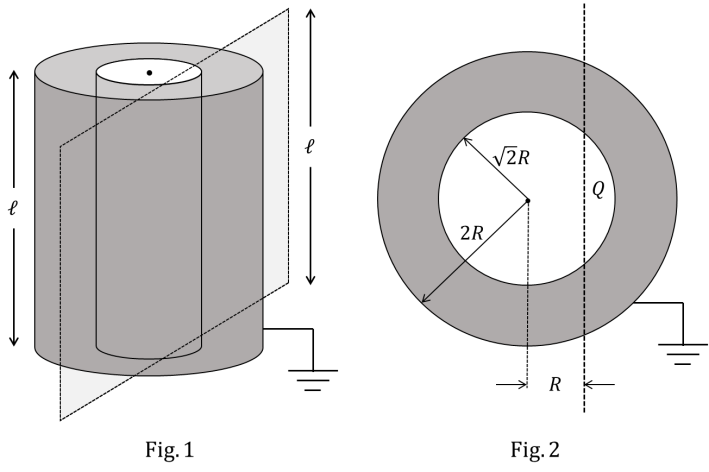
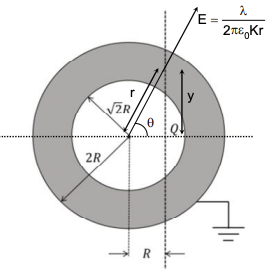
Two co-axial conducting cylinders of same length $\ell$ with radii $\sqrt{2}R$ and $2R$ are kept, as shown in Fig. 1. The charge on the inner cylinder is $Q$ and the outer cylinder is grounded. The annular region between the cylinders is filled with a material of dielectric constant $\kappa = 5$. Consider an imaginary plane of the same length $\ell$ at a distance $R$ from the common axis of the cylinders. This plane is parallel to the axis of the cylinders. The cross-sectional view of this arrangement is shown in Fig. 2. Ignoring edge effects, the flux of the electric field through the plane is ($\epsilon_0$ is the permittivity of free space): Co-axial cylinders setup
(A)
$\frac{Q}{30\epsilon_0}$
(B)
$\frac{Q}{15\epsilon_0}$
(C)
$\frac{Q}{60\epsilon_0}$
(D)
$\frac{Q}{120\epsilon_0}$
Answer: C

Solution

We need to calculate the electric flux through a rectangular plane embedded in the dielectric material between two cylinders.

1. Electric Field in the Annular Region:
Using Gauss's Law for a cylinder of infinite length (approximation since \( l \) is large compared to radii, or simply applying the formula for coaxial cable): The electric field at a distance \( r \) from the axis is given by: Electric Field \[ E = \frac{\lambda}{2 \pi \epsilon_0 \kappa r} \] where \( \lambda = Q/l \) is the linear charge density, and \( \kappa = 5 \) is the dielectric constant. So, \( E = \frac{Q}{2 \pi \epsilon_0 (5) l r} = \frac{Q}{10 \pi \epsilon_0 l r} \).
2. Setup for Flux Calculation:
The flux \( \phi = \int \mathbf{E} \cdot d\mathbf{A} \). The plane is parallel to the axis at a distance \( R \) from the center. Let's set up a coordinate system where the plane is vertical. Consider a thin strip on this plane at a vertical height \( y \) from the horizontal axis. The strip has length \( l \) and width \( dy \). Area element \( dA = l \cdot dy \). The distance of this strip from the center (radius) is \( r = \sqrt{R^2 + y^2} \). The electric field vector is radial. The angle \( \theta \) between the electric field vector and the surface normal (which is horizontal) satisfies \( \cos \theta = \frac{R}{r} = \frac{R}{\sqrt{R^2 + y^2}} \). Thus, the flux through the strip is: \[ d\phi = E \cos \theta dA = \left( \frac{\lambda}{2 \pi \epsilon_0 \kappa r} \right) \left( \frac{R}{r} \right) (l dy) = \frac{\lambda l R}{2 \pi \epsilon_0 \kappa} \frac{dy}{r^2} \] Substituting \( r^2 = R^2 + y^2 \): \[ d\phi = \frac{\lambda l R}{2 \pi \epsilon_0 \kappa} \frac{dy}{R^2 + y^2} \]

3. Limits of Integration:
The flux is restricted to the region between the inner and outer cylinders. At inner cylinder: \( r = \sqrt{2}R \implies \sqrt{R^2 + y^2} = \sqrt{2}R \implies y^2 = R^2 \implies y = R \). At outer cylinder: \( r = 2R \implies \sqrt{R^2 + y^2} = 2R \implies y^2 = 3R^2 \implies y = \sqrt{3}R \). The total flux is through both the upper and lower parts of the plane (symmetry), so we integrate from \( R \) to \( \sqrt{3}R \) and multiply by 2. \[ \phi = 2 \int_{R}^{\sqrt{3}R} \frac{\lambda l R}{2 \pi \epsilon_0 \kappa} \frac{dy}{R^2 + y^2} \]

4. Evaluate Integral:
\[ \phi = \frac{\lambda l R}{\pi \epsilon_0 \kappa} \int_{R}^{\sqrt{3}R} \frac{dy}{R^2 + y^2} \] Recall \( \int \frac{dx}{a^2 + x^2} = \frac{1}{a} \tan^{-1}(x/a) \). \[ \phi = \frac{\lambda l R}{\pi \epsilon_0 \kappa} \left[ \frac{1}{R} \tan^{-1}\left(\frac{y}{R}\right) \right]_{R}^{\sqrt{3}R} \] \[ \phi = \frac{\lambda l}{\pi \epsilon_0 \kappa} \left( \tan^{-1}(\sqrt{3}) - \tan^{-1}(1) \right) \] Substitute \( \lambda l = Q \) and \( \kappa = 5 \): \[ \phi = \frac{Q}{5 \pi \epsilon_0} \left( \frac{\pi}{3} - \frac{\pi}{4} \right) \] \[ \phi = \frac{Q}{5 \pi \epsilon_0} \left( \frac{\pi}{12} \right) = \frac{Q}{60 \epsilon_0} \]

Bloom Level
Evaluate
Topic
Physics
Difficulty
5
Ideal Time
180
Sub-topics
Electrostatics Electric Flux Gauss's Law
PRIMARY SKILL TESTED
Integration of Electric Flux over a Non-Standard Surface

Option Distractor Reasons

A

Result if one forgets the factor of 1/2 from integration or uses incorrect limits.

B

Result from calculation errors, potentially missing the dielectric constant.

D

Result if one calculates flux for only half the plane (ignoring symmetry).

Q.3
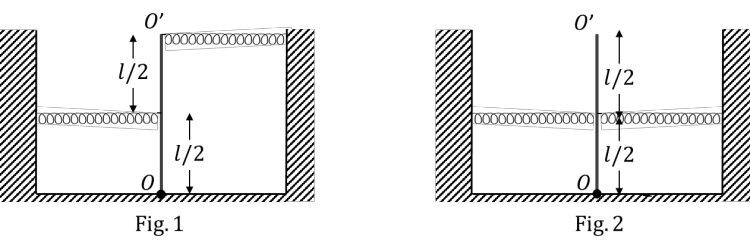
As shown in the figures, a uniform rod $OO'$ of length $l$ is hinged at the point $O$ and held in place vertically between two walls using two massless springs of same spring constant. The springs are connected at the midpoint and at the top-end ($O'$) of the rod, as shown in Fig. 1 and the rod is made to oscillate by a small angular displacement. The frequency of oscillation of the rod is $f_1$. On the other hand, if both the springs are connected at the midpoint of the rod, as shown in Fig. 2 and the rod is made to oscillate by a small angular displacement, then the frequency of oscillation is $f_2$. Ignoring gravity and assuming motion only in the plane of the diagram, the value of $\frac{f_1}{f_2}$ is: Springs at midpoint and top
(A)
2
(B)
$\sqrt{2}$
(C)
$\sqrt{\frac{5}{2}}$
(D)
$\sqrt{\frac{2}{5}}$
Answer: C

Solution

We need to compare the oscillation frequencies \( f_1 \) and \( f_2 \) for the two arrangements.

General Formula: For angular SHM, the restoring torque is \( \tau = -C \theta \). The angular frequency is \( \omega = \sqrt{\frac{C}{I}} \), where \( I \) is the moment of inertia about the hinge. Here, \( I = \frac{m l^2}{3} \).

Case I: One spring at the midpoint (\( l/2 \)) and one at the top end (\( l \)). Both springs act to restore the rod. Displacement at midpoint: \( x_1 = \frac{l}{2} \theta \). Force \( F_1 = k x_1 \). Displacement at top: \( x_2 = l \theta \). Force \( F_2 = k x_2 \). Torque \( \tau_1 = - [ F_1 \cdot \frac{l}{2} + F_2 \cdot l ] \) \( \tau_1 = - [ k(\frac{l}{2}\theta)(\frac{l}{2}) + k(l\theta)(l) ] \) \( \tau_1 = - k l^2 \theta [ \frac{1}{4} + 1 ] = - \frac{5}{4} k l^2 \theta \) Torsional constant \( C_1 = \frac{5}{4} k l^2 \). \( \omega_1^2 = \frac{C_1}{I} = \frac{\frac{5}{4} k l^2}{\frac{m l^2}{3}} = \frac{15k}{4m} \)

Case II: Two springs connected at the midpoint (\( l/2 \)), effectively in parallel for rotational displacement. Displacement: \( x = \frac{l}{2} \theta \). Both springs provide restoring force in the same direction. Total Force \( F = 2 \cdot k \cdot x = 2k(\frac{l}{2}\theta) = k l \theta \). Torque \( \tau_2 = - F \cdot \frac{l}{2} = - (k l \theta)(\frac{l}{2}) = - \frac{1}{2} k l^2 \theta \) Torsional constant \( C_2 = \frac{1}{2} k l^2 \). \( \omega_2^2 = \frac{C_2}{I} = \frac{\frac{1}{2} k l^2}{\frac{m l^2}{3}} = \frac{3k}{2m} \)

Calculate Ratio: \( \frac{f_1}{f_2} = \sqrt{\frac{\omega_1^2}{\omega_2^2}} = \sqrt{\frac{15k/4m}{3k/2m}} \) \( \frac{f_1}{f_2} = \sqrt{\frac{15}{4} \cdot \frac{2}{3}} = \sqrt{\frac{5}{2}} \)

This matches option (C).

Bloom Level
Analyze
Topic
Physics
Difficulty
3
Ideal Time
120
Sub-topics
Simple Harmonic Motion Rotational Dynamics
PRIMARY SKILL TESTED
Calculating Torsional Spring Constant and Frequency of Angular SHM

Option Distractor Reasons

A

Likely result of calculation error in moment arms or forces.

B

Assuming springs add linearly without accounting for distance squared in torque.

D

Inverse ratio \( \sqrt{2/5} \).

Q.4
Consider a star of mass $m_2$ kg revolving in a circular orbit around another star of mass $m_1$ kg with $m_1 \gg m_2$. The heavier star slowly acquires mass from the lighter star at a constant rate of $\gamma$ kg/s. In this transfer process, there is no other loss of mass. If the separation between the centers of the stars is $r$, then its relative rate of change $\frac{1}{r} \frac{dr}{dt}$ (in s$^{-1}$) is given by:
(A)
$-\frac{3\gamma}{2m_2}$
(B)
$-\frac{2\gamma}{m_2}$
(C)
$-\frac{2\gamma}{m_1}$
(D)
$-\frac{3\gamma}{2m_1}$
Answer: MARKS TO ALL
SECTION 2 (Maximum Marks: 16)
  • This section contains FOUR (04) questions.
  • Each question has FOUR options (A), (B), (C) and (D). ONE OR MORE THAN ONE of these four option(s) is(are) correct answer(s).
  • For each question, choose the option(s) corresponding to (all) the correct answer(s).
  • Answer to each question will be evaluated according to the following marking scheme:
    • Full Marks : +4 ONLY if (all) the correct option(s) is(are) chosen;
    • Partial Marks : +3 If all the four options are correct but ONLY three options are chosen;
    • Partial Marks : +2 If three or more options are correct but ONLY two options are chosen, both of which are correct;
    • Partial Marks : +1 If two or more options are correct but ONLY one option is chosen and it is a correct option;
    • Zero Marks : 0 If none of the options is chosen (i.e. the question is unanswered);
    • Negative Marks : −2 In all other cases.
Q.5
A positive point charge of $10^{-8}$ C is kept at a distance of 20 cm from the center of a neutral conducting sphere of radius 10 cm. The sphere is then grounded and the charge on the sphere is measured. The grounding is then removed and subsequently the point charge is moved by a distance of 10 cm further away from the center of the sphere along the radial direction. Taking $\frac{1}{4\pi\epsilon_0} = 9 \times 10^9$ Nm$^2$/C$^2$ (where $\epsilon_0$ is the permittivity of free space), which of the following statements is/are correct:
(A)
Before the grounding, the electrostatic potential of the sphere is 450 V.
(B)
Charge flowing from the sphere to the ground because of grounding is $5 \times 10^{-9}$ C.
(C)
After the grounding is removed, the charge on the sphere is $-5 \times 10^{-9}$ C.
(D)
The final electrostatic potential of the sphere is 300 V.
Answer: A, B, C

Solution

System Setup:

  • Point charge \( q = 10^{-8} \) C.
  • Sphere radius \( R = 10 \) cm = 0.1 m.
  • Distance from center \( d_1 = 20 \) cm = 0.2 m.
  • \( k = 9 \times 10^9 \) Nm\(^2\)/C\(^2\).

Step 1: Before Grounding (Analysis of Option A) The sphere is neutral. The potential at the center (and everywhere on/inside the conductor) is due to the external charge \( q \) plus the induced charges. The net potential due to induced charges at the center is zero (sum of \( q_{ind}/R \) where \( \sum q_{ind} = 0 \)). No, wait. Potential of a neutral conducting sphere in the field of a point charge: The potential is constant throughout the sphere. Potential at center = Potential due to \( q \) at distance \( d_1 \) + Potential due to induced charges. Wait, for a neutral sphere, the average potential is not necessarily just \( kq/d_1 \). Actually, the potential of an isolated neutral conductor is determined by the potential at its center, which is \( V_c = \frac{kq}{d_1} + V_{induced} \). Since the total induced charge is zero and distributed on the surface, the potential at the center due to induced charges is \( \int \frac{k dq_{ind}}{R} = \frac{k}{R} \int dq_{ind} = 0 \). So, \( V_{sphere} = \frac{kq}{d_1} \). Calculation: \( V = \frac{9 \times 10^9 \times 10^{-8}}{0.2} = \frac{90}{0.2} = 450 \) V. Statement (A) is Correct.

Step 2: Grounding Process (Analysis of Option B) The sphere is grounded, so its potential becomes 0. Let the new charge on the sphere be \( Q \). Potential \( V = \frac{kQ}{R} + \frac{kq}{d_1} = 0 \). \( \frac{Q}{R} = - \frac{q}{d_1} \) \( Q = - q \frac{R}{d_1} = - 10^{-8} \times \frac{0.1}{0.2} = - \frac{1}{2} \times 10^{-8} = -5 \times 10^{-9} \) C. Initial charge was 0. Final charge is \( -5 \times 10^{-9} \) C. Charge flowed from ground to sphere is \( -5 \times 10^{-9} \) C. Therefore, charge flowed from sphere to ground is \( +5 \times 10^{-9} \) C. Statement (B) is Correct.

Step 3: Grounding Removed (Analysis of Option C) The grounding is removed. The charge \( Q = -5 \times 10^{-9} \) C is trapped on the sphere. Statement (C) is Correct.

Step 4: Point Charge Moved (Analysis of Option D) The point charge \( q \) is moved 10 cm further away. New distance \( d_2 = 20 + 10 = 30 \) cm = 0.3 m. The charge on the sphere is still \( Q = -5 \times 10^{-9} \) C. New Potential of the sphere \( V_{final} = \frac{kQ}{R} + \frac{kq}{d_2} \). \( V_{final} = \frac{9 \times 10^9 \times (-5 \times 10^{-9})}{0.1} + \frac{9 \times 10^9 \times 10^{-8}}{0.3} \) Term 1: \( \frac{-45}{0.1} = -450 \) V. Term 2: \( \frac{90}{0.3} = 300 \) V. \( V_{final} = -450 + 300 = -150 \) V. The statement says 300 V. Statement (D) is Incorrect.

Correct Options: A, B, C

Bloom Level
Analyze
Topic
Physics
Difficulty
4
Ideal Time
180
Sub-topics
Electrostatics Conductors Electric Potential
PRIMARY SKILL TESTED
Calculating Electric Potential of Conductor Systems with Induction and Grounding

Option Distractor Reasons

D

Result of miscalculating the final potential, likely by ignoring the contribution of the sphere's own charge or sign errors.

Q.6
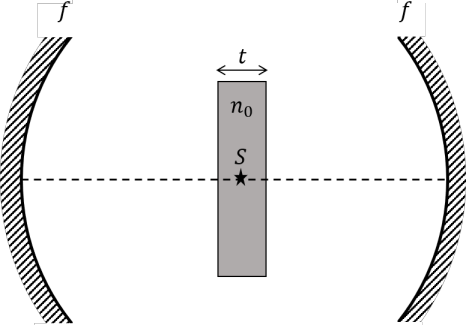
Two identical concave mirrors each of focal length $f$ are facing each other as shown in the schematic diagram. The focal length $f$ is much larger than the size of the mirrors. A glass slab of thickness $t$ and refractive index $n_0$ is kept equidistant from the mirrors and perpendicular to their common principal axis. A monochromatic point light source $S$ is embedded at the center of the slab on the principal axis, as shown in the schematic diagram. For the image to be formed on $S$ itself, which of the following distances between the two mirrors is/are correct: Two concave mirrors with a slab and source S in between
(A)
$4f + (1 - \frac{1}{n_0})t$
(B)
$2f + (1 - \frac{1}{n_0})t$
(C)
$4f + (n_0 - 1)t$
(D)
$2f + (n_0 - 1)t$
Answer: A, B

Solution (Question 6)

1. Analyze the Optical Path and Shift:

The light source \( S \) is embedded at the center of a glass slab of thickness \( t \) and refractive index \( n_0 \). Rays traveling from \( S \) towards either mirror pass through a thickness of \( t/2 \) of the glass.

Refraction at the plane surface of the slab causes an apparent shift in the position of the object. For an object at a real depth \( d_{real} \) inside a medium of refractive index \( \mu \), the apparent depth is \( d_{app} = \frac{d_{real}}{\mu} \).

The shift in the position of the object in the direction of light propagation is given by:

$$ \text{Shift} = d_{real} - d_{app} = \frac{t}{2} - \frac{t/2}{n_0} = \frac{t}{2} \left( 1 - \frac{1}{n_0} \right) $$

This means the object \( S \) appears closer to the mirror surface by this shift amount.

2. Define Distances:

Let \( d \) be the distance between the two mirrors. Since the slab is equidistant from the mirrors, the geometric distance from the center (source \( S \)) to either mirror is \( d/2 \).

The apparent distance of the source \( S \) from the mirror, \( u \), is:

$$ u = \text{Geometric Distance} - \text{Shift} $$ $$ u = \frac{d}{2} - \frac{t}{2} \left( 1 - \frac{1}{n_0} \right) $$

3. Conditions for Image to Form on \( S \) itself:

For the image to form back at the source \( S \), the rays must retrace their path to the original position. There are two primary cases for a concave mirror where this symmetry can occur in this setup:

Case A: Rays strike the mirror normally.

This happens when the object (apparent position of \( S \)) is located at the center of curvature of the mirror. Thus, \( u = 2f \).

$$ \frac{d}{2} - \frac{t}{2} \left( 1 - \frac{1}{n_0} \right) = 2f $$ $$ \frac{d}{2} = 2f + \frac{t}{2} \left( 1 - \frac{1}{n_0} \right) $$ $$ d = 4f + t \left( 1 - \frac{1}{n_0} \right) $$

This matches Option (A).

Case B: Rays strike the mirror and become parallel to the principal axis.

This happens when the object (apparent position of \( S \)) is located at the focal point of the mirror. Thus, \( u = f \).

If the rays become parallel after reflection from the first mirror, they will travel across to the second identical mirror. Parallel rays striking a concave mirror focus at its focal point. Due to the symmetry of the setup, the focal point of the second mirror coincides with the apparent position of \( S \) as seen from that side. Thus, the image forms at \( S \).

$$ \frac{d}{2} - \frac{t}{2} \left( 1 - \frac{1}{n_0} \right) = f $$ $$ \frac{d}{2} = f + \frac{t}{2} \left( 1 - \frac{1}{n_0} \right) $$ $$ d = 2f + t \left( 1 - \frac{1}{n_0} \right) $$

This matches Option (B).

Therefore, both distances are possible correct configurations.

Bloom Level
Apply
Topic
Physics
Difficulty
3 (Moderate)
Ideal Time
120 seconds
Sub-topics
Ray Optics Refraction Spherical Mirrors
PRIMARY SKILL TESTED
Conceptual understanding of image formation with refraction and reflection.

Option Distractor Reasons

C

Uses the term \( (n_0 - 1)t \), which corresponds to optical path difference rather than spatial shift due to refraction.

D

Similar error to C, using the incorrect shift formula.

Q.7
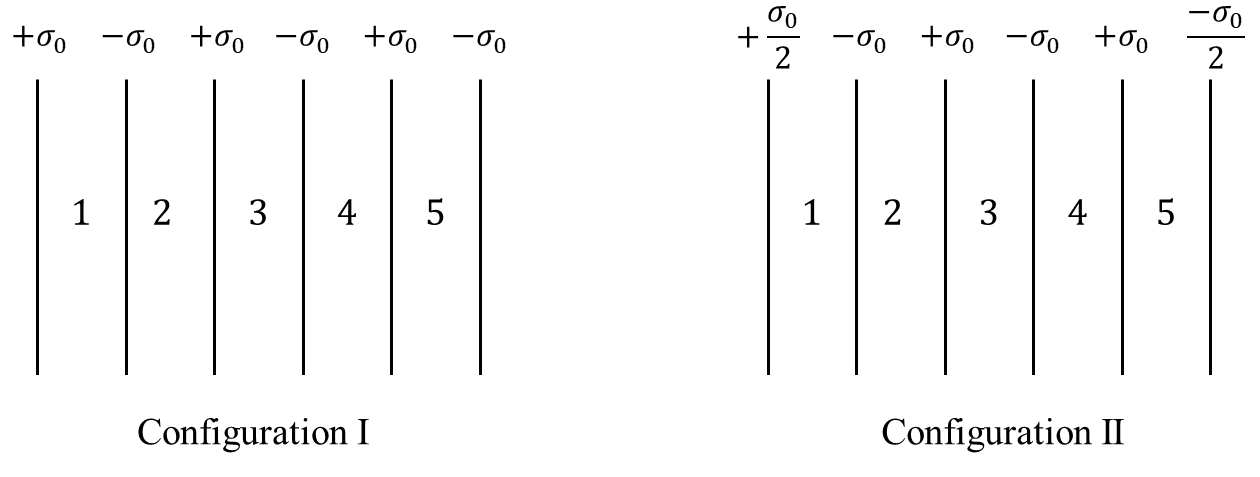
Six infinitely large and thin non-conducting sheets are fixed in configurations I and II. As shown in the figure, the sheets carry uniform surface charge densities which are indicated in terms of $\sigma_0$. The separation between any two consecutive sheets is 1 $\mu$m. The various regions between the sheets are denoted as 1, 2, 3, 4 and 5. If $\sigma_0 = 9$ $\mu$C/m$^2$, then which of the following statements is/are correct:
(Take permittivity of free space $\epsilon_0 = 9 \times 10^{-12}$ F/m) Six non-conducting sheets
(A)
In region 4 of the configuration I, the magnitude of the electric field is zero.
(B)
In region 3 of the configuration II, the magnitude of the electric field is $\frac{\sigma_0}{\epsilon_0}$.
(C)
Potential difference between the first and the last sheets of the configuration I is 5 V.
(D)
Potential difference between the first and the last sheets of the configuration II is zero.
Answer: A

Solution

Analysis of Electric Fields due to Infinite Sheets:

The electric field \( E \) due to a single infinite sheet with charge density \( \sigma \) is given by \( E = \frac{\sigma}{2\epsilon_0} \), directed away from the sheet if \( \sigma > 0 \) and towards it if \( \sigma < 0 \). The net field in any region is the vector sum of fields from all sheets.

Option (A): Region 4 of Configuration I

Configuration I has charge densities: \( +\sigma_0, -\sigma_0, +\sigma_0, -\sigma_0, +\sigma_0, -\sigma_0 \).

Region 4 is located between the 4th sheet (\(-\sigma_0\)) and the 5th sheet (\(+\sigma_0\)).

  • Sheets to the left (1, 2, 3, 4): Sum of charge densities = \( \sigma_0 - \sigma_0 + \sigma_0 - \sigma_0 = 0 \).
  • Sheets to the right (5, 6): Sum of charge densities = \( \sigma_0 - \sigma_0 = 0 \).

Using the superposition principle, the net field is proportional to the difference between the net charge density to the left and to the right. Since both are zero, the electric field \( E_4 = 0 \).
Alternatively, summing individual fields (Right is positive): \( E = \frac{\sigma_0}{2\epsilon_0}(+1 -1 +1 -1 -1 +1) = 0 \).
Statement (A) is correct.

Option (B): Region 3 of Configuration II

Configuration II has charge densities: \( +\frac{\sigma_0}{2}, -\sigma_0, +\sigma_0, -\sigma_0, +\sigma_0, -\frac{\sigma_0}{2} \).

Region 3 is between the 3rd (\(+\sigma_0\)) and 4th (\(-\sigma_0\)) sheets.

  • Sheets to the left (1, 2, 3): Net \( \sigma_L = \frac{\sigma_0}{2} - \sigma_0 + \sigma_0 = \frac{\sigma_0}{2} \).
  • Sheets to the right (4, 5, 6): Net \( \sigma_R = -\sigma_0 + \sigma_0 - \frac{\sigma_0}{2} = -\frac{\sigma_0}{2} \).

The field points from positive net charge to negative net charge (Left to Right). Magnitude \( E = \frac{1}{2\epsilon_0} (\sigma_{net, left} - \sigma_{net, right}) = \frac{1}{2\epsilon_0} (\frac{\sigma_0}{2} - (-\frac{\sigma_0}{2})) = \frac{\sigma_0}{2\epsilon_0} \).

Statement (B) claims \( E = \frac{\sigma_0}{\epsilon_0} \), which is incorrect.

Option (C): Potential Difference in Configuration I

We need \( V_1 - V_6 = \int E \, dx = \sum E_i d \). The sequence of fields in regions 1 to 5 for Config I:

  • Region 1 (between 1&2): Left net \(\sigma_0\), Right net \(-\sigma_0\). \( E = \sigma_0/\epsilon_0 \).
  • Region 2 (between 2&3): Left net \(0\), Right net \(0\). \( E = 0 \).
  • Region 3 (between 3&4): Left net \(\sigma_0\), Right net \(-\sigma_0\). \( E = \sigma_0/\epsilon_0 \).
  • Region 4 (between 4&5): \( E = 0 \).
  • Region 5 (between 5&6): \( E = \sigma_0/\epsilon_0 \).

Total Potential Difference \( \Delta V = (\frac{\sigma_0}{\epsilon_0} + 0 + \frac{\sigma_0}{\epsilon_0} + 0 + \frac{\sigma_0}{\epsilon_0})d = \frac{3\sigma_0 d}{\epsilon_0} \).

Substituting values: \( \Delta V = 3 \times \frac{(9\times 10^{-6})(10^{-6})}{9\times 10^{-12}} = 3 \times 1 = 3 \, \text{V} \).

Statement (C) claims 5 V, which is incorrect.

Option (D): Potential Difference in Configuration II

Calculating fields in Config II:

  • Region 1: \( \sigma_L = \sigma_0/2 \). \( E_1 = \frac{\sigma_0}{2\epsilon_0} \).
  • Region 2: \( \sigma_L = -\sigma_0/2 \). \( E_2 = -\frac{\sigma_0}{2\epsilon_0} \).
  • Region 3: \( \sigma_L = \sigma_0/2 \). \( E_3 = \frac{\sigma_0}{2\epsilon_0} \).
  • Region 4: \( \sigma_L = -\sigma_0/2 \). \( E_4 = -\frac{\sigma_0}{2\epsilon_0} \).
  • Region 5: \( \sigma_L = \sigma_0/2 \). \( E_5 = \frac{\sigma_0}{2\epsilon_0} \).

Sum of fields: \( \sum E = \frac{\sigma_0}{2\epsilon_0} (1 - 1 + 1 - 1 + 1) = \frac{\sigma_0}{2\epsilon_0} \). \( \Delta V = E_{net} \cdot d = \frac{\sigma_0 d}{2\epsilon_0} = 0.5 \, \text{V} \).

Statement (D) claims 0 V, which is incorrect.

Bloom Level
Analyze
Topic
Physics
Difficulty
4 (Hard)
Ideal Time
180 seconds
Sub-topics
Electrostatics Gauss's Law Electric Potential
PRIMARY SKILL TESTED
Superposition of electric fields from multiple charge distributions.

Option Distractor Reasons

B

Incorrectly calculates the superposition of fields, likely missing the factor of 1/2 in the infinite sheet formula or misidentifying direction.

C

Calculation error in summing the potential drops across different regions (Result is 3V, not 5V).

D

Incorrect assumption that alternating symmetric fields sum to zero potential difference; they actually result in a net non-zero value (0.5V).

Q.8
The efficiency of a Carnot engine operating with a hot reservoir kept at a temperature of 1000 K is 0.4. It extracts 150 J of heat per cycle from the hot reservoir. The work extracted from this engine is being fully used to run a heat pump which has a coefficient of performance 10. The hot reservoir of the heat pump is at a temperature of 300 K. Which of the following statements is/are correct:
(A)
Work extracted from the Carnot engine in one cycle is 60 J.
(B)
Temperature of the cold reservoir of the Carnot engine is 600 K.
(C)
Temperature of the cold reservoir of the heat pump is 270 K.
(D)
Heat supplied to the hot reservoir of the heat pump in one cycle is 540 J.
Answer: A, B, C

Solution

1. Carnot Engine Analysis:

Given parameters:

  • Temperature of hot reservoir, \( T_{1} = 1000 \, \text{K} \)
  • Efficiency, \( \eta = 0.4 \)
  • Heat extracted from hot reservoir, \( Q_{1} = 150 \, \text{J} \)

Calculate Work Extracted (\( W \)):

$$ \eta = \frac{W}{Q_{1}} $$ $$ W = \eta \times Q_{1} = 0.4 \times 150 = 60 \, \text{J} $$

This matches Statement (A).

Calculate Cold Reservoir Temperature (\( T_{2} \)):

$$ \eta = 1 - \frac{T_{2}}{T_{1}} $$ $$ 0.4 = 1 - \frac{T_{2}}{1000} \implies \frac{T_{2}}{1000} = 0.6 $$ $$ T_{2} = 600 \, \text{K} $$

This matches Statement (B).

2. Heat Pump Analysis:

The work \( W = 60 \, \text{J} \) drives a heat pump.
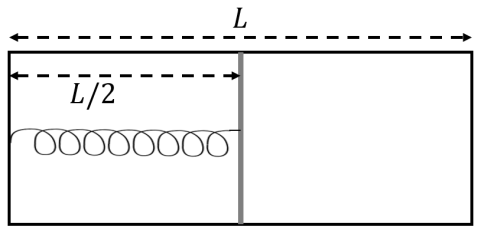
Given parameters for the heat pump:

  • Coefficient of Performance (COP), \( \beta = 10 \)
  • Temperature of hot reservoir (where heat is pumped to), \( T_{H} = 300 \, \text{K} \)

Calculate Cold Reservoir Temperature (\( T_{L} \)):

For a Carnot heat pump, the COP is defined as:

$$ \beta = \frac{T_{H}}{T_{H} - T_{L}} $$ $$ 10 = \frac{300}{300 - T_{L}} $$ $$ 3000 - 10 T_{L} = 300 $$ $$ 10 T_{L} = 2700 \implies T_{L} = 270 \, \text{K} $$

This matches Statement (C).

Calculate Heat Supplied to Hot Reservoir (\( Q_{H} \)):

By definition of COP for a heat pump (\( \beta = Q_{H} / W \)):

$$ Q_{H} = \beta \times W = 10 \times 60 = 600 \, \text{J} $$

Statement (D) claims the heat supplied is 540 J. However, \( Q_{H} = 600 \, \text{J} \). Note that the heat extracted from the cold reservoir would be \( Q_{L} = Q_{H} - W = 600 - 60 = 540 \, \text{J} \), but the question asks for heat supplied to the hot reservoir.

Thus, Statement (D) is incorrect.

Conclusion: Statements A, B, and C are correct.

Bloom Level
Apply
Topic
Physics
Difficulty
2 (Easy/Moderate)
Ideal Time
90 seconds
Sub-topics
Thermodynamics Carnot Engine Heat Pump
PRIMARY SKILL TESTED
Application of efficiency and COP formulas for thermodynamic cycles.

Option Distractor Reasons

D

Confuses "Heat supplied to hot reservoir" (\( Q_H = 600 \) J) with "Heat extracted from cold reservoir" (\( Q_L = 540 \) J).

SECTION 3 (Maximum Marks: 32)
  • This section contains EIGHT (08) questions.
  • The answer to each question is a NUMERICAL VALUE.
  • For each question, enter the correct numerical value of the answer.
  • If the numerical value has more than two decimal places, truncate/round-off the value to TWO decimal places.
  • Answer to each question will be evaluated according to the following marking scheme:
    • Full Marks : +4 If ONLY the correct numerical value is entered in the designated place;
    • Zero Marks : 0 In all other cases.
Q.9
A conducting solid sphere of radius $R$ and mass $M$ carries a charge $Q$. The sphere is rotating about an axis passing through its center with a uniform angular speed $\omega$. The ratio of the magnitudes of the magnetic dipole moment to the angular momentum about the same axis is given as $\alpha \frac{Q}{2M}$. The value of $\alpha$ is ___
Answer: [1.65 to 1.67]

Solution

Step 1: Understand the Charge and Mass Distribution

  • The problem specifies a conducting solid sphere. For a conductor, any excess charge \(Q\) resides entirely on the outer surface. Thus, the charge distribution behaves like a spherical shell.
  • The mass \(M\) is that of a solid sphere, distributed uniformly throughout the volume.

Step 2: Calculate the Magnetic Moment (\(\mu\))

Consider the charge \(Q\) distributed uniformly on the surface of a sphere of radius \(R\). If the sphere rotates with angular velocity \(\omega\):

The magnetic moment of a rotating spherical shell is given by:

$$ \mu = \frac{1}{3} Q R^2 \omega $$

(Note: This can be derived by integrating the magnetic moments of infinitesimal rings on the surface: \(d\mu = (\text{Area}) \cdot dI\). For a shell, \(\mu = \frac{Q}{2M_{\text{shell}}} L_{\text{shell}}\). Since \(L_{\text{shell}} = \frac{2}{3} M_{\text{shell}} R^2 \omega\), we get \(\mu = \frac{Q}{2M_{\text{shell}}} (\frac{2}{3} M_{\text{shell}} R^2 \omega) = \frac{1}{3}QR^2\omega\)).

Step 3: Calculate the Angular Momentum (\(L\))

The angular momentum is determined by the mass distribution. For a solid sphere of mass \(M\) and radius \(R\):

$$ L = I \omega = \frac{2}{5} M R^2 \omega $$

Step 4: Determine the Ratio and Solve for \(\alpha\)

Now, we take the ratio of the magnitude of the magnetic dipole moment to the angular momentum:

$$ \frac{\mu}{L} = \frac{\frac{1}{3} Q R^2 \omega}{\frac{2}{5} M R^2 \omega} $$ $$ \frac{\mu}{L} = \frac{1/3}{2/5} \cdot \frac{Q}{M} = \frac{5}{6} \frac{Q}{M} $$

The problem states that this ratio is given as \(\alpha \frac{Q}{2M}\). Equating the two expressions:

$$ \frac{5}{6} \frac{Q}{M} = \alpha \frac{Q}{2M} $$

Canceling common terms (\(\frac{Q}{M}\)):

$$ \frac{5}{6} = \frac{\alpha}{2} $$ $$ \alpha = \frac{10}{6} = \frac{5}{3} $$ $$ \alpha \approx 1.67 $$
Bloom Level
Analyze
Topic
Electromagnetism
Difficulty
3
Ideal Time
120
Sub-topics
Magnetic Moment Angular Momentum Gyromagnetic Ratio
PRIMARY SKILL TESTED
Calculating magnetic moment and angular momentum for different mass/charge distributions.
Q.10
A hydrogen atom, initially at rest in its ground state, absorbs a photon of frequency $\nu_1$ and ejects the electron with a kinetic energy of 10 eV. The electron then combines with a positron at rest to form a positronium atom in its ground state and simultaneously emits a photon of frequency $\nu_2$. The center of mass of the resulting positronium atom moves with a kinetic energy of 5 eV. It is given that positron has the same mass as that of electron and the positronium atom can be considered as a Bohr atom, in which the electron and the positron orbit around their center of mass. Considering no other energy loss during the whole process, the difference between the two photon energies (in eV) is ___
Answer: [11.7 to 11.9]

Solution

Step 1: Analyze the First Process (Photoelectric Effect on Hydrogen)

A photon of frequency \(\nu_1\) ionizes a Hydrogen atom from its ground state. The energy conservation equation is:

$$ E_{\text{photon}} = \text{Ionization Energy} + \text{Kinetic Energy of electron} $$ $$ h\nu_1 = 13.6 \text{ eV} + 10 \text{ eV} $$ $$ h\nu_1 = 23.6 \text{ eV} $$

Step 2: Analyze the Second Process (Positronium Formation)

The ejected electron (KE = 10 eV) combines with a positron at rest to form a Positronium atom (bound state of \(e^-\) and \(e^+\)).

  • Initial Energy (\(E_i\)): The total energy before combination is the kinetic energy of the electron (since the positron is at rest and potential energy at infinite separation is zero). $$ E_i = 10 \text{ eV} $$
  • Final Energy (\(E_f\)): The system forms a Positronium atom moving with kinetic energy, and emits a photon \(h\nu_2\).
    • Positronium Kinetic Energy (\(KE_{Ps}\)) = 5 eV (Given).
    • Positronium Binding Energy: The reduced mass of the positronium system is \(\mu = \frac{m_e m_e}{m_e + m_e} = \frac{m_e}{2}\). The ground state energy is \(E_{Ps} = -13.6 \text{ eV} \times \frac{\mu}{m_e} = -6.8 \text{ eV}\).
    • Photon Energy = \(h\nu_2\).

Using Conservation of Energy:

$$ E_i = KE_{Ps} + E_{Ps} + h\nu_2 $$ $$ 10 \text{ eV} = 5 \text{ eV} + (-6.8 \text{ eV}) + h\nu_2 $$ $$ 10 = -1.8 + h\nu_2 $$ $$ h\nu_2 = 11.8 \text{ eV} $$

Step 3: Calculate the Difference

We need to find the difference between the two photon energies:

$$ h\nu_1 - h\nu_2 = 23.6 \text{ eV} - 11.8 \text{ eV} $$ $$ h\nu_1 - h\nu_2 = 11.8 \text{ eV} $$
Bloom Level
Apply
Topic
Modern Physics
Difficulty
3
Ideal Time
150
Sub-topics
Photoelectric Effect Bohr Model Conservation of Energy
PRIMARY SKILL TESTED
Application of energy conservation in atomic transitions and collisions.
Q.11
An ideal monatomic gas of $n$ moles is taken through a cycle $WXYZW$ consisting of consecutive adiabatic and isobaric quasi-static processes, as shown in the schematic $V$-$T$ diagram. The volume of the gas at $W, X$ and $Y$ points are, 64 cm$^3$, 125 cm$^3$ and 250 cm$^3$, respectively. If the absolute temperature of the gas $T_W$ at the point $W$ is such that $nRT_W = 1$ J ($R$ is the universal gas constant), then the amount of heat absorbed (in J) by the gas along the path $XY$ is ___ V-T diagram for cycle WXYZW
Answer: 1.6

Solution

Given Data:

  • Monatomic gas (\(\gamma = 5/3\)).
  • Volumes: \(V_W = 64\), \(V_X = 125\), \(V_Y = 250\) (units in \(cm^3\)).
  • Condition at W: \(nRT_W = 1 \text{ J}\).

Step 1: Analyze Process W-X (Adiabatic Expansion)

For an adiabatic process involving an ideal gas:

$$ TV^{\gamma-1} = \text{constant} $$ $$ T_W V_W^{\gamma-1} = T_X V_X^{\gamma-1} $$

Substituting \(\gamma - 1 = \frac{5}{3} - 1 = \frac{2}{3}\):

$$ T_W (64)^{2/3} = T_X (125)^{2/3} $$ $$ T_W (4^3)^{2/3} = T_X (5^3)^{2/3} $$ $$ T_W (4^2) = T_X (5^2) $$ $$ 16 T_W = 25 T_X \Rightarrow T_X = \frac{16}{25} T_W $$

Step 2: Analyze Process X-Y (Isobaric Expansion)

For an isobaric process, Charles's Law applies:

$$ \frac{V}{T} = \text{constant} \Rightarrow \frac{V_X}{T_X} = \frac{V_Y}{T_Y} $$ $$ T_Y = T_X \left(\frac{V_Y}{V_X}\right) $$ $$ T_Y = T_X \left(\frac{250}{125}\right) = 2T_X $$

Substitute \(T_X\):

$$ T_Y = 2 \left(\frac{16}{25} T_W\right) = \frac{32}{25} T_W $$

Step 3: Calculate Heat Absorbed in Process X-Y

For an isobaric process, heat absorbed is given by:

$$ Q_{XY} = n C_P \Delta T $$

For a monatomic gas, \(C_P = \frac{5}{2} R\).

$$ \Delta T = T_Y - T_X = \frac{32}{25}T_W - \frac{16}{25}T_W = \frac{16}{25}T_W $$ $$ Q_{XY} = n \left(\frac{5}{2}R\right) \left(\frac{16}{25}T_W\right) $$ $$ Q_{XY} = \frac{5}{2} \cdot \frac{16}{25} \cdot (nRT_W) $$

Simplifying the fraction:

$$ Q_{XY} = \frac{1}{1} \cdot \frac{8}{5} \cdot (nRT_W) = \frac{8}{5} nRT_W $$

Given that \(nRT_W = 1 \text{ J}\):

$$ Q_{XY} = \frac{8}{5} (1) = 1.6 \text{ J} $$
Bloom Level
Apply
Topic
Thermodynamics
Difficulty
3
Ideal Time
150
Sub-topics
Adiabatic Process Isobaric Process Specific Heat
PRIMARY SKILL TESTED
Calculating heat transfer using thermodynamic process equations and ideal gas laws.
Q.12
A geostationary satellite above the equator is orbiting around the earth at a fixed distance $r_1$ from the center of the earth. A second satellite is orbiting in the equatorial plane in the opposite direction to the earth’s rotation, at a distance $r_2$ from the center of the earth, such that $r_1 = 1.21 r_2$. The time period of the second satellite as measured from the geostationary satellite is $\frac{24}{p}$ hours. The value of $p$ is ___
Answer: [2.3 to 2.4]

Solution

Step 1: Determine the Time Period of the Second Satellite

According to Kepler's Third Law, $T^2 \propto r^3$, or $T \propto r^{3/2}$.

For the geostationary satellite (Satellite 1):

  • Period $T_1 = 24$ hours.
  • Radius $r_1$.

For the second satellite (Satellite 2):

  • Radius $r_2 = \frac{r_1}{1.21}$.

The ratio of their periods is:

$$ \frac{T_1}{T_2} = \left(\frac{r_1}{r_2}\right)^{3/2} = (1.21)^{3/2} $$ $$ \frac{T_1}{T_2} = (1.1^2)^{3/2} = (1.1)^3 = 1.331 $$ $$ T_2 = \frac{T_1}{1.331} $$

Step 2: Calculate the Relative Time Period

Let $t$ be the time period of the second satellite as observed from the first. This is the time between two consecutive encounters.

  • Satellite 1 (Geostationary) moves with angular velocity $\omega_1 = \frac{2\pi}{T_1}$ in the direction of Earth's rotation (say, West to East).
  • Satellite 2 moves in the opposite direction (East to West) with angular velocity $\omega_2 = \frac{2\pi}{T_2}$.

The relative angular velocity is the sum of their angular speeds because they are moving in opposite directions:

$$ \omega_{\text{rel}} = \omega_1 + \omega_2 $$ $$ \frac{2\pi}{t} = \frac{2\pi}{T_1} + \frac{2\pi}{T_2} $$ $$ \frac{1}{t} = \frac{1}{T_1} + \frac{1}{T_2} $$

Substituting $T_2 = \frac{T_1}{1.331}$:

$$ \frac{1}{t} = \frac{1}{T_1} + \frac{1.331}{T_1} = \frac{2.331}{T_1} $$ $$ t = \frac{T_1}{2.331} $$

Step 3: Solve for p

Given $T_1 = 24$ hours, we have:

$$ t = \frac{24}{2.331} \text{ hours} $$

The problem states the time period is $\frac{24}{p}$ hours. Comparing the two expressions:

$$ p = 2.331 $$

Rounding to two decimal places (as per the answer key range):

$$ p \approx 2.33 $$
Bloom Level
Apply
Topic
Gravitation
Difficulty
3
Ideal Time
120
Sub-topics
Kepler's Laws Relative Velocity Satellite Motion
PRIMARY SKILL TESTED
Calculating relative angular velocity and applying Kepler's third law.
Q.13
The left and right compartments of a thermally isolated container of length $L$ are separated by a thermally conducting, movable piston of area $A$. The left and right compartments are filled with $\frac{3}{2}$ and 1 moles of an ideal gas, respectively. In the left compartment the piston is attached by a spring with spring constant $k$ and natural length $\frac{2L}{5}$. In thermodynamic equilibrium, the piston is at a distance $\frac{L}{2}$ from the left and right edges of the container as shown in the figure. Under the above conditions, if the pressure in the right compartment is $P = \frac{kL}{A}\alpha$, then the value of $\alpha$ is ____ Container with piston and spring
Answer: 0.2

Solution

Step 1: Analyze the Equilibrium State

  • The container of length $L$ is divided equally at equilibrium, so the length of each compartment is $L/2$.
  • Volume of each compartment $V = A(L/2)$.
  • Left compartment: $n_L = 1.5$ moles. Pressure $P_L$.
  • Right compartment: $n_R = 1$ mole. Pressure $P_R$.
  • Since the piston is thermally conducting, both sides are at the same temperature $T$.

Step 2: Force Balance Equation

The piston is in equilibrium under the influence of gas pressures and the spring force.

  • Spring extension: The natural length is $0.4L$ ($2L/5$). The current length is $0.5L$ ($L/2$).
  • Extension $x = 0.5L - 0.4L = 0.1L = \frac{L}{10}$.
  • The spring is stretched, so it pulls the piston to the left.
  • Force balance (Rightward Forces = Leftward Forces): $$ P_L A = P_R A + kx $$

Step 3: Use Ideal Gas Law

Express pressures using $PV = nRT$:

$$ P_L = \frac{n_L RT}{V} = \frac{1.5 RT}{AL/2} = \frac{3RT}{AL} $$ $$ P_R = \frac{n_R RT}{V} = \frac{1 RT}{AL/2} = \frac{2RT}{AL} $$

Substitute these into the force balance equation:

$$ \left(\frac{3RT}{AL}\right)A = \left(\frac{2RT}{AL}\right)A + k\left(\frac{L}{10}\right) $$ $$ \frac{3RT}{L} = \frac{2RT}{L} + \frac{kL}{10} $$ $$ \frac{RT}{L} = \frac{kL}{10} \Rightarrow RT = \frac{kL^2}{10} $$

Step 4: Calculate Pressure in Right Compartment ($P_R$)

We need to find $P_R$ in terms of $kL/A$.

$$ P_R = \frac{2RT}{AL} $$

Substitute $RT = \frac{kL^2}{10}$:

$$ P_R = \frac{2}{AL} \left( \frac{kL^2}{10} \right) $$ $$ P_R = \frac{2kL}{10A} = \frac{1}{5} \frac{kL}{A} = 0.2 \frac{kL}{A} $$

Step 5: Identify $\alpha$

The problem states $P = \frac{kL}{A} \alpha$. Comparing this with our result:

$$ \alpha = 0.2 $$
Bloom Level
Analyze
Topic
Thermodynamics
Difficulty
3
Ideal Time
150
Sub-topics
Ideal Gas Law Mechanical Equilibrium Hooke's Law
PRIMARY SKILL TESTED
Combining thermodynamics (gas laws) with mechanics (forces and springs) to solve for system parameters.
Q.14
In a Young’s double slit experiment, a combination of two glass wedges $A$ and $B$, having refractive indices 1.7 and 1.5, respectively, are placed in front of the slits, as shown in the figure. The separation between the slits is $d = 2$ mm and the shortest distance between the slits and the screen is $D = 2$ m. Thickness of the combination of the wedges is $t = 12$ $\mu$m. The value of $l$ as shown in the figure is 1 mm. Neglect any refraction effect at the slanted interface of the wedges. Due to the combination of the wedges, the central maximum shifts (in mm) with respect to O by ____ Young's double slit with wedges A and B
Answer: 1.2

Solution

Step 1: Understand the Geometry of the Wedges

The setup consists of two overlapping wedges forming a rectangular block of constant total thickness $12 \mu\text{m}$.

  • Wedge A has refractive index $n_A = 1.7$.
  • Wedge B has refractive index $n_B = 1.5$.
  • The wedges are symmetric but inverted. Let's assume the combination forms a block of length $L$.
  • From the diagram: $L = d + 2l = 2 \text{ mm} + 2(1 \text{ mm}) = 4 \text{ mm}$.

Step 2: Determine Thicknesses at the Slits

Due to the linear slope of the wedges and the symmetry of the arrangement:

  • Let $t_1$ be the thickness of the thinner part of a wedge at the position of the first slit (distance $l$ from the edge).
  • Let $t_2$ be the thickness of the thicker part of the same wedge at the position of the second slit (distance $3l$ from the edge).
  • Using similar triangles: $\frac{t_1}{l} = \frac{t_2}{L-l} = \frac{t_2}{3l}$. Thus, $t_2 = 3t_1$.
  • The sum of the thicknesses of the two complementary wedges at any point is constant ($12 \mu\text{m}$). Since the arrangement is symmetric, the thickness of the thick part of one wedge plus the thin part of the other is the total thickness. $$ t_1 + t_2 = 12 \mu\text{m} $$
  • Substituting $t_2 = 3t_1$: $$ t_1 + 3t_1 = 12 \Rightarrow 4t_1 = 12 \Rightarrow t_1 = 3 \mu\text{m} $$ $$ t_2 = 9 \mu\text{m} $$

So at Slit 1 (top): Thickness of Wedge B ($n_B$) is $t_1 = 3 \mu\text{m}$. Thickness of Wedge A ($n_A$) is $t_2 = 9 \mu\text{m}$. At Slit 2 (bottom): Thickness of Wedge B ($n_B$) is $t_2 = 9 \mu\text{m}$. Thickness of Wedge A ($n_A$) is $t_1 = 3 \mu\text{m}$.

Step 3: Calculate Optical Path Difference ($\Delta x$)

The optical path length (OPL) added by a medium of thickness $t$ is $(n-1)t$. Path difference between the two rays emerging from the slits:

$$ \Delta x = \text{OPL}_2 - \text{OPL}_1 $$ $$ \text{OPL}_1 = (n_A - 1)t_2 + (n_B - 1)t_1 = (0.7)(9) + (0.5)(3) = 6.3 + 1.5 = 7.8 \mu\text{m} $$ $$ \text{OPL}_2 = (n_A - 1)t_1 + (n_B - 1)t_2 = (0.7)(3) + (0.5)(9) = 2.1 + 4.5 = 6.6 \mu\text{m} $$ $$ \Delta x = 6.6 - 7.8 = -1.2 \mu\text{m} $$

The magnitude of the path difference is $|\Delta x| = 1.2 \mu\text{m}$.

Step 4: Calculate the Shift of the Central Maximum

For the central maximum, the total path difference (geometric + optical) must be zero. $$ d \sin \theta + \Delta x = 0 $$ Using the approximation $\sin \theta \approx \tan \theta = y/D$: $$ \frac{dy}{D} = |\Delta x| $$ $$ y = \frac{D |\Delta x|}{d} $$ Substitute the values ($D = 2 \text{ m}$, $d = 2 \text{ mm} = 2 \times 10^{-3} \text{ m}$): $$ y = \frac{2}{2 \times 10^{-3}} (1.2 \times 10^{-6}) $$ $$ y = 10^3 \times 1.2 \times 10^{-6} = 1.2 \times 10^{-3} \text{ m} $$ $$ y = 1.2 \text{ mm} $$

Bloom Level
Evaluate
Topic
Optics
Difficulty
4
Ideal Time
180
Sub-topics
Young's Double Slit Experiment Optical Path Difference Refraction
PRIMARY SKILL TESTED
Calculating optical path difference introduced by variable thickness elements and finding fringe shift.
Q.15
A projectile of mass 200 g is launched in a viscous medium at an angle 60° with the horizontal, with an initial velocity of 270 m/s. It experiences a viscous drag force $\vec{F} = -c\vec{v}$ where the drag coefficient $c = 0.1$ kg/s and $\vec{v}$ is the instantaneous velocity of the projectile. The projectile hits a vertical wall after 2 s. Taking $e = 2.7$, the horizontal distance of the wall from the point of projection (in m) is ____
Answer: [167 to 171]

Solution

Step 1: Set up the equation of motion for the horizontal component

The projectile experiences a drag force $\vec{F} = -c\vec{v}$. For the horizontal motion (x-direction), the force is $F_x = -cv_x$. According to Newton's Second Law:

$$ m a_x = -c v_x $$ $$ m \frac{dv_x}{dt} = -c v_x $$ $$ \frac{dv_x}{v_x} = -\frac{c}{m} dt $$

Step 2: Solve for horizontal velocity $v_x(t)$

Integrate both sides from time $0$ to $t$:

$$ \int_{v_{x0}}^{v_x} \frac{dv}{v} = -\frac{c}{m} \int_0^t dt $$ $$ \ln\left(\frac{v_x}{v_{x0}}\right) = -\frac{c}{m} t $$ $$ v_x(t) = v_{x0} e^{-\frac{c}{m} t} $$

The initial horizontal velocity is: $$ v_{x0} = v_0 \cos(60^\circ) = 270 \times \frac{1}{2} = 135 \text{ m/s} $$

Step 3: Solve for horizontal position $x(t)$

Since $v_x = \frac{dx}{dt}$, we integrate the velocity function:

$$ x(t) = \int_0^t v_x(\tau) d\tau = \int_0^t v_{x0} e^{-\frac{c}{m} \tau} d\tau $$ $$ x(t) = v_{x0} \left[ \frac{e^{-\frac{c}{m} \tau}}{-c/m} \right]_0^t $$ $$ x(t) = \frac{m v_{x0}}{c} \left( 1 - e^{-\frac{c}{m} t} \right) $$

Step 4: Substitute values and calculate distance at $t = 2$ s

Given parameters: $m = 200 \text{ g} = 0.2 \text{ kg}$ $c = 0.1 \text{ kg/s}$ $t = 2 \text{ s}$ $e = 2.7$

First, calculate the exponent coefficient: $$ \frac{c}{m} = \frac{0.1}{0.2} = 0.5 \text{ s}^{-1} $$ $$ \frac{c}{m} t = 0.5 \times 2 = 1 $$

Next, calculate the pre-factor: $$ \frac{m v_{x0}}{c} = \frac{0.2 \times 135}{0.1} = 2 \times 135 = 270 \text{ m} $$

Now, substitute into the position equation: $$ x(2) = 270 \left( 1 - e^{-1} \right) $$ $$ x(2) = 270 \left( 1 - \frac{1}{2.7} \right) $$ $$ x(2) = 270 \left( \frac{2.7 - 1}{2.7} \right) = 270 \left( \frac{1.7}{2.7} \right) = 270 \times \frac{17}{27} $$ $$ x(2) = 10 \times 17 = 170 \text{ m} $$

Bloom Level
Analyze
Topic
Mechanics
Difficulty
4
Ideal Time
200
Sub-topics
Projectile Motion Viscous Drag Differential Equations
PRIMARY SKILL TESTED
Solving for motion under a velocity-dependent resistive force (drag).
Q.16
An audio transmitter (T) and a receiver (R) are hung vertically from two identical massless strings of length 8 m with their pivots well separated along the $X$ axis. They are pulled from the equilibrium position in opposite directions along the $X$ axis by a small angular amplitude $\theta_0 = \cos^{-1}(0.9)$ and released simultaneously. If the natural frequency of the transmitter is 660 Hz and the speed of sound in air is 330 m/s, the maximum variation in the frequency (in Hz) as measured by the receiver (Take the acceleration due to gravity $g = 10$ m/s$^2$) is ___ Transmitter T and Receiver R pendulum setup
Answer: [26 to 33]

Solution

Step 1: Calculate the maximum speed of the bobs

Both the transmitter (source) and receiver (observer) are released from an angle $\theta_0$. They will attain their maximum velocity at the lowest point (equilibrium position) of the swing. Using the principle of conservation of energy:

$$ PE_{\text{loss}} = KE_{\text{gain}} $$ $$ mgL(1 - \cos\theta_0) = \frac{1}{2} m v_{max}^2 $$ $$ v_{max} = \sqrt{2gL(1 - \cos\theta_0)} $$

Given: $L = 8 \text{ m}$, $g = 10 \text{ m/s}^2$, $\cos\theta_0 = 0.9$ $$ v_{max} = \sqrt{2 \times 10 \times 8 \times (1 - 0.9)} $$ $$ v_{max} = \sqrt{160 \times 0.1} = \sqrt{16} = 4 \text{ m/s} $$ Both the source velocity ($v_s$) and observer velocity ($v_o$) at the lowest point are $4 \text{ m/s}$.

Step 2: Determine maximum and minimum received frequencies

The maximum frequency variation occurs between the case where they approach each other at maximum speed and the case where they recede from each other at maximum speed.

  • Maximum Frequency ($f_{max}$): Both approach each other. Observer moves towards source (+ve $v_o$). Source moves towards observer (-ve $v_s$ in denominator). $$ f_{max} = f_0 \left( \frac{v_{sound} + v_o}{v_{sound} - v_s} \right) $$ $$ f_{max} = 660 \left( \frac{330 + 4}{330 - 4} \right) = 660 \left( \frac{334}{326} \right) \approx 676.20 \text{ Hz} $$
  • Minimum Frequency ($f_{min}$): Both move away from each other. Observer moves away from source (-ve $v_o$). Source moves away from observer (+ve $v_s$ in denominator). $$ f_{min} = f_0 \left( \frac{v_{sound} - v_o}{v_{sound} + v_s} \right) $$ $$ f_{min} = 660 \left( \frac{330 - 4}{330 + 4} \right) = 660 \left( \frac{326}{334} \right) \approx 644.19 \text{ Hz} $$

Step 3: Calculate the variation

$$ \Delta f = f_{max} - f_{min} $$ $$ \Delta f = 676.20 - 644.19 = 32.01 \text{ Hz} $$
Bloom Level
Apply
Topic
Waves
Difficulty
3
Ideal Time
180
Sub-topics
Doppler Effect Conservation of Energy Pendulum Motion
PRIMARY SKILL TESTED
Calculating Doppler shift for a moving source and moving observer.
Chemistry
SECTION 1 (Maximum Marks: 12)
  • This section contains FOUR (04) questions.
  • Each question has FOUR options (A), (B), (C) and (D). ONLY ONE of these four options is the correct answer.
  • For each question, choose the option corresponding to the correct answer.
  • Marking Scheme:
    • +3 If ONLY the correct option is chosen;
    • 0 If none of the options is chosen (i.e. the question is unanswered);
    • −1 In all other cases.
Q.1
During sodium nitroprusside test of sulphide ion in an aqueous solution, one of the ligands coordinated to the metal ion is converted to
(A)
$\text{NOS}^{-}$
(B)
$\text{SCN}^{-}$
(C)
$\text{SNO}^{-}$
(D)
$\text{NCS}^{-}$
Answer: A

Solution

Correct Answer: (A)

The sodium nitroprusside test is a specific qualitative test for the detection of sulphide ions (\(S^{2-}\)).

  1. The reagent used is sodium nitroprusside: \(Na_2[Fe(CN)_5NO]\). The complex ion is \([Fe(CN)_5NO]^{2-}\).
  2. When sulphide ions are added to an aqueous solution of sodium nitroprusside, a purple/violet colored complex is formed.
  3. The reaction involves the nucleophilic attack of the sulphide ion (\(S^{2-}\)) on the nitrogen atom of the nitrosyl (\(NO^+\)) ligand.
  4. The reaction is: \[ [Fe(CN)_5NO]^{2-} + S^{2-} \rightarrow [Fe(CN)_5(NOS)]^{4-} \]
  5. The resulting ligand formed is the thionitroprusside ion, \(NOS^-\).

Thus, the \(NO\) ligand is converted to \(NOS^-\).

Bloom Level
Remember
Topic
Chemistry
Difficulty
2
Ideal Time
30
Sub-topics
Coordination Compounds Qualitative Analysis
PRIMARY SKILL TESTED
Knowledge of specific chemical tests and ligand transformations in coordination chemistry.

Option Distractor Reasons

B

\(SCN^-\) (Thiocyanate) is involved in the test for \(Fe^{3+}\) ions, not the sulphide test with nitroprusside.

C

\(SNO^-\) is an incorrect chemical formula for the ligand formed; the connection is established via the Nitrogen atom to Sulphur.

D

\(NCS^-\) (Isothiocyanate) is a linkage isomer of thiocyanate and is not the product of the reaction between \(NO^+\) and \(S^{2-}\).

Q.2
The complete hydrolysis of $\text{ICl}$, $\text{ClF}_3$ and $\text{BrF}_5$, respectively, gives
(A)
$\text{IO}^{-}$, $\text{ClO}_2^{-}$ and $\text{BrO}_3^{-}$
(B)
$\text{IO}_3^{-}$, $\text{ClO}_2^{-}$ and $\text{BrO}_3^{-}$
(C)
$\text{IO}^{-}$, $\text{ClO}^{-}$ and $\text{BrO}_2^{-}$
(D)
$\text{IO}_3^{-}$, $\text{ClO}_4^{-}$ and $\text{BrO}_2^{-}$
Answer: A

Solution

Correct Answer: (A)

During the hydrolysis of interhalogen compounds (\(XX'_n\)), the larger/less electronegative halogen (X) forms the oxyacid, while the smaller/more electronegative halogen (X') forms the hydrohalic acid (HX'). The oxidation state of the central halogen remains unchanged.

  • ICl (Iodine Monochloride): Iodine is in the +1 oxidation state. \[ ICl + H_2O \rightarrow \underset{\text{Hypoiodous acid}}{HOI} + HCl \] \(HOI\) dissociates to give \(H^+\) and \(IO^-\).
  • ClF\(_3\) (Chlorine Trifluoride): Chlorine is in the +3 oxidation state. \[ ClF_3 + 2H_2O \rightarrow \underset{\text{Chlorous acid}}{HClO_2} + 3HF \] \(HClO_2\) dissociates to give \(H^+\) and \(ClO_2^-\).
  • BrF\(_5\) (Bromine Pentafluoride): Bromine is in the +5 oxidation state. \[ BrF_5 + 3H_2O \rightarrow \underset{\text{Bromic acid}}{HBrO_3} + 5HF \] \(HBrO_3\) dissociates to give \(H^+\) and \(BrO_3^-\).

Therefore, the anions formed are \(IO^-\), \(ClO_2^-\), and \(BrO_3^-\).

Bloom Level
Apply
Topic
Chemistry
Difficulty
3
Ideal Time
60
Sub-topics
P-Block Elements Interhalogen Compounds
PRIMARY SKILL TESTED
Predicting hydrolysis products of inorganic compounds based on oxidation states.

Option Distractor Reasons

B

Incorrectly suggests \(IO_3^-\) (Iodate, +5 state) is formed from ICl (+1 state).

C

Incorrectly suggests \(ClO^-\) (Hypochlorite, +1 state) is formed from \(ClF_3\) (+3 state) and \(BrO_2^-\) (+3 state) from \(BrF_5\) (+5 state).

D

Incorrectly suggests \(IO_3^-\) (+5) and \(ClO_4^-\) (Perchlorate, +7) are formed, mismatching the original oxidation states.

Q.3
Monocyclic compounds P, Q, R and S are the major products formed in the reaction sequences given below. Monocyclic compounds P, Q, R and S

The product having the highest number of unsaturated carbon atom(s) is
(A)
P
(B)
Q
(C)
R
(D)
S
Answer: D

Solution

Correct Answer: (D) S

We analyze each reaction scheme to find the number of unsaturated carbon atoms in the major product. Note: In this context (based on the provided solution key), "unsaturated carbon" refers to carbons in alkene double bonds (C=C) and aromatic rings, excluding carbonyl carbons (C=O).

Unsaturated Carbons Unsaturated Carbons

Comparing the counts:
P=6, Q=8, R=8, S=10.
The highest number is in S.

Bloom Level
Evaluate
Topic
Chemistry
Difficulty
4
Ideal Time
180
Sub-topics
Carboxylic Acids Aldol Condensation Hydrocarbons
PRIMARY SKILL TESTED
Analysis of multi-step organic synthesis pathways and structural identification of products.

Option Distractor Reasons

A

Product P has only 6 unsaturated carbons (benzene ring only, carbonyl excluded in this counting logic).

B

Product Q has 8 unsaturated carbons (6 in benzene + 2 in alkene).

C

Product R has 8 unsaturated carbons (6 in benzene + 2 in alkene chain).

Q.4
The correct reaction/reaction sequence that would produce a dicarboxylic acid as the major product is Reaction sequence
Answer: C

Solution

Correct Answer: (C)

We analyze the reaction sequence for each option to determine the final product:

  1. (A) Reaction of 2-chloroethanol:
    • \(HO-CH_2-CH_2-Cl \xrightarrow{NaCN} HO-CH_2-CH_2-CN\) (Nucleophilic substitution).
    • Hydrolysis (\(OH^-, H_3O^+\)) converts \(-CN\) to \(-COOH\).
    • Product: 3-hydroxypropanoic acid (\(HO-CH_2-CH_2-COOH\)). This is a hydroxy-acid, not a dicarboxylic acid.
  2. (B) Oxidation of Glucose:
    • \(Br_2/H_2O\) is a mild oxidizing agent. It oxidizes the aldehyde group (\(-CHO\)) to carboxylic acid (\(-COOH\)) but leaves primary and secondary alcohol groups untouched.
    • Product: Gluconic acid (\(HOOC-(CHOH)_4-CH_2OH\)). This is a monocarboxylic acid.
  3. (C) Reaction of Bromocyclohexane:
    • Step 1: \(KOH, EtOH\) causes dehydrohalogenation (E2 elimination) to form Cyclohexene.
    • Step 2: \(KMnO_4, H_2SO_4, \Delta\) causes vigorous oxidative cleavage of the double bond.
    • The cyclic alkene breaks at the double bond, and both carbons are oxidized to carboxylic acid groups.
    • Product: Hexanedioic acid (Adipic acid) (\(HOOC-CH_2-CH_2-CH_2-CH_2-COOH\)). This is a dicarboxylic acid.
  4. (D) Oxidation of Hydroxy-ketone:
    • \(H_2CrO_4\) (Chromic acid) is a strong oxidizing agent. It oxidizes the primary alcohol to a carboxylic acid.
    • It does not typically cleave the carbon chain adjacent to the ketone under these conditions.
    • Product: A keto-acid (e.g., 2,4-dimethyl-4-oxopentanoic acid).

Thus, only reaction sequence (C) produces a dicarboxylic acid as the major product.

Bloom Level
Analyze
Topic
Organic Chemistry
Difficulty
3
Ideal Time
60
Sub-topics
Hydrocarbons Carboxylic Acids Oxidation Reactions
PRIMARY SKILL TESTED
Predicting organic reaction products involving functional group interconversions and oxidative cleavage.

Option Distractor Reasons

A

Produces a hydroxy-acid because the alcohol group is not oxidized.

B

Bromine water is a selective oxidant that only affects the aldehyde group, resulting in a mono-acid.

D

Oxidation of the alcohol yields a carboxylic acid, but the ketone remains, resulting in a keto-acid, not a diacid.

SECTION 2 (Maximum Marks: 16)
  • This section contains FOUR (04) questions.
  • Each question has FOUR options. ONE OR MORE THAN ONE of these four options is(are) correct.
  • Marking Scheme:
    • +4 ONLY if (all) the correct option(s) is(are) chosen;
    • +3 If all 4 options are correct but ONLY 3 are chosen;
    • +2 If 3 or more options are correct but ONLY 2 correct ones are chosen;
    • +1 If 2 or more options are correct but ONLY 1 correct one is chosen;
    • 0 If unanswered;
    • −2 In all other cases.
Q.5
The correct statement(s) about intermolecular forces is(are)
(A)
The potential energy between two point charges approaches zero more rapidly than the potential energy between a point dipole and a point charge as the distance between them approaches infinity.
(B)
The average potential energy of two rotating polar molecules that are separated by a distance $r$ has $1/r^3$ dependence.
(C)
The dipole-induced dipole average interaction energy is independent of temperature.
(D)
Nonpolar molecules attract one another even though neither has a permanent dipole moment.
Answer: C, D

Solution

Correct Answer: (C) and (D)

We evaluate each statement regarding intermolecular forces:

  • (A) Potential Energy distance dependence:
    • Ion-Ion interaction energy: \(E \propto \frac{1}{r}\).
    • Ion-Dipole interaction energy: \(E \propto \frac{1}{r^2}\).
    • As distance \(r \rightarrow \infty\), the term \(\frac{1}{r^2}\) approaches zero faster (more rapidly) than \(\frac{1}{r}\).
    • The statement claims the ion-ion energy (\(1/r\)) approaches zero more rapidly than ion-dipole (\(1/r^2\)). This is False.
  • (B) Rotating Polar Molecules (Keesom Force):
    • The average potential energy for two freely rotating permanent dipoles is inversely proportional to \(r^6\) (i.e., \(E \propto \frac{1}{r^6}\)).
    • The statement claims \(1/r^3\) dependence (which is true for static/fixed dipoles, not rotating ones). This is False.
  • (C) Dipole-Induced Dipole (Debye Force):
    • This interaction arises from the polarization of a non-polar molecule by a permanent dipole.
    • The interaction energy formula is \(E = -\frac{\mu^2 \alpha}{r^6}\), where \(\alpha\) is polarizability.
    • Unlike orientation forces (Keesom), induction does not depend on the thermal averaging of orientations in the same way, so it is generally considered independent of temperature. This is True.
  • (D) Dispersion Forces (London Forces):
    • These forces arise from instantaneous dipole-induced dipole interactions.
    • They exist between all atoms and molecules, including nonpolar ones. This is True.
Bloom Level
Understand
Topic
Physical Chemistry
Difficulty
4
Ideal Time
90
Sub-topics
States of Matter Van der Waals Forces
PRIMARY SKILL TESTED
Understanding the distance dependence and characteristics of various intermolecular forces.

Option Distractor Reasons

A

Confuses the rate of decay; \(1/r^2\) decays faster than \(1/r\), so the potential energy of the dipole interaction approaches zero more rapidly.

B

Incorrectly applies the static dipole formula (\(1/r^3\)) instead of the thermal average for rotating dipoles (\(1/r^6\)).

Q.6
The compound(s) with P–H bond(s) is(are)
(A)
$\text{H}_3\text{PO}_4$
(B)
$\text{H}_3\text{PO}_3$
(C)
$\text{H}_4\text{P}_2\text{O}_7$
(D)
$\text{H}_3\text{PO}_2$
Answer: B, D

Solution

Correct Answer: (B) and (D)

We examine the structures of the given phosphorus oxyacids to count the number of P-H bonds. Note that hydrogen atoms attached directly to phosphorus (P-H) are non-ionizable (reducing), while those attached to oxygen (P-O-H) are acidic.

  • (A) \(H_3PO_4\) (Orthophosphoric acid):
    Structure: One \(P=O\) bond, three \(P-OH\) bonds.
    Number of P-H bonds: 0.
  • (B) \(H_3PO_3\) (Orthophosphorous acid):
    Structure: One \(P=O\) bond, two \(P-OH\) bonds, one \(P-H\) bond.
    Number of P-H bonds: 1.
  • (C) \(H_4P_2O_7\) (Pyrophosphoric acid):
    Structure: Two \(P=O\) units connected by an oxygen bridge (\(P-O-P\)), with four \(P-OH\) groups total.
    Number of P-H bonds: 0.
  • (D) \(H_3PO_2\) (Hypophosphorous acid):
    Structure: One \(P=O\) bond, one \(P-OH\) bond, two \(P-H\) bonds.
    Number of P-H bonds: 2.

Therefore, compounds (B) and (D) contain P-H bonds.

Bloom Level
Remember
Topic
Inorganic Chemistry
Difficulty
2
Ideal Time
45
Sub-topics
P-Block Elements Structures of Oxyacids
PRIMARY SKILL TESTED
Drawing and identifying structures of phosphorus oxyacids.

Option Distractor Reasons

A

\(H_3PO_4\) has only P-OH bonds (tribasic acid), no reducing P-H hydrogens.

C

\(H_4P_2O_7\) is a condensation product of phosphoric acid and retains only P-OH bonds.

Q.7
For the reaction sequence given below, the correct statement(s) is(are) Reaction sequence
(A)
Both X and Y are oxygen containing compounds.
(B)
Y on heating with $\text{CHCl}_3/\text{KOH}$ forms isocyanide.
(C)
Z reacts with Hinsberg’s reagent.
(D)
Z is an aromatic primary amine.
Answer: A, C

Solution

Correct Answer: (A), (C)

The reaction sequence describes the preparation of phthalimide and its subsequent use in the Gabriel Phthalimide Synthesis.

Gabriel Phthalimide Synthesis

Evaluating Statements:

  • (A): Both X and Y contain carbonyl oxygens. (True)
  • (B): Y is an N-substituted imide, not a primary amine. The Carbylamine test (heating with \(CHCl_3/KOH\)) is specific to primary amines. Y will not give this test. (False)
  • (C): Z is a primary amine (\(1^\circ\)). Primary amines react with Hinsberg's reagent (Benzenesulfonyl chloride) to form sulfonamides soluble in alkali. (True)
  • (D): In the Gabriel synthesis, aryl halides (\(Ar-X\)) generally do not undergo the necessary nucleophilic substitution step to form Y. Therefore, R is typically an alkyl group, making Z an aliphatic primary amine, not aromatic. (False)
Bloom Level
Analyze
Topic
Organic Chemistry
Difficulty
3
Ideal Time
90
Sub-topics
Amines Gabriel Phthalimide Synthesis
PRIMARY SKILL TESTED
Mechanism and scope of Gabriel Phthalimide Synthesis and identification of reaction intermediates.

Option Distractor Reasons

B

Confuses the imide (Y) with the amine product (Z); only the final amine product Z gives the isocyanide test.

D

Overlooks the limitation of Gabriel synthesis where aryl halides (Ar-X) do not react, meaning the product amine is aliphatic.

Q.8
For the reaction sequence given below, the correct statement(s) is(are) Reaction sequence

(A)
P is optically active.
(B)
S gives Bayer’s test.
(C)
Q gives effervescence with aq. $\text{NaHCO}_3$.
(D)
R is an alkyne.
Answer: B, C

Solution

Correct Answer: (B), (C)

We track the structure and stereochemistry through the reaction scheme:

Reaction Sequence
Bloom Level
Evaluate
Topic
Organic Chemistry
Difficulty
4
Ideal Time
120
Sub-topics
Stereochemistry Oxidation & Reduction Decarboxylation
PRIMARY SKILL TESTED
Analysis of organic synthesis pathways involving functional group transformations and stereochemical symmetry checking.

Option Distractor Reasons

A

Fails to identify the symmetry in the diol product P, leading to the incorrect conclusion that it is chiral.

D

Incorrectly predicts the product of decarboxylation; removal of -COOH groups from a saturated chain yields an alkane, not an alkyne.

SECTION 3 (Maximum Marks: 32)
  • This section contains EIGHT (08) questions.
  • The answer to each question is a NUMERICAL VALUE.
  • If the numerical value has more than two decimal places, truncate/round-off the value to TWO decimal places.
  • Marking Scheme:
    • +4 If ONLY the correct numerical value is entered;
    • 0 In all other cases.
Q.9
The density (in $\text{g cm}^{-3}$) of the metal which forms a cubic close packed (ccp) lattice with an axial distance (edge length) equal to 400 pm is ______.
Use: Atomic mass of metal = 105.6 amu and Avogadro’s constant = $6 \times 10^{23} \text{ mol}^{-1}$
Answer: 10.85 to 11.1

Solution

Correct Answer: 11.00

To find the density (\(d\)) of the metal, we use the formula for a cubic lattice:

\[ d = \frac{Z \cdot M}{a^3 \cdot N_A} \]

Given values:

  • Lattice type: Cubic Close Packed (ccp) / Face Centered Cubic (fcc), so \( Z = 4 \).
  • Edge length (\(a\)): \( 400 \text{ pm} = 400 \times 10^{-10} \text{ cm} = 4 \times 10^{-8} \text{ cm} \).
  • Atomic Mass (\(M\)): \( 105.6 \text{ g/mol} \).
  • Avogadro's Constant (\(N_A\)): \( 6 \times 10^{23} \text{ mol}^{-1} \).

Calculation:

  1. Calculate volume of unit cell (\(a^3\)): \[ a^3 = (4 \times 10^{-8})^3 = 64 \times 10^{-24} \text{ cm}^3 \]
  2. Substitute values into the density formula: \[ d = \frac{4 \times 105.6}{(64 \times 10^{-24}) \times (6 \times 10^{23})} \]
  3. Simplify the denominator: \[ 64 \times 6 \times 10^{-24} \times 10^{23} = 384 \times 10^{-1} = 38.4 \]
  4. Calculate final density: \[ d = \frac{422.4}{38.4} = 11 \text{ g cm}^{-3} \]
Bloom Level
Apply
Topic
Physical Chemistry
Difficulty
2
Ideal Time
60
Sub-topics
Solid State Density Calculation
PRIMARY SKILL TESTED
Numerical application of the density formula for crystal lattices.
Q.10
The solubility of barium iodate in an aqueous solution prepared by mixing 200 mL of 0.010 M barium nitrate with 100 mL of 0.10 M sodium iodate is $X \times 10^{-6} \text{ mol dm}^{-3}$. The value of $X$ is ______.
Use: Solubility product constant ($K_{sp}$) of barium iodate = $1.58 \times 10^{-9}$
Answer: 3.85 to 4.15

Solution for Q. 10

Step 1: Write the balanced chemical equation and calculate initial millimoles.

The reaction between barium nitrate and sodium iodate is:

$$ \text{Ba(NO}_3)_2 + 2\text{NaIO}_3 \rightarrow \text{Ba(IO}_3)_2 \downarrow + 2\text{NaNO}_3 $$

Initial millimoles (mmol) of reactants:

  • For \( \text{Ba(NO}_3)_2 \): \( 200 \, \text{mL} \times 0.010 \, \text{M} = 2 \, \text{mmol} \)
  • For \( \text{NaIO}_3 \): \( 100 \, \text{mL} \times 0.10 \, \text{M} = 10 \, \text{mmol} \)

Step 2: Determine the limiting reagent and concentration of excess ions.

From stoichiometry, 1 mole of \( \text{Ba}^{2+} \) reacts with 2 moles of \( \text{IO}_3^- \).

Therefore, 2 mmol of \( \text{Ba}^{2+} \) will react with \( 2 \times 2 = 4 \, \text{mmol} \) of \( \text{IO}_3^- \).

  • \( \text{Ba}^{2+} \) is the limiting reagent and is completely precipitated (ignoring solubility for a moment).
  • Remaining \( \text{IO}_3^- = 10 - 4 = 6 \, \text{mmol} \).

Total volume of the solution \( = 200 + 100 = 300 \, \text{mL} \).

Concentration of excess iodate ions:

$$ [\text{IO}_3^-] = \frac{6 \, \text{mmol}}{300 \, \text{mL}} = \frac{1}{50} \, \text{M} = 0.02 \, \text{M} $$

Step 3: Calculate the solubility using \( K_{sp} \).

Let the solubility of \( \text{Ba(IO}_3)_2 \) be \( S \). This corresponds to the concentration of \( \text{Ba}^{2+} \) in solution.

The equilibrium is: \( \text{Ba(IO}_3)_2(s) \rightleftharpoons \text{Ba}^{2+}(aq) + 2\text{IO}_3^-(aq) \)

Using the solubility product constant equation:

$$ K_{sp} = [\text{Ba}^{2+}][\text{IO}_3^-]^2 $$

Substitute the values (approximating total \( [\text{IO}_3^-] \) as the excess concentration due to the common ion effect):

$$ 1.58 \times 10^{-9} = S \times (0.02)^2 $$

$$ S = \frac{1.58 \times 10^{-9}}{4 \times 10^{-4}} $$

$$ S = \frac{1.58}{4} \times 10^{-5} = 0.395 \times 10^{-5} \, \text{M} $$

$$ S = 3.95 \times 10^{-6} \, \text{M} $$

Conclusion:

Comparing this with \( X \times 10^{-6} \text{ mol dm}^{-3} \), we get \( X = 3.95 \).

Bloom Level
Apply
Topic
Chemical Equilibrium
Difficulty
3/5
Ideal Time
120s
Sub-topics
Solubility Product Common Ion Effect
PRIMARY SKILL TESTED
Application of Ksp concept with common ion effect stoichiometry.
Q.11
Adsorption of phenol from its aqueous solution on to fly ash obeys Freundlich isotherm. At a given temperature, from $10 \text{ mg g}^{-1}$ and $16 \text{ mg g}^{-1}$ aqueous phenol solutions, the concentrations of adsorbed phenol are measured to be $4 \text{ mg g}^{-1}$ and $10 \text{ mg g}^{-1}$, respectively. At this temperature, the concentration (in $\text{mg g}^{-1}$) of adsorbed phenol from $20 \text{ mg g}^{-1}$ aqueous solution of phenol will be ______.
Use: $\log_{10} 2 = 0.3$
Answer: 15.5 to 16.5

Solution for Q. 11

Step 1: Formulate equations using the Freundlich Adsorption Isotherm.

The Freundlich isotherm equation is given by:

$$ \frac{x}{m} = K \cdot C^{1/n} $$

Where \( x/m \) is the amount adsorbed per unit mass and \( C \) is the equilibrium concentration.

Given Data:

  • Case 1: \( C_1 = 10 \), \( (x/m)_1 = 4 \)
  • Case 2: \( C_2 = 16 \), \( (x/m)_2 = 10 \)

Substituting these into the equation:

(1) \( 4 = K(10)^{1/n} \)

(2) \( 10 = K(16)^{1/n} \)

Step 2: Solve for \( 1/n \).

Divide equation (2) by equation (1):

$$ \frac{10}{4} = \left( \frac{16}{10} \right)^{1/n} $$

$$ 2.5 = (1.6)^{1/n} $$

Taking log on both sides:

$$ \log(2.5) = \frac{1}{n} \log(1.6) $$

$$ \log\left(\frac{10}{4}\right) = \frac{1}{n} \log\left(\frac{16}{10}\right) $$

$$ (\log 10 - \log 4) = \frac{1}{n} (\log 16 - \log 10) $$

Using \( \log 2 \approx 0.3 \):

$$ (1 - 2(0.3)) = \frac{1}{n} (4(0.3) - 1) $$

$$ (1 - 0.6) = \frac{1}{n} (1.2 - 1) $$

$$ 0.4 = \frac{1}{n} (0.2) $$

$$ \frac{1}{n} = \frac{0.4}{0.2} = 2 $$

Step 3: Calculate the value for the third case.

We need to find \( x/m \) for \( C_3 = 20 \, \text{mg g}^{-1} \).

$$ \frac{x}{m} = K(20)^{1/n} $$

Dividing this by equation (1) \( [4 = K(10)^{1/n}] \):

$$ \frac{x/m}{4} = \left( \frac{20}{10} \right)^{1/n} $$

$$ \frac{x/m}{4} = (2)^2 $$

$$ \frac{x/m}{4} = 4 \implies \frac{x}{m} = 16 $$

Answer: The concentration of adsorbed phenol is 16.00.

Bloom Level
Analyze
Topic
Surface Chemistry
Difficulty
3/5
Ideal Time
150s
Sub-topics
Adsorption Freundlich Isotherm
PRIMARY SKILL TESTED
Mathematical derivation and application of Isotherm equations.
Q.12
Consider a reaction $A + R \longrightarrow Product$. The rate of this reaction is measured to be $k[A][R]$. At the start of the reaction, the concentration of $R$, $[R]_0$, is 10-times the concentration of $A$, $[A]_0$. The reaction can be considered to be a pseudo first order reaction with assumption that $k[R] = k'$ is constant. Due to this assumption, the relative error (in %) in the rate when this reaction is 40% complete, is ______.
[$k$ and $k'$ represent corresponding rate constants]
Answer: 4 to 4.25

Solution for Q. 12

Step 1: Define initial conditions and rate laws.

Reaction: \( A + R \rightarrow \text{Product} \)

True Rate Law: \( r = k[A][R] \)

Let initial concentration \( [A]_0 = a \). Then \( [R]_0 = 10a \).

Step 2: Calculate concentrations at 40% completion.

When the reaction is 40% complete, 0.4 of \( [A]_0 \) has reacted.

  • \( [A] = a - 0.4a = 0.6a \)
  • \( [R] = 10a - 0.4a = 9.6a \) (Since stoichiometry is 1:1)

Step 3: Calculate the True Rate (\( r_{true} \)).

$$ r_{true} = k(0.6a)(9.6a) = 5.76 k a^2 $$

Step 4: Calculate the Pseudo First Order Rate (\( r_{pseudo} \)).

In the pseudo first order approximation, the concentration of the excess reagent \( R \) is assumed to be constant at its initial value.

Assumption: \( [R] \approx [R]_0 = 10a \)

$$ r_{pseudo} = k[A][R]_0 = k(0.6a)(10a) = 6 k a^2 $$

Step 5: Calculate Relative Error.

Relative Error in rate is given by the formula:

$$ \text{Relative Error (\%)} = \frac{|r_{pseudo} - r_{true}|}{r_{true}} \times 100 $$

$$ \text{Error (\%)} = \frac{6 k a^2 - 5.76 k a^2}{5.76 k a^2} \times 100 $$

$$ \text{Error (\%)} = \frac{0.24}{5.76} \times 100 $$

$$ \text{Error (\%)} = \frac{2400}{576} \approx 4.166... $$

Answer: The relative error is approximately 4.17.

Bloom Level
Evaluate
Topic
Chemical Kinetics
Difficulty
4/5
Ideal Time
150s
Sub-topics
Rate Laws Pseudo First Order Reaction
PRIMARY SKILL TESTED
Error analysis in reaction kinetics assumptions.
Q.13
At 300 K, an ideal dilute solution of a macromolecule exerts osmotic pressure that is expressed in terms of the height ($h$) of the solution (density = $1.00 \text{ g cm}^{-3}$) where $h$ is equal to 2.00 cm. If the concentration of the dilute solution of the macromolecule is $2.00 \text{ g dm}^{-3}$, the molar mass of the macromolecule is calculated to be $X \times 10^4 \text{ g mol}^{-1}$. The value of $X$ is ______.
Use: Universal gas constant ($R$) = $8.3 \text{ J K}^{-1} \text{ mol}^{-1}$ and acceleration due to gravity ($g$) = $10 \text{ m s}^{-2}$
Answer: 2.4 to 2.55

Solution for Q. 13

Step 1: Convert all units to the SI system.

Given parameters:

  • Height of solution column ($h$) = $2.00 \text{ cm} = 0.02 \text{ m}$
  • Density ($\rho$) = $1.00 \text{ g cm}^{-3} = 1000 \text{ kg m}^{-3}$
  • Gravity ($g$) = $10 \text{ m s}^{-2}$
  • Concentration ($C_{mass}$) = $2.00 \text{ g dm}^{-3} = 2.00 \text{ kg m}^{-3}$ (since $1 \text{ g/L} = 1 \text{ kg/m}^3$)

Step 2: Calculate the Osmotic Pressure ($\Pi$).

The osmotic pressure is equivalent to the hydrostatic pressure of the solution column:

$$ \Pi = h \rho g $$

$$ \Pi = 0.02 \text{ m} \times 1000 \text{ kg m}^{-3} \times 10 \text{ m s}^{-2} $$

$$ \Pi = 200 \text{ Pa (Pascals)} $$

Step 3: Calculate the Molar Mass ($M$).

Using the osmotic pressure equation $\Pi = C RT$, where $C$ is the molar concentration ($mol/m^3$):

$$ C = \frac{\text{Concentration}_{mass}}{M} $$

Substituting into the main equation:

$$ \Pi = \frac{C_{mass} R T}{M} $$

We rearrange to solve for $M$ (in kg/mol, since we are using SI units):

$$ M = \frac{C_{mass} R T}{\Pi} $$

$$ M = \frac{2.00 \times 8.3 \times 300}{200} $$

$$ M = \frac{4980}{200} = 24.9 \text{ kg mol}^{-1} $$

Step 4: Convert to g/mol and find $X$.

$$ M = 24.9 \text{ kg mol}^{-1} = 24900 \text{ g mol}^{-1} $$

Expressing in scientific notation as required ($X \times 10^4$):

$$ 24900 = 2.49 \times 10^4 $$

$$ X = 2.49 $$

Bloom Level
Apply
Topic
Solutions
Difficulty
3/5
Ideal Time
120s
Sub-topics
Osmotic Pressure Colligative Properties
PRIMARY SKILL TESTED
Unit conversion and application of osmotic pressure formulas in SI units.
Q.14
An electrochemical cell is fueled by the combustion of butane at 1 bar and 298 K. Its cell potential is $\frac{X}{F} \times 10^3$ volts, where $F$ is the Faraday constant. The value of $X$ is ______.
Use: Standard Gibbs energies of formation at 298 K are: $\Delta_f G^\circ_{\text{CO}_2} = -394 \text{ kJ mol}^{-1}$; $\Delta_f G^\circ_{\text{water}} = -237 \text{ kJ mol}^{-1}$; $\Delta_f G^\circ_{\text{butane}} = -18 \text{ kJ mol}^{-1}$
Answer: 105.4 to 105.6

Solution for Q. 14

Step 1: Write the balanced combustion reaction.

$$ \text{C}_4\text{H}_{10}(g) + \frac{13}{2}\text{O}_2(g) \rightarrow 4\text{CO}_2(g) + 5\text{H}_2\text{O}(l) $$

Step 2: Calculate $\Delta_r G^\circ$ for the reaction.

Using standard Gibbs energies of formation ($\Delta_f G^\circ$):

$$ \Delta_r G^\circ = \sum \Delta_f G^\circ (\text{Products}) - \sum \Delta_f G^\circ (\text{Reactants}) $$

$$ \Delta_r G^\circ = [4(-394) + 5(-237)] - [1(-18) + \frac{13}{2}(0)] $$

$$ \Delta_r G^\circ = [-1576 - 1185] + 18 $$

$$ \Delta_r G^\circ = -2761 + 18 = -2743 \text{ kJ mol}^{-1} $$

$$ \Delta_r G^\circ = -2743 \times 10^3 \text{ J mol}^{-1} $$

Step 3: Determine the number of electrons exchanged ($n$).

Consider the oxidation state changes:

  • Carbon: In $\text{C}_4\text{H}_{10}$, average O.S. is $-2.5$. In $\text{CO}_2$, O.S. is $+4$. Change per C = $6.5$. Total for 4 carbons = $4 \times 6.5 = 26$.
  • Oxygen: In $\text{O}_2$, O.S. is $0$. In Products, O.S. is $-2$. Total change = $13 \text{ atoms} \times 2 = 26$.

Thus, $n = 26$.

Step 4: Calculate the Cell Potential ($E^\circ_{\text{cell}}$).

Using the relationship between Gibbs energy and cell potential:

$$ \Delta_r G^\circ = -nFE^\circ_{\text{cell}} $$

$$ -2743 \times 10^3 = -26 \times F \times E^\circ_{\text{cell}} $$

$$ E^\circ_{\text{cell}} = \frac{2743}{26 F} \times 10^3 $$

Given $E_{\text{cell}} = \frac{X}{F} \times 10^3$, we can equate:

$$ X = \frac{2743}{26} = 105.5 $$

Bloom Level
Analyze
Topic
Electrochemistry
Difficulty
3/5
Ideal Time
150s
Sub-topics
Fuel Cells Gibbs Free Energy Nernst Equation
PRIMARY SKILL TESTED
Connecting thermodynamics ($\Delta G$) with electrochemistry ($E_{cell}$).
Q.15
The sum of the spin only magnetic moment values (in B.M.) of $[\text{Mn(Br)}_6]^{3-}$ and $[\text{Mn(CN)}_6]^{3-}$ is _____.
Answer: 7.5 to 7.8

Solution for Q. 15

Step 1: Determine the oxidation state of Mn in both complexes.

Manganese ($Z=25$) has the electronic configuration $[\text{Ar}] 3d^5 4s^2$.

  • For $[\text{Mn(Br)}_6]^{3-}$: $x + 6(-1) = -3 \Rightarrow x = +3$.
  • For $[\text{Mn(CN)}_6]^{3-}$: $x + 6(-1) = -3 \Rightarrow x = +3$.

The $\text{Mn}^{3+}$ ion has a $3d^4$ configuration.

Step 2: Apply Crystal Field Theory (CFT).

Case 1: $[\text{Mn(Br)}_6]^{3-}$

  • $\text{Br}^-$ is a Weak Field Ligand.
  • Result: High Spin complex. Electrons do not pair up in $t_{2g}$ before filling $e_g$.
  • Configuration: $t_{2g}^3 e_g^1$.
  • Number of unpaired electrons ($n_1$) = 4.
  • Magnetic Moment $\mu_1 = \sqrt{4(4+2)} = \sqrt{24} \approx 4.90$ B.M.

Case 2: $[\text{Mn(CN)}_6]^{3-}$

  • $\text{CN}^-$ is a Strong Field Ligand.
  • Result: Low Spin complex. Electrons pair up in $t_{2g}$ due to large splitting energy ($\Delta_o$).
  • Configuration: $t_{2g}^4 e_g^0$.
  • Number of unpaired electrons ($n_2$) = 2.
  • Magnetic Moment $\mu_2 = \sqrt{2(2+2)} = \sqrt{8} \approx 2.82$ B.M.

Step 3: Calculate the sum.

$$ \text{Sum} = \sqrt{24} + \sqrt{8} \approx 4.90 + 2.82 = 7.72 $$

Bloom Level
Apply
Topic
Coordination Chemistry
Difficulty
2/5
Ideal Time
100s
Sub-topics
Crystal Field Theory Magnetic Moment Spectrochemical Series
PRIMARY SKILL TESTED
Determining electronic configuration based on ligand field strength.
Q.16
A linear octasaccharide (molar mass = $1024 \text{ g mol}^{-1}$) on complete hydrolysis produces three monosaccharides: ribose, 2-deoxyribose and glucose. The amount of 2-deoxyribose formed is 58.26 % (w/w) of the total amount of the monosaccharides produced in the hydrolyzed products. The number of ribose unit(s) present in one molecule of octasaccharide is ______.
Use: Molar mass (in $\text{g mol}^{-1}$): ribose = 150, 2-deoxyribose = 134, glucose = 180; Atomic mass (in amu): H = 1, O = 16
Answer: 2

Solution for Q. 16

Step 1: Understand the Hydrolysis Reaction.

An octasaccharide consists of 8 monosaccharide units. Being linear, these units are linked by 7 glycosidic bonds.

Complete hydrolysis requires the addition of one water molecule for each bond broken.

$$ \text{Octasaccharide} + 7\text{H}_2\text{O} \rightarrow \text{Mixture of Monosaccharides} $$

Step 2: Apply Conservation of Mass.

Calculate the total mass of the products formed from 1 mole of octasaccharide:

  • Mass of Octasaccharide = $1024$ g/mol
  • Mass of Water added ($7 \text{ moles}$) = $7 \times 18 = 126$ g/mol
  • Total Mass of Products = $1024 + 126 = 1150$ g

Step 3: Determine the number of 2-deoxyribose units.

The problem states that 2-deoxyribose constitutes $58.26\%$ (w/w) of the products.

$$ \text{Mass of 2-deoxyribose} = \frac{58.26}{100} \times 1150 \text{ g} $$

$$ \text{Mass of 2-deoxyribose} \approx 670 \text{ g} $$

Given the molar mass of 2-deoxyribose is $134$ g/mol, the number of units ($z$) is:

$$ z = \frac{670}{134} = 5 \text{ units} $$

Step 4: Solve for Ribose units ($x$) and Glucose units ($y$).

We know the total number of units is 8. Since we have 5 units of 2-deoxyribose:

$$ x + y = 8 - 5 = 3 \text{ units} \quad \text{......(1)} $$

Calculate the remaining mass for Ribose and Glucose:

$$ \text{Remaining Mass} = \text{Total Mass} - \text{Mass of 2-deoxyribose} $$

$$ \text{Remaining Mass} = 1150 - 670 = 480 \text{ g} $$

Using the molar masses (Ribose = 150, Glucose = 180):

$$ 150x + 180y = 480 \quad \text{......(2)} $$

Simplify equation (2) by dividing by 30:

$$ 5x + 6y = 16 $$

From equation (1), substitute $y = 3 - x$:

$$ 5x + 6(3 - x) = 16 $$

$$ 5x + 18 - 6x = 16 $$

$$ -x = -2 \implies x = 2 $$

Answer: The number of ribose units is 2.

Bloom Level
Analyze
Topic
Biomolecules
Difficulty
3/5
Ideal Time
150s
Sub-topics
Carbohydrates Stoichiometry Hydrolysis
PRIMARY SKILL TESTED
Stoichiometric analysis of polymer hydrolysis using mass conservation.