JEE Advanced 2026
Paper 2
- This section contains FOUR (04) questions.
- Each question has FOUR options (A), (B), (C) and (D). ONLY ONE is correct.
- Marking Scheme: +3, 0, -1.
Solution
Step 1: Square the given magnitudes to obtain dot products.
From $|\vec{a}+\vec{b}|^2 = 21$:
\[ |\vec{a}|^2 + |\vec{b}|^2 + 2\vec{a}\cdot\vec{b} = 21 \quad \text{...(i)} \]
From $|\vec{a}-\vec{b}|^2 = 9$:
\[ |\vec{a}|^2 + |\vec{b}|^2 - 2\vec{a}\cdot\vec{b} = 9 \quad \text{...(ii)} \]
Adding (i) and (ii): $|\vec{a}|^2 + |\vec{b}|^2 = 15$. Subtracting: $\vec{a}\cdot\vec{b} = 3$.
Step 2: Use the perpendicularity condition. Since $\vec{a} \perp (\vec{a}-\vec{b})$:
\[ \vec{a}\cdot(\vec{a}-\vec{b}) = 0 \;\Rightarrow\; |\vec{a}|^2 = \vec{a}\cdot\vec{b} = 3 \]
Hence $|\vec{b}|^2 = 15 - 3 = 12$.
Step 3: Compute the area of $\triangle OPR$. Here $\vec{OP} = \vec{a}$ and $\vec{OR} = \vec{a}+\vec{b}$, so:
\[ \text{Area} = \tfrac{1}{2}\,|\vec{a}\times(\vec{a}+\vec{b})| = \tfrac{1}{2}|\vec{a}\times\vec{b}| \]
Using the Lagrange identity $|\vec{a}\times\vec{b}|^2 = |\vec{a}|^2|\vec{b}|^2 - (\vec{a}\cdot\vec{b})^2 = 3 \cdot 12 - 9 = 27$.
\[ \text{Area} = \tfrac{1}{2}\sqrt{27} = \dfrac{3\sqrt{3}}{2} \]
Therefore the answer is C.
Option Distractor Reasons
A student may forget the factor of $\tfrac{1}{2}$ in the cross-product area formula and report $\sqrt{3}$ instead of $\tfrac{3\sqrt{3}}{2}$, or mis-simplify $\sqrt{27}/2$.
Results from computing $|\vec{a}\times\vec{b}|^2 = 3$ instead of $27$ (e.g., confusing $|\vec{a}|^2|\vec{b}|^2$ with $|\vec{a}||\vec{b}|$).
Comes from using $\vec{a}\cdot\vec{b} = 3$ directly as the cross-product magnitude — a confusion between dot and cross products.
Solution
The parabola is $y^2 = 16x$, so $4a = 16 \Rightarrow a = 4$. Focus $= (4, 0)$.
Step 1: Tangent $T$ at $(64, 32)$ uses the formula $yy_1 = 8(x + x_1)$:
\[ 32y = 8(x + 64) \;\Rightarrow\; 4y = x + 64 \]
Slope of $T$ is $m_T = \tfrac{1}{4}$.
Step 2: Tangent $L$ at $(x_1, y_1)$: $yy_1 = 8(x + x_1)$, with slope $m_L = \dfrac{8}{y_1}$.
Step 3: Perpendicularity: $m_T \cdot m_L = -1$:
\[ \dfrac{1}{4} \cdot \dfrac{8}{y_1} = -1 \;\Rightarrow\; y_1 = -2 \]
Step 4: Since $(x_1, y_1)$ lies on the parabola, $y_1^2 = 16 x_1 \Rightarrow 4 = 16 x_1 \Rightarrow x_1 = \tfrac{1}{4}$.
Step 5: Distance from $\left(\tfrac{1}{4}, -2\right)$ to focus $(4, 0)$:
\[ d = \sqrt{\left(4 - \tfrac{1}{4}\right)^2 + (0-(-2))^2} = \sqrt{\dfrac{225}{16} + 4} = \sqrt{\dfrac{289}{16}} = \dfrac{17}{4} \]
Answer: C.
Option Distractor Reasons
Arises from dropping the $+4$ inside the radical (i.e., ignoring the $y$-coordinate difference) and reporting $\tfrac{15}{4}$.
Using the focal-distance shortcut $x_1 + a$ but with the wrong $x_1$, or computing $|x_1 - (-4)|$ mistakenly using directrix $x = -4$.
Comes from arithmetic slips inside the square root — e.g., $\sqrt{16 + 9} = 5$ — by treating differences as integers.
Solution
Step 1: Factor numerator and denominator:
\[ \dfrac{dy}{dx} = \dfrac{y^3(e^{5x} + 1)}{e^x(1 + y^4)} \]
This is a separable equation:
\[ \dfrac{1 + y^4}{y^3}\,dy = \dfrac{e^{5x}+1}{e^{x}}\,dx \]
Step 2: Integrate both sides.
LHS: $\displaystyle\int (y^{-3} + y)\,dy = -\dfrac{1}{2y^2} + \dfrac{y^2}{2}$.
RHS: $\displaystyle\int (e^{4x} + e^{-x})\,dx = \dfrac{e^{4x}}{4} - e^{-x}$.
Thus:
\[ -\dfrac{1}{2y^2} + \dfrac{y^2}{2} = \dfrac{e^{4x}}{4} - e^{-x} + \lambda \]
Step 3: Apply $y(0) = \tfrac{1}{\sqrt{2}}$:
\[ -1 + \tfrac{1}{4} = \tfrac{1}{4} - 1 + \lambda \;\Rightarrow\; \lambda = 0 \]
Step 4: At $x = \ln 2$: $e^{4x} = 16$, $e^{-x} = \tfrac{1}{2}$. Setting $t = y^2$:
\[ -\dfrac{1}{2t} + \dfrac{t}{2} = 4 - \dfrac{1}{2} = \dfrac{7}{2} \]
Multiplying by $2t$: $t^2 - 7t - 1 = 0 \Rightarrow t = \dfrac{7 \pm \sqrt{53}}{2}$.
Since $y > 0$ we take the positive root: $y^2 = \dfrac{7 + \sqrt{53}}{2}$, so $y = \sqrt{\dfrac{7+\sqrt{53}}{2}}$.
Answer: B.
Option Distractor Reasons
Arises from an arithmetic slip in computing the discriminant — e.g., $49 - 16 = 33$ instead of $49 + 4 = 53$ — or mis-evaluating the RHS at $x = \ln 2$.
Comes from forgetting that the substitution was $t = y^2$ and reporting $y = t$ directly — missing the final square root.
Combines both errors above: a discriminant mistake and forgetting to take the square root for $y$.
Solution
Step 1: Multiply numerator and denominator by $3^{-x}$:
\[ I = \int_{0}^{2} \dfrac{3^{-x}}{1 + 3\cdot 3^{-x}}\,dx \]
Step 2: Substitute $t = 3^{-x}$, so $dt = -3^{-x}\ln 3\,dx$, i.e., $3^{-x}\,dx = -\dfrac{dt}{\ln 3}$.
Limits: $x = 0 \Rightarrow t = 1$; $x = 2 \Rightarrow t = \tfrac{1}{9}$.
\[ I = -\dfrac{1}{\ln 3}\int_{1}^{1/9} \dfrac{dt}{1 + 3t} = \dfrac{1}{\ln 3}\int_{1/9}^{1} \dfrac{dt}{1 + 3t} \]
Step 3: Evaluate:
\[ I = \dfrac{1}{\ln 3}\cdot\dfrac{1}{3}\Big[\ln(1+3t)\Big]_{1/9}^{1} = \dfrac{1}{3\ln 3}\left[\ln 4 - \ln\tfrac{4}{3}\right] \]
\[ = \dfrac{1}{3\ln 3}\cdot\ln 3 = \dfrac{1}{3} \]
Answer: B.
Option Distractor Reasons
Forgetting the factor of $\tfrac{1}{3}$ from $\int \tfrac{dt}{1+3t}$ and arriving at $\tfrac{1}{2}$ via a sign/arithmetic error.
Forgetting to cancel the $\ln 3$ in the numerator with the $\ln 3$ in the denominator — leaving $\tfrac{\ln 3}{3}$.
A misapplied substitution that leaves $\tfrac{1}{2\ln 3}\cdot\ln 3 = \tfrac{\ln 3}{2}$ — confusion between the $\tfrac{1}{2}$ that would come from $\int\tfrac{dt}{1+2t}$ and the correct $\tfrac{1}{3}$.
- This section contains FIVE (05) questions.
- Each question has FOUR options (A), (B), (C) and (D). ONE OR MORE THAN ONE of these four option(s) is(are) correct answer(s).
- Marking Scheme: +4 (all correct), partial marks +3/+2/+1 as applicable, 0 unanswered, -1 otherwise.
Solution
Expand $(x^2-1)^{10} = \displaystyle\sum_{r=0}^{10} \binom{10}{r}(-1)^{10-r} x^{2r}$. The general term is $T_{r+1} = (-1)^{10-r}\binom{10}{r}x^{2r}$.
(A) Coefficient of $x^8$ in $f(x)$:
After 10 differentiations, an $x^{2r}$ term contributes only if $2r \ge 10$. For an $x^8$ output we need $2r - 10 = 8 \Rightarrow r = 9$. The relevant term in the expansion is $-\binom{10}{9}x^{18} = -\dfrac{10!}{9!}x^{18}$.
Differentiating $x^{18}$ ten times gives $\dfrac{18!}{8!}x^8$. So coefficient of $x^8$ in $f(x)$ is:
\[ -\dfrac{10!}{9!}\cdot\dfrac{18!}{8!} = -10\cdot\dfrac{18!}{8!} \]
(A) is correct. ✓
(B) $f(1) + f(-1)$:
Let $g(x) = (x-1)^{10}(x+1)^{10}$. By the Leibniz rule, $g^{(10)}(x) = \displaystyle\sum_{k=0}^{10}\binom{10}{k}\dfrac{d^k}{dx^k}(x-1)^{10}\,\dfrac{d^{10-k}}{dx^{10-k}}(x+1)^{10}$.
At $x = 1$, every term vanishes except $k = 10$, giving $g^{(10)}(1) = 10!\cdot 2^{10}$. Similarly at $x = -1$, only $k = 0$ survives: $g^{(10)}(-1) = 2^{10}\cdot 10!$.
\[ f(1) + f(-1) = 2\cdot 10!\cdot 2^{10} = 10!\cdot 2^{11} \]
(B) is correct. ✓
(C) Degree of $f(x)$: $(x^2-1)^{10}$ has degree 20, so its 10th derivative has degree $20 - 10 = 10$. (C) is correct. ✓
(D) Constant term: Constant comes from differentiating $x^{10}$ (i.e., $r = 5$) ten times, giving $10!$. The coefficient of $x^{10}$ in the expansion is $-\binom{10}{5} = -\dfrac{10!}{5!\,5!}$. So the constant term is $-\dfrac{(10!)^2}{5!\cdot 5!}$, not $-\dfrac{10!}{5!}$. (D) is incorrect. ✗
Option Distractor Reasons
A student may keep only one factorial denominator in $\binom{10}{5} = \dfrac{10!}{5!\,5!}$, dropping a $5!$ — yielding $-\dfrac{10!}{5!}$. They also need to multiply by the $10!$ that comes from differentiating $x^{10}$ ten times, which is easy to forget.
Solution
Since $a, b, c$ are in AP: $2b = a + c$. Let the integer roots be $\alpha, \beta$. By Vieta's:
\[ \alpha + \beta = -\dfrac{b}{a},\qquad \alpha\beta = \dfrac{c}{a} \]
Since $a, b, c > 0$, both $\alpha + \beta < 0$ and $\alpha\beta > 0$, so $\alpha, \beta$ are negative integers.
(A) $c - b$ is a multiple of $a$:
From $2b = a + c$, $c - b = b - a$. Also $b = -a(\alpha+\beta)$ where $\alpha+\beta \in \mathbb{Z}$, so $b$ is a multiple of $a$, hence $c - b = b - a$ is a multiple of $a$. ✓
(B) Both roots are odd integers:
Use $2b = a + c$ with Vieta's: $\alpha + \beta = -\dfrac{a+c}{2a} = -\dfrac{1}{2} - \dfrac{c}{2a} = -\dfrac{1}{2} - \dfrac{\alpha\beta}{2}$.
Multiply by 2: $2\alpha + 2\beta + \alpha\beta + 1 = 0 \Rightarrow (\alpha + 2)(\beta + 2) = 3$.
Since $\alpha, \beta$ are negative integers, $(\alpha+2, \beta+2)$ must be $(-1, -3)$ or $(-3, -1)$, giving roots $\{-3, -5\}$ — both odd. ✓
(C) If $c = 15$, then $ab = 8$:
Roots are $-3, -5$ so $\alpha\beta = 15 = c/a \Rightarrow a = 1$. Then $b = -a(\alpha+\beta) = 8$, so $ab = 8$. ✓
(D) If $b = 8$, then $x = 3$ is a root:
The roots are always $-3$ and $-5$ (negative). So $x = 3$ is never a root. ✗
Option Distractor Reasons
A student noting $b = 8$ may guess that the roots are $\pm 3, \pm 5$ without checking signs, and conclude that $3$ could be a root. The signs of Vieta's formulas force both roots negative because $a, b, c > 0$.
Solution
Step 1: Find $S$ (foot of perpendicular from $R$ on $L$).
Line $L$: $\dfrac{x-1}{1} = \dfrac{y-2}{1} = \dfrac{z+1}{2} = \lambda$, so a general point is $S(\lambda+1, \lambda+2, 2\lambda-1)$.
$\vec{SR} = (4 - \lambda - 1,\,-1-\lambda-2,\,5-2\lambda+1) = (3-\lambda,\,-3-\lambda,\,6-2\lambda)$.
Setting $\vec{SR}\cdot(1,1,2) = 0$: $(3-\lambda) + (-3-\lambda) + 2(6-2\lambda) = 12 - 6\lambda = 0 \Rightarrow \lambda = 2$.
So $S = (3, 4, 3)$.
Step 2: Find $T$ using the ratio $PS:ST = 1:2$.
$S = \dfrac{2P + T}{3} \Rightarrow T = 3S - 2P = (9-2, 12-4, 9+2) = (7, 8, 11)$.
Step 3: Area of $\triangle PRT$.
$\vec{PR} = (3,-3,6)$, $\vec{RT} = (3,9,6)$.
\[ \vec{PR}\times\vec{RT} = \begin{vmatrix} \hat i & \hat j & \hat k \\ 3 & -3 & 6 \\ 3 & 9 & 6 \end{vmatrix} = (-72,\,0,\,36) = 9(-8,0,4) \]
$|\vec{PR}\times\vec{RT}| = 9\sqrt{64+16} = 9\sqrt{80} = 36\sqrt{5}$. So Area $= \tfrac{1}{2}\cdot 36\sqrt{5} = 18\sqrt{5}$. (D) ✓
Step 4: Orthocentre of $\triangle PRT$.
Since $\vec{PR}\cdot\vec{PT} = (3,-3,6)\cdot(6,6,12) = 18-18+72 = 72 \neq 0$, the triangle is not right-angled at $P$. The orthocentre $H$ lies on the altitude from $R$ (line $RS$, extended).
Direction $\vec{RS} = (-1, 5, -2)$ (or $\vec{SR}$). Parametrise: $H = (4 + \mu, -1 - 5\mu, 5 + 2\mu)$.
Condition: $\vec{PH}\cdot\vec{RT} = 0$. With $\vec{PH} = (3+\mu, -3-5\mu, 6+2\mu)$ and $\vec{RT} = (3,9,6)$:
$3(3+\mu) + 9(-3-5\mu) + 6(6+2\mu) = 9 + 3\mu - 27 - 45\mu + 36 + 12\mu = 18 - 30\mu = 0 \Rightarrow \mu = \tfrac{3}{5}$.
So $H = \left(4 + \tfrac{3}{5},\,-1 - 3,\,5 + \tfrac{6}{5}\right) = \left(\dfrac{23}{5},\,-4,\,\dfrac{31}{5}\right)$. (A) ✓
Option Distractor Reasons
Often arises from confusing the orthocentre with the centroid $\tfrac{P+R+T}{3} = \left(4, \tfrac{10}{3}, 5\right)$ and "rounding" to $(4,3,5)$.
$6\sqrt{5}$ would arise from computing area of $\triangle PRS$ (which has $PS:ST = 1:2$, so area scales by factor of 3) rather than $\triangle PRT$.
Solution
Step 1: Solve the ODE. Rewrite: $x\,dy - y\,dx = -x^3\,dx$. Divide by $x^2$:
\[ \dfrac{x\,dy - y\,dx}{x^2} = -x\,dx \;\Rightarrow\; d\!\left(\dfrac{y}{x}\right) = -x\,dx \]
Integrating: $\dfrac{y}{x} = -\dfrac{x^2}{2} + c$. Using $y(1) = 0$: $0 = -\tfrac{1}{2} + c \Rightarrow c = \tfrac{1}{2}$.
\[ f(x) = \dfrac{x}{2} - \dfrac{x^3}{2} \]
Step 2: Critical points. $f'(x) = \dfrac{1}{2} - \dfrac{3x^2}{2} = -\dfrac{1}{2}(3x^2 - 1)$.
$f'(x) = 0 \Rightarrow x = \pm\dfrac{1}{\sqrt{3}}$. In $(0,\infty)$ only $x = \tfrac{1}{\sqrt{3}}$ matters.
Sign of $f'$: positive for $x < \tfrac{1}{\sqrt{3}}$, negative for $x > \tfrac{1}{\sqrt{3}}$. So $x = \tfrac{1}{\sqrt{3}}$ is a local maximum. (B) ✓, (A) ✗
Step 3: On $(1, 2)$ we have $x > \tfrac{1}{\sqrt{3}}$, so $f'(x) < 0$ — $f$ is decreasing, not increasing. (C) ✗
Step 4: Number of solutions to $f(x) = g(x)$ in $(0,\infty)$.
\[ -\dfrac{x^3}{2} + \dfrac{x}{2} = 4x^3 - 5x^2 + \dfrac{3x}{2} \]
$\Rightarrow 9x^3 - 10x^2 + 2x = 0 \Rightarrow x(9x^2 - 10x + 2) = 0$.
$x = 0$ is excluded (since $x > 0$). For $9x^2 - 10x + 2 = 0$: discriminant $= 100 - 72 = 28 > 0$, sum $= \tfrac{10}{9} > 0$, product $= \tfrac{2}{9} > 0$ — both roots positive and real.
So exactly 2 solutions in $(0,\infty)$. (D) ✓
Option Distractor Reasons
Sign-error in $f'$: forgetting the leading minus sign in $-\tfrac{1}{2}(3x^2-1)$ and concluding the critical point is a minimum instead of a maximum.
A student may assume "polynomial through origin, positive slope at 0" implies $f$ is increasing, missing that the cubic eventually turns down past $\tfrac{1}{\sqrt 3}$.
Solution
Step 1: Compute $ST$.
\[ ST = \begin{bmatrix} 0 & -1 \\ 1 & 0 \end{bmatrix}\begin{bmatrix} 1 & 1 \\ 0 & 1 \end{bmatrix} = \begin{bmatrix} 0 & -1 \\ 1 & 1 \end{bmatrix} \]
So $a = 0$, $b = -1$, $c = 1$, $d = 1$.
(A) $\dfrac{b+ia}{d+ic} = \dfrac{-1+0}{1+i} = \dfrac{-1}{1+i} \cdot \dfrac{1-i}{1-i} = \dfrac{-1+i}{2} = \dfrac{i-1}{2} \neq i$. ✗
(B) $\dfrac{a\omega+b}{c\omega+d} = \dfrac{-1}{\omega+1}$. Using $1 + \omega + \omega^2 = 0$, we have $\omega + 1 = -\omega^2$, so $\dfrac{-1}{-\omega^2} = \dfrac{1}{\omega^2} = \omega$ (since $\omega^3 = 1$). ✓
(C) Compute $(ST)^2 = \begin{bmatrix} 0 & -1 \\ 1 & 1 \end{bmatrix}^2 = \begin{bmatrix} -1 & -1 \\ 1 & 0 \end{bmatrix}$.
The eigenvalues of $ST$ are primitive 6th roots of unity (since the characteristic polynomial is $\lambda^2 - \lambda + 1 = 0$), so $(ST)^6 = I$. Thus $(ST)^2 = (ST)^m \iff (ST)^{m-2} = I \iff 6 \mid (m-2) \iff m \in \{8, 14, 20, \ldots\}$.
So $m - 2$ must be a multiple of 6, not $m$ itself a multiple of 8. (C) ✗
(D) $\dfrac{az+b}{cz+d} = \dfrac{-1}{z+1}$. Write $z = x + iy$ with $y > 0$:
\[ \dfrac{-1}{(x+1)+iy} = \dfrac{-(x+1)+iy}{(x+1)^2 + y^2} \]
Imaginary part $= \dfrac{y}{(x+1)^2+y^2} > 0$, so the image lies in $H$. ✓
Option Distractor Reasons
A student may not actually rationalise $\dfrac{-1}{1+i}$ and informally claim the ratio equals $i$ because both numerator and denominator look similar.
Students often see the smallest valid $m = 8$ and assume "8 is the period", concluding $m$ must be a multiple of 8. The correct constraint is $m \equiv 2 \pmod{6}$.
- This section contains FIVE (05) questions.
- The answer to each question is a NUMERICAL VALUE.
- Marking Scheme: +4, 0 otherwise.
Solution
Key observation: For $g$ to satisfy $g(f(x)) = 2^x$, the values $g(f(1)), g(f(2)), \ldots, g(f(5))$ must equal $2, 4, 8, 16, 32$ — all distinct. Hence $f(1), f(2), \ldots, f(5)$ must be distinct, i.e., $f$ must be injective.
Step 1: Count injective $f: A \to B$. Total injections from a 5-element set to a 7-element set: $\dfrac{7!}{2!} = {}^7P_5 = 7 \cdot 6 \cdot 5 \cdot 4 \cdot 3 = 2520$. (Equivalently $\binom{7}{5}\cdot 5! = 21\cdot 120$.)
Step 2: Subtract injections with $f(2) = 2$ or $f(4) = 4$ (using inclusion–exclusion).
Injections with $f(2) = 2$: fix $f(2)=2$, then map remaining 4 elements injectively into the other 6 values: $\binom{6}{4}\cdot 4! = 15 \cdot 24 = 360$.
Similarly injections with $f(4) = 4$: $360$.
Injections with both $f(2) = 2$ and $f(4) = 4$: fix both, map remaining 3 into 5 values: $\binom{5}{3}\cdot 3! = 10 \cdot 6 = 60$.
Step 3: Apply inclusion-exclusion.
\[ |T| = 2520 - 360 - 360 + 60 = 1860 \]
Answer: 1860.
Solution
Let $M$ = number of Maths books, $P$ = number of Physics books, with $M + P = 6$, $0 \le M \le 6$, $0 \le P \le 5$. So $M \ge 1$. $X = |M - P|$.
Total ways = $\binom{11}{6} = 462$. Compute each case:
| $M$ | $P$ | $X$ | Ways $\binom{6}{M}\binom{5}{P}$ |
|---|---|---|---|
| 1 | 5 | 4 | 6 |
| 2 | 4 | 2 | 75 |
| 3 | 3 | 0 | 200 |
| 4 | 2 | 2 | 150 |
| 5 | 1 | 4 | 30 |
| 6 | 0 | 6 | 1 |
(Note: $\binom{6}{3}\binom{5}{3} = 20 \cdot 10 = 200$.)
Compute $\alpha = E[X]$:
\[ \alpha = \dfrac{4(6) + 2(75) + 0(200) + 2(150) + 4(30) + 6(1)}{462} = \dfrac{24 + 150 + 0 + 300 + 120 + 6}{462} = \dfrac{600}{462} = \dfrac{100}{77} \]
\[ 77\alpha = 100 \]
Solution
Step 1: Sum and sum of squares of all 10 observations.
$\sum_{i=1}^{10} x_i = 10 \cdot 5 = 50$. Variance: $\dfrac{\sum x_i^2}{10} - 25 = 7 \Rightarrow \sum x_i^2 = 320$.
Step 2: Sum and sum of squares of first 8.
$\sum_{i=1}^{8} x_i = 8 \cdot 4 = 32$. Variance $3.5$ gives $\dfrac{\sum_{i=1}^8 x_i^2}{8} - 16 = 3.5 \Rightarrow \sum_{i=1}^8 x_i^2 = 8 \cdot 19.5 = 156$.
Step 3: Find $x_9 + x_{10}$ and $x_9^2 + x_{10}^2$.
$x_9 + x_{10} = 50 - 32 = 18$. $x_9^2 + x_{10}^2 = 320 - 156 = 164$.
Step 4: Solve. From $x_9 = 18 - x_{10}$:
$(18 - x_{10})^2 + x_{10}^2 = 164 \Rightarrow 2x_{10}^2 - 36 x_{10} + 324 = 164 \Rightarrow x_{10}^2 - 18 x_{10} + 80 = 0$
$(x_{10} - 8)(x_{10} - 10) = 0 \Rightarrow x_{10} \in \{8, 10\}$.
Since $x_9 < x_{10}$: $x_9 = 8, x_{10} = 10$.
\[ 3x_9 + 2x_{10} = 24 + 20 = 44 \]
Solution
Step 1: Eccentricities and foci.
For $E$: $a_E^2 = 18$, $b_E^2 = 12$, so $e_E = \sqrt{1 - \tfrac{12}{18}} = \tfrac{1}{\sqrt 3}$. Hence $e_H = \sqrt 3$.
Shared focal distance: $a_E \cdot e_E = \sqrt{18}\cdot \tfrac{1}{\sqrt 3} = \sqrt 6$. For $H$: $a_H \cdot e_H = \sqrt 6 \Rightarrow a_H \sqrt 3 = \sqrt 6 \Rightarrow a_H = \sqrt 2$, so $a_H^2 = 2$.
$b_H^2 = a_H^2(e_H^2 - 1) = 2(3-1) = 4$. So $H: \dfrac{x^2}{2} - \dfrac{y^2}{4} = 1$.
Step 2: Intersect $H$ with $x^2 = \sqrt 5 \, y$.
Substitute $x^2 = \sqrt 5 \, y$ into $H$: $\dfrac{\sqrt 5\, y}{2} - \dfrac{y^2}{4} = 1 \Rightarrow 2\sqrt 5\, y - y^2 = 4 \Rightarrow y^2 - 2\sqrt 5\, y + 4 = 0$.
$y = \dfrac{2\sqrt 5 \pm \sqrt{20 - 16}}{2} = \sqrt 5 \pm 1$. So $y_1 = \sqrt 5 - 1$, $y_2 = \sqrt 5 + 1$.
$x^2 = \sqrt 5 \, y \Rightarrow x_1 = \sqrt{\sqrt 5(\sqrt 5 - 1)} = \sqrt{5 - \sqrt 5}$ and $x_2 = \sqrt{5 + \sqrt 5}$ (taking positive roots, first quadrant).
Step 3: Compute $d^2$.
$d^2 = (x_2 - x_1)^2 + (y_2 - y_1)^2$ $= \left(\sqrt{5+\sqrt 5} - \sqrt{5-\sqrt 5}\right)^2 + (2)^2$
$= (5+\sqrt 5) + (5-\sqrt 5) - 2\sqrt{(5+\sqrt 5)(5-\sqrt 5)} + 4 = 10 - 2\sqrt{25 - 5} + 4 = 14 - 2\sqrt{20} = 14 - 4\sqrt 5$.
So $a = 14$, $b = -4 \Rightarrow a - b = 18$.
Solution
Let $\{x\} = x - [x]$ denote the fractional part. Then $f(x) = [x^3]\,\ln(1 + \sin^2(\pi\{x\}))$ and $g(x) = x^3 \sin^2(\pi\ln(1 + \{x\}))$.
Analyse $f$: $\sin^2(\pi\{x\}) = 0$ whenever $\{x\} \in \{0\}$ (i.e., integer $x$), and for $\{x\}\to 1^-$ we have $\sin^2(\pi\{x\}) \to 0$. So the second factor is continuous at every integer. The discontinuities of $[x^3]$ are where $x^3$ is an integer. On $(-3, 3)$, $x^3 \in (-27, 27)$. The integer values of $x^3$ that produce a jump in $[x^3]$ are $x^3 \in \{-26, -25, \ldots, 25, 26\}$ — except perfect cubes don't actually cause discontinuity issues for $f$ since the log factor vanishes there too. Total integer values: $26 - (-26) + 1 = 53$ but we must remove $x^3 \in \{-27, -8, -1, 0, 1, 8\}$ — wait, more carefully:
Discontinuity of $f$ at $x$ requires both $[x^3]$ to jump AND the second factor to be non-zero. At $x$ where $x^3$ is an integer (but $x$ is not), $[x^3]$ jumps. The second factor $\ln(1+\sin^2(\pi\{x\}))$ vanishes only when $\{x\} \in \{0\}$, i.e., $x \in \mathbb Z$.
So $f$ is discontinuous at every non-integer $x$ for which $x^3 \in \mathbb{Z}$, i.e., $x = (n)^{1/3}$ for $n$ a non-cube integer with $|n| < 27$.
Integers $n$ in $(-27, 27)$: $-26, -25, \ldots, 25, 26$, i.e., $53$ values. Remove perfect cubes among them: $-8, -1, 0, 1, 8$ (cube roots are integers: $-2, -1, 0, 1, 2 \in (-3,3)$). So $|A| = 53 - 5 = 48$.
Analyse $g$: $g$ at an integer $x = I$: $g(I) = I^3 \sin^2(\pi \ln 1) = 0$. Right-limit: $\lim_{x\to I^+} x^3 \sin^2(\pi\ln(1+\{x\})) = I^3 \cdot 0 = 0$. Left-limit: $\lim_{x\to I^-} x^3 \sin^2(\pi\ln(1+\{x\}))$. As $x \to I^-$, $\{x\} \to 1^-$, so $\ln(1+\{x\}) \to \ln 2$, giving $I^3 \sin^2(\pi\ln 2)$.
This left-limit equals $0$ only if $I = 0$ or $\sin^2(\pi\ln 2) = 0$. Since $\ln 2 \notin \mathbb{Z}$, $\sin^2(\pi\ln 2) \neq 0$. So $g$ is discontinuous at every nonzero integer in $(-3, 3)$: $\{-2, -1, 1, 2\}$. $|B| = 4$.
Intersection $A \cap B$: $A$ consists of non-integers (cube roots of non-cube integers); $B$ consists of integers. So $A \cap B = \varnothing$, $|A\cap B| = 0$.
\[ |A| + 2|B| - |A \cap B| = 48 + 2(4) - 0 = 56 \]
- This section contains TWO (02) question stems.
- There are TWO (02) questions corresponding to each question stem.
- The answer to each question is a NUMERICAL VALUE.
- Marking Scheme: +2, 0 otherwise.
Solution
Step 1: Equate $C_1$ and $C_2$: $e^{-x} = e^{-x}(\sin x + \cos x) \Rightarrow \sin x + \cos x = 1$.
Step 2: Rewrite: $\sqrt 2 \sin\!\left(x + \tfrac{\pi}{4}\right) = 1 \Rightarrow \sin\!\left(x+\tfrac{\pi}{4}\right) = \dfrac{1}{\sqrt 2} = \sin\tfrac{\pi}{4}$.
Step 3: General solution: $x + \tfrac{\pi}{4} = k\pi + (-1)^k\tfrac{\pi}{4}$.
For even $k = 2m$: $x = 2m\pi$, giving $x \in \{0, 2\pi, 4\pi, 6\pi, 8\pi, 10\pi\}$ — 6 values in $[0, 10\pi]$.
For odd $k = 2m+1$: $x = (2m+1)\pi - \tfrac{\pi}{2} = (4m+1)\tfrac{\pi}{2}$, giving $x \in \left\{\tfrac{\pi}{2}, \tfrac{5\pi}{2}, \tfrac{9\pi}{2}, \tfrac{13\pi}{2}, \tfrac{17\pi}{2}\right\}$ — 5 values in $[0, 10\pi]$.
Total: $n = 6 + 5 = 11$.
Solution
From Q.15: $\alpha_1 = 0$, $\alpha_2 = \tfrac{\pi}{2}$, $\alpha_3 = 2\pi$, $\alpha_4 = \tfrac{5\pi}{2}$.
Step 1: Identify which curve is on top. Difference is $C_2 - C_1 = e^{-x}(\sin x + \cos x - 1)$, sign determined by $\sin x + \cos x - 1$.
On $[0, \tfrac{\pi}{2}]$: $\sin x + \cos x \ge 1$, so $C_2 \ge C_1$.
On $[\tfrac{\pi}{2}, 2\pi]$: $\sin x + \cos x \le 1$, so $C_1 \ge C_2$.
On $[2\pi, \tfrac{5\pi}{2}]$: $\sin x + \cos x \ge 1$, so $C_2 \ge C_1$.
Step 2: Use the antiderivative. Note that
\[ \int e^{-x}(\sin x + \cos x - 1)\,dx = e^{-x}(1 - \cos x) + C \]
(verify: $\dfrac{d}{dx}\!\left[e^{-x}(1-\cos x)\right] = -e^{-x}(1-\cos x) + e^{-x}\sin x = e^{-x}(\sin x + \cos x - 1)$. ✓)
Let $F(x) = e^{-x}(1-\cos x)$. Then:
$\beta = [F(\pi/2) - F(0)] - [F(2\pi) - F(\pi/2)] + [F(5\pi/2) - F(2\pi)]$
$= 2F(\pi/2) - F(0) - 2F(2\pi) + F(5\pi/2)$.
Compute each: $F(0) = 0$, $F(\pi/2) = e^{-\pi/2}$, $F(2\pi) = 0$, $F(5\pi/2) = e^{-5\pi/2}$.
So $\beta = 2e^{-\pi/2} + e^{-5\pi/2}$.
Step 3: $\beta - 2e^{-\pi/2} = e^{-5\pi/2}$.
\[ -\dfrac{1}{\pi}\ln\!\left(e^{-5\pi/2}\right) = -\dfrac{1}{\pi}\cdot\left(-\dfrac{5\pi}{2}\right) = \dfrac{5}{2} = 2.50 \]
Solution
Step 1: Find $P$. Add the two equations: $5(x^2+y^2) = 2$, so $x^2 + y^2 = \tfrac{2}{5}$. Subtract: $3y^2 = 1 - \tfrac{2}{5} \cdot ... $ — easier: subtract first from second: $3x^2 - 3y^2 = 0 \Rightarrow x = y$ (first quadrant). Substitute: $5x^2 = 1 \Rightarrow x = y = \tfrac{1}{\sqrt 5}$. So $P = \left(\tfrac{1}{\sqrt 5}, \tfrac{1}{\sqrt 5}\right)$.
Step 2: Slopes by implicit differentiation.
For $E_1: x^2 + 4y^2 = 1$: $2x + 8y\,y' = 0 \Rightarrow y' = -\dfrac{x}{4y}$. At $P$: $m_1 = -\dfrac{1}{4}$.
For $E_2: 4x^2 + y^2 = 1$: $8x + 2y\,y' = 0 \Rightarrow y' = -\dfrac{4x}{y}$. At $P$: $m_2 = -4$.
Step 3: Angle between two lines:
\[ \tan\theta = \left|\dfrac{m_1 - m_2}{1 + m_1 m_2}\right| = \left|\dfrac{-\tfrac{1}{4} - (-4)}{1 + (-\tfrac{1}{4})(-4)}\right| = \left|\dfrac{\tfrac{15}{4}}{2}\right| = \dfrac{15}{8} \]
\[ 4\tan\theta = \dfrac{15}{2} = 7.50 \]
Solution
Step 1: The two ellipses are reflections of each other across $y = x$. The common region is symmetric about both axes and about $y = x$, so 8 congruent pieces fit by symmetry. In the first quadrant, by symmetry across $y = x$, take twice the slice between $y = x$ and ellipse $E_1$ (the upper boundary in that slice).
In the first quadrant for $0 \le x \le \tfrac{1}{\sqrt 5}$, the boundary "below" $y = x$ matters; by full 8-fold symmetry:
\[ \alpha = 8\int_0^{1/\sqrt 5}\!\!\left(\tfrac{1}{2}\sqrt{1 - x^2} - x\right)dx \]
(Here $\tfrac{1}{2}\sqrt{1-x^2}$ is $y$ from $E_1$, and $y = x$ is the line of symmetry. The shaded slice in the diagram.)
Step 2: Evaluate.
\[ \int_0^{1/\sqrt 5}\!\sqrt{1-x^2}\,dx = \left[\dfrac{x}{2}\sqrt{1-x^2} + \dfrac{1}{2}\sin^{-1}x\right]_0^{1/\sqrt 5} = \dfrac{1}{2\sqrt 5}\cdot\dfrac{2}{\sqrt 5} + \dfrac{1}{2}\sin^{-1}\!\dfrac{1}{\sqrt 5} = \dfrac{1}{5} + \dfrac{1}{2}\sin^{-1}\!\dfrac{1}{\sqrt 5} \]
\[ \int_0^{1/\sqrt 5}\!x\,dx = \dfrac{1}{10} \]
\[ \alpha = 8\left[\dfrac{1}{2}\left(\dfrac{1}{5} + \dfrac{1}{2}\sin^{-1}\!\dfrac{1}{\sqrt 5}\right) - \dfrac{1}{10}\right] = 8\left[\dfrac{1}{10} + \dfrac{1}{4}\sin^{-1}\!\dfrac{1}{\sqrt 5} - \dfrac{1}{10}\right] = 2\sin^{-1}\!\dfrac{1}{\sqrt 5} \]
Step 3: So $\sin\!\tfrac{\alpha}{2} = \dfrac{1}{\sqrt 5}$, $\cos\!\tfrac{\alpha}{2} = \dfrac{2}{\sqrt 5}$, $\tan\!\tfrac{\alpha}{2} = \dfrac{1}{2}$.
\[ \tan\alpha = \dfrac{2\tan(\alpha/2)}{1 - \tan^2(\alpha/2)} = \dfrac{1}{1 - 1/4} = \dfrac{4}{3} \]
\[ \cot\alpha = \dfrac{3}{4} = 0.75 \]
- This section contains FOUR (04) questions.
- Each question has FOUR options (A), (B), (C) and (D). ONLY ONE is correct.
- Marking Scheme: +3, 0, -1.
| Salt | Concentration (M) | Molar conductivity (S cm$^2$ mol$^{-1}$) |
|---|---|---|
| NaNO$_3$ | 0.01 | 111 |
| 0.04 | 101 | |
| NaCl | 0.01 | 117 |
| 0.04 | 107 | |
| AgNO$_3$ | 0.01 | 125 |
| 0.04 | 116 |
(Assume that AgCl dissolved in water ionizes completely and that the molar conductivity of saturated AgCl solution is equal to its limiting molar conductivity.)
Solution
Step 1: Use Debye–Hückel–Onsager equation $\Lambda_m = \Lambda_m^{\infty} - A\sqrt{C}$ to find limiting molar conductivities.
For NaNO$_3$: $\;111 = \Lambda_m^{\infty} - A(10^{-2})^{1/2}$ and $\;101 = \Lambda_m^{\infty} - A(4\times 10^{-2})^{1/2}$.
Subtracting: $10 = A(0.2 - 0.1) = 0.1A \Rightarrow A = 100$, so $\Lambda_m^{\infty}(\text{NaNO}_3) = 111 + 100(0.1) = 121$.
For NaCl: similarly $10 = 0.1A \Rightarrow A = 100$, so $\Lambda_m^{\infty}(\text{NaCl}) = 117 + 10 = 127$.
For AgNO$_3$: $9 = 0.1A \Rightarrow A = 90$, so $\Lambda_m^{\infty}(\text{AgNO}_3) = 125 + 9 = 134$.
Step 2: Use Kohlrausch's law of independent migration of ions.
\[ \Lambda_m^{\infty}(\text{AgCl}) = \Lambda_m^{\infty}(\text{AgNO}_3) + \Lambda_m^{\infty}(\text{NaCl}) - \Lambda_m^{\infty}(\text{NaNO}_3) = 134 + 127 - 121 = 140 \text{ S cm}^2\text{ mol}^{-1} \]
Step 3: Relate solubility to conductivity.
\[ \Lambda_m^{\infty} = \dfrac{\kappa \times 1000}{C_{\text{molar}}} \;\Rightarrow\; 140 = \dfrac{1.40 \times 10^{-6} \times 1000}{S} \]
\[ S = \dfrac{1.40 \times 10^{-3}}{140} = 10^{-5}\ \text{mol L}^{-1} \]
Step 4: Compute $\log_{10}(X^{-1})$ where $X = 10^{-5}$:
\[ \log_{10}\left(\dfrac{1}{10^{-5}}\right) = \log_{10}(10^5) = 5 \]
Therefore the answer is C.
Option Distractor Reasons
A student who skips the $\sqrt{C}$ extrapolation and directly uses tabulated conductivities at $0.01\,M$ ($117 + 125 - 111 = 131$) gets $S \approx 10^{-5}\cdot(140/131)$, but rounding errors in conductivity-to-solubility can mis-tally and give $\log = 3$.
Forgetting to convert $\kappa$ to $\Lambda_m^{\infty}$ correctly (e.g., dropping the factor of $1000$) shifts the solubility by one decade and produces $\log = 4$.
An off-by-one error inflating $S$ to $10^{-6}$ (e.g., mishandling the units of $\kappa$ as $1.40\times 10^{-7}$) yields $\log = 6$.
Solution
Step 1: Determine the hybridization and number of lone pairs on N in each species using VSEPR.
$\mathrm{NO_2^-}$ — central N has $sp^2$ hybridization with one lone pair. Lone-pair–bond-pair repulsion compresses the angle below $120^{\circ}$; experimentally $\approx 115^{\circ}$.
$\mathrm{NO_3^-}$ — central N is $sp^2$ with three equivalent N–O bonds and no lone pair. The geometry is perfect trigonal planar at $120^{\circ}$.
$\mathrm{NO_2}$ (neutral) — central N is $sp^2$ but holds a single unpaired electron (odd electron). A single electron repels less than a full lone pair, so the angle opens up above $120^{\circ}$; experimentally $\approx 134^{\circ}$.
$\mathrm{NO_2^+}$ (nitronium ion) — central N is $sp$ hybridized with no lone pair, isoelectronic with $\mathrm{CO_2}$. Linear: $180^{\circ}$.
Step 2: Arrange in increasing order of ONO bond angle:
\[ \underbrace{\mathrm{NO_2^-}}_{115^{\circ}} \;<\; \underbrace{\mathrm{NO_3^-}}_{120^{\circ}} \;<\; \underbrace{\mathrm{NO_2}}_{134^{\circ}} \;<\; \underbrace{\mathrm{NO_2^+}}_{180^{\circ}} \]
Therefore the answer is B.
Option Distractor Reasons
Inverts the order — assumes more bonded oxygens implies a larger angle, ignoring lone-pair compression in $\mathrm{NO_2^-}$ vs $\mathrm{NO_3^-}$.
Swaps $\mathrm{NO_3^-}$ and $\mathrm{NO_2^-}$ — a student may believe more oxygens always compress the angle more, missing that $\mathrm{NO_3^-}$ has no lone pair while $\mathrm{NO_2^-}$ has one.
Misplaces $\mathrm{NO_2^+}$ — forgets that $sp$ hybridization gives a linear ion at $180^{\circ}$, the largest possible angle.
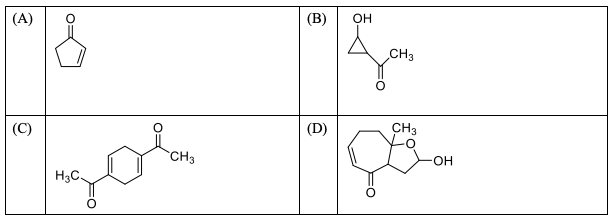
Solution
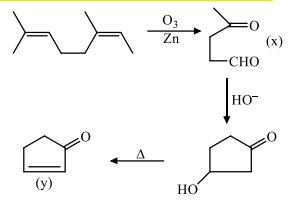
Step 1: Identify the structure of natural rubber. It is cis-1,4-polyisoprene with the repeat unit $-[\mathrm{CH_2-C(CH_3)=CH-CH_2}]-$.
Step 2: Reductive ozonolysis ($\mathrm{O_3, Zn/H_2O}$) cleaves each C=C, giving a carbonyl on each carbon of the former double bond. From the repeat unit this produces 4-oxopentanal: $\mathrm{CH_3{-}CO{-}CH_2{-}CH_2{-}CHO}$ — compound $X$.
Step 3: Verify the diagnostic tests.
- Iodoform test (positive): the methyl ketone group $\mathrm{CH_3{-}CO{-}R}$ in $X$ gives $\mathrm{CHI_3}$.
- Tollen's test (positive): the terminal aldehyde $-\mathrm{CHO}$ is oxidized to a carboxylate, producing a silver mirror.
Both tests confirm $X$ is 4-oxopentanal.
Step 4: Treat $X$ with aqueous $\mathrm{NaOH}$ — this is an intramolecular aldol condensation. The α-carbon between the two carbonyls is deprotonated; the resulting enolate attacks the aldehyde carbonyl intramolecularly. The β-hydroxy aldol intermediate then dehydrates on heating to give an α,β-unsaturated cyclic ketone.
Counting atoms: 5-carbon dicarbonyl → 5-membered ring with a single endocyclic C=C conjugated with the C=O. The product is cyclopent-2-en-1-one.
Therefore the answer is A.
Option Distractor Reasons
A 3-membered ring would arise only from a 1,3-dicarbonyl undergoing a different cyclization — not applicable for a 1,4-dicarbonyl like 4-oxopentanal.
An aromatic diketone implies dimerization with elaborate ring closures — not the major outcome of intramolecular aldol of a single dicarbonyl monomer.
A bicyclic hemiketal-type structure is not the major condensation product; the β-hydroxy aldol dehydrates on heating to the α,β-unsaturated enone.
Solution
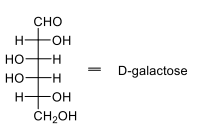
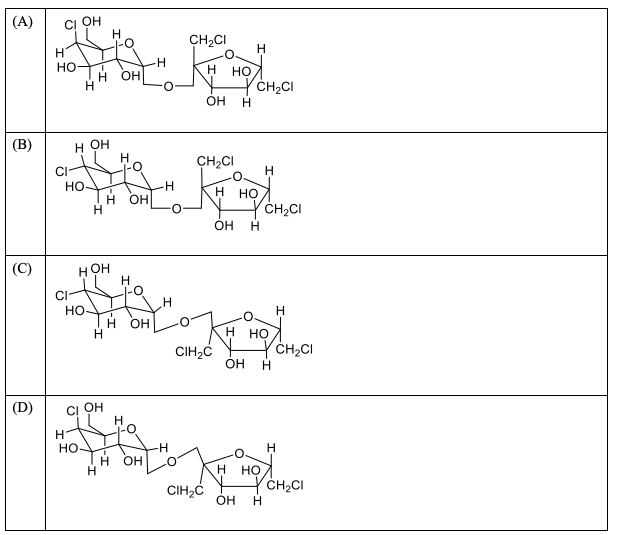
Step 1: Identify the sweetener. The artificial sweetener built from a chlorinated galactose joined to a dichlorinated fructose is sucralose.
Step 2: Place the chlorines.
- On the pyranose (galactose) ring: Cl replaces the OH at C4 ("4-chloro-4-deoxy").
- On the furanose (fructose) ring: Cl replaces the OH at C1 and at C6 ("1,6-dichloro-1,6-dideoxy").
Step 3: Set the stereochemistry. Sucrose has $\alpha$-D-glucose linked to $\beta$-D-fructose; sucralose differs from sucrose by inverting C4 of the glucose unit, converting glucose → galactose (C4 epimer). So the pyranose ring must show inverted C4 relative to glucose.
Only option A has: (i) the pyranose Cl at C4 with the galactose-type C4 epimerization, (ii) the furanose with $\mathrm{CH_2Cl}$ at C1 and at C6, and (iii) the $\alpha$,$\beta$-1,2-glycosidic linkage.
Therefore the answer is A.
Option Distractor Reasons
Retains the glucose configuration at C4 (does not perform the galactose epimerization), so the C4 stereochemistry is wrong.
Mislocates a chloromethyl group on the fructose: C2 is the anomeric carbon of fructose and bears the glycosidic O–link, not Cl. Only C1 and C6 are dichlorinated.
Keeps the glucose configuration on the pyranose ring instead of inverting C4 — gives the wrong sugar identity.
- This section contains FIVE (05) questions.
- Each question has FOUR options (A), (B), (C) and (D). ONE OR MORE THAN ONE are correct.
- Marking Scheme: Full +4, Partial +3/+2/+1 (rules apply), 0 for unanswered, −1 otherwise.
Solution
Step 1: Write the integrated and differential rate laws for $R \rightarrow P$ (first order in $R$).
\[ [R] = [R]_0\,e^{-kt}, \qquad [P] = [R]_0\,(1 - e^{-kt}) \]
\[ \dfrac{d[P]}{dt} = -\dfrac{d[R]}{dt} = k[R] = k[R]_0\,e^{-kt} \]
Step 2: Test each option.
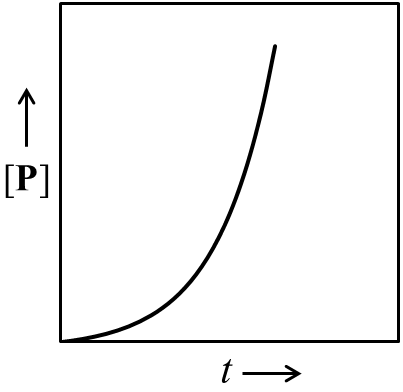
(A) $[P]$ vs $t$: $[P] = [R]_0(1 - e^{-kt})$ rises and plateaus at $[R]_0$ (concave-down, saturating). A concave-up unbounded curve is wrong.
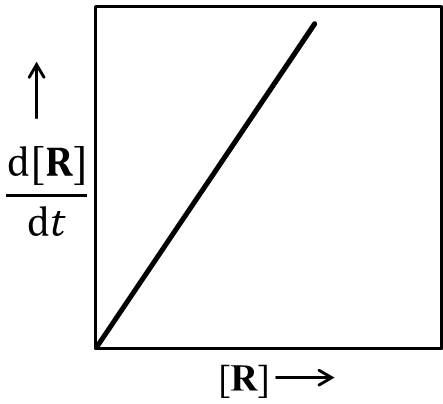
(B) $d[R]/dt$ vs $[R]$: $d[R]/dt = -k[R]$, a straight line through the origin with negative slope $-k$, not positive. Wrong.
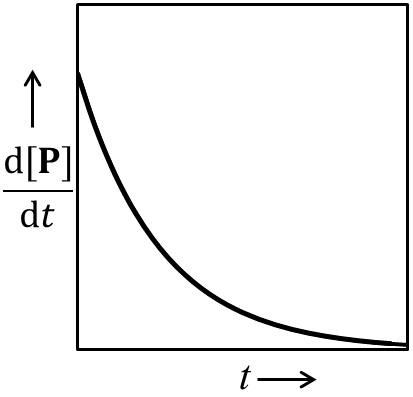
(C) $d[P]/dt$ vs $t$: $d[P]/dt = k[R]_0\,e^{-kt}$, which decays exponentially in $t$. Correct.
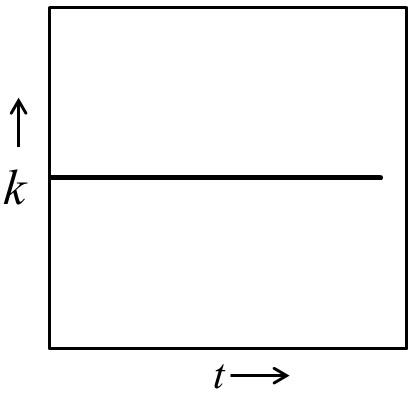
(D) $k$ vs $t$: for a given temperature, $k$ is a constant; the plot is a horizontal line. Correct.
Therefore the correct options are C and D.
Option Distractor Reasons
A student may sketch $[P]$ vs $t$ as concave-up unbounded growth (confusing it with autocatalysis); but for a closed first-order reaction, $[P]$ approaches $[R]_0$ asymptotically — concave-down saturation, not unbounded growth.
$d[R]/dt = -k[R]$ has a negative slope. A positive-slope plot ignores the consumption of $R$ (sign error).
\[ \mathrm{Xe(g) + F_2(g)} \xrightarrow[\text{1:5 ratio}]{\text{873 K, 7 bar}} P \] \[ P + \mathrm{O_2F_2} \xrightarrow{\,143\ \text{K}\,} Q + \mathrm{O_2} \] \[ Q + \mathrm{H_2O} \xrightarrow{\text{complete hydrolysis}} R + \mathrm{HF} \] Correct statement(s) about the compounds $P$, $Q$ and $R$ is(are)
Solution
Step 1: Identify $P$, $Q$, $R$.
- Xe + F$_2$ in 1:5 ratio at 873 K, 7 bar — this stoichiometry and condition gives XeF$_4$ as $P$. (A 1:20 Xe:F$_2$ ratio at higher pressure gives XeF$_6$, while 2:1 gives XeF$_2$.)
- $\mathrm{XeF_4 + O_2F_2} \xrightarrow{143\,K} \mathrm{XeF_6 + O_2}$, so $Q = $ XeF$_6$.
- Complete hydrolysis of XeF$_6$: $\mathrm{XeF_6 + 3H_2O \rightarrow XeO_3 + 6HF}$, so $R = $ XeO$_3$.
Step 2: Evaluate each statement.
(A) XeF$_4$ has two lone pairs on Xe. Xe (8 valence e$^-$) forms 4 bonds to F, using $sp^3d^2$ hybridization. Remaining lone pairs $= (8 - 4)/2 = 2$. Geometry is square planar. Correct.
(B) XeF$_6$ has perfect octahedral geometry. XeF$_6$ has seven electron domains (6 bonds + 1 lone pair) — it's $sp^3d^3$, distorted from a perfect octahedron (capped octahedron / distorted octahedral). Incorrect.
(C) XeF$_6$ can act as a fluorinating agent. XeF$_6$ is a powerful fluorinating agent (donates F to many substrates such as silicon, sulfur compounds, metal oxides). Correct.
(D) XeO$_3$ is trigonal pyramidal. Xe in XeO$_3$ has 3 bond pairs and 1 lone pair ($sp^3$, AX$_3$E), giving trigonal pyramidal geometry. Correct.
Therefore the correct options are A, C, D.
Option Distractor Reasons
Students often count only the six Xe–F bonds and conclude octahedral geometry, missing the stereochemically active lone pair on Xe that distorts XeF$_6$ from a regular octahedron (AX$_6$E).
Solution
(A) IE$_2$ of C vs IE$_2$ of B:
- B: $1s^2\,2s^2\,2p^1 \;\xrightarrow{\text{IE}_1}\; \mathrm{B}^+ : 1s^2\,2s^2$. IE$_2$ removes an electron from the stable $2s^2$ subshell.
- C: $1s^2\,2s^2\,2p^2 \;\xrightarrow{\text{IE}_1}\; \mathrm{C}^+ : 1s^2\,2s^2\,2p^1$. IE$_2$ removes an electron from the less penetrating $2p$ subshell.
Removing from a $2p$ orbital takes less energy than from a fully filled $2s$. So IE$_2$(C) < IE$_2$(B). Correct.
(B) Ionic radii Na$^+$, Mg$^{2+}$, Al$^{3+}$: all three are isoelectronic with Ne. For isoelectronic species, the cation with the highest nuclear charge has the smallest radius:
\[ \underbrace{\mathrm{Al^{3+}}}_{Z=13,\ \text{smallest}} \;<\; \mathrm{Mg^{2+}} \;<\; \underbrace{\mathrm{Na^{+}}}_{Z=11,\ \text{largest}} \]
Correct.
(C) Density of K vs Na (solids): K has a much larger atomic volume than Na (atomic radius increases down the group). Although K is heavier, its volume increases faster, so density actually decreases: $\rho(\mathrm{Na}) = 0.97$ g/cm$^3$, $\rho(\mathrm{K}) = 0.86$ g/cm$^3$. K is less dense than Na. Incorrect.
(D) H–H vs F–F bond strength: H–H bond enthalpy $\approx 436$ kJ/mol; F–F bond enthalpy $\approx 159$ kJ/mol (anomalously weak due to lone-pair repulsion on adjacent F atoms). H–H is stronger than F–F. Incorrect.
Therefore the correct options are A and B.
Option Distractor Reasons
A student may assume heavier atoms always give denser solids, missing the fact that atomic volume in group 1 increases faster than atomic mass from Na to K, so $\rho$(K) is actually less than $\rho$(Na).
Confuses bond-length trend with bond-strength trend: H–H is shorter than F–F, but H–H is also much stronger because F–F is destabilized by lone-pair repulsions across its short bond.
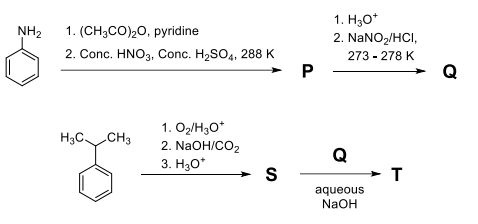
Solution
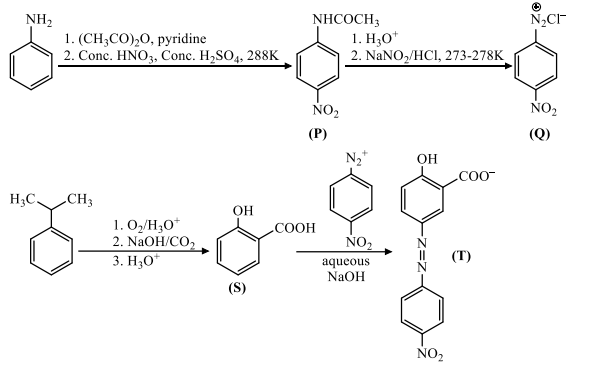
Step 1: Trace the synthesis of $P$ and $Q$.
- Aniline + (CH$_3$CO)$_2$O/pyridine → acetanilide (the acetyl group protects/deactivates the amine and is moderately para-directing).
- Acetanilide + conc. HNO$_3$/conc. H$_2$SO$_4$ at 288 K → 4-nitroacetanilide (para-major). So $P$ = 4-nitroacetanilide (one nitro group, not two).
- $P$ + H$_3$O$^+$ hydrolyzes off the acetyl group to give 4-nitroaniline; then NaNO$_2$/HCl at 273–278 K gives the diazonium salt 4-nitrobenzenediazonium chloride = $Q$.
Step 2: Trace $S$ (lower branch). Cumene + O$_2$/H$_3$O$^+$ is the Cumene Process → phenol + acetone. Phenol + NaOH/CO$_2$ (Kolbe–Schmitt) followed by H$_3$O$^+$ gives salicylic acid (2-hydroxybenzoic acid) = $S$.
Step 3: Coupling step. $Q$ (electrophilic diazonium cation) couples with the activated phenol/salicylic acid ring of $S$ in alkaline solution → azo dye $T$: 5-((4-nitrophenyl)diazenyl)-2-hydroxybenzoic acid. The extended conjugation across the diazo bridge makes $T$ a coloured compound.
Step 4: Evaluate each statement.
(A) $Q$ + ethanol → aromatic aldehyde? Diazonium salts with ethanol give Ar–H (reductive deamination) via radical mechanism, not an aromatic aldehyde. Incorrect.
(B) $S$ gives positive phthalein dye test. Salicylic acid heated with concentrated H$_2$SO$_4$ in the presence of resorcinol/phenol gives a coloured phthalein-type dye (fluorescein-type if resorcinol is used). The phthalein dye test relies on the γ-hydroxy carboxylic acid character of salicylic acid (or its ester capability). Correct.
(C) $P$ is a dinitro compound. At 288 K with conc. HNO$_3$/H$_2$SO$_4$, acetanilide gives mono-nitration (para). $P$ is mononitro, not dinitro. Incorrect.
(D) $T$ is coloured. The –N=N– azo linkage in $T$ with electron-donating (–OH) and electron-withdrawing (–NO$_2$, –COOH) substituents creates extensive conjugation, absorbing visible light. Azo dyes are paradigm colored compounds. Correct.
Therefore the correct options are B and D.
Option Distractor Reasons
A student may confuse ArN$_2^+$ + EtOH (which gives Ar–H + acetaldehyde via hydride transfer / radical loss of N$_2$) with the conversion to ArCHO. The aromatic product is ArH, not ArCHO.
Assuming forcing conditions automatically give polynitration ignores the deactivating effect of the first $-\mathrm{NO_2}$ and the mild temperature (288 K), under which only mononitration of acetanilide occurs.
Given: Specific rotations of L-(−)-glucose and L-(+)-fructose are $-52.5^{\circ}$ and $+92.5^{\circ}$, respectively.
Solution
(A) HNO$_3$ oxidation: Glucose itself is oxidized by dilute HNO$_3$ to saccharic acid (glucaric acid) — both –CHO and the primary $-\mathrm{CH_2OH}$ become –COOH. Gluconic acid (already a monocarboxylic acid from –CHO oxidation) is further oxidized at the primary –CH$_2$OH by HNO$_3$ also to saccharic acid. Hence the statement "glucose is not oxidized to saccharic acid" is incorrect.
(B) Fehling's test on fructose: Fructose has no free aldehyde, but in the alkaline Fehling's medium it undergoes Lobry de Bruyn–van Ekenstein rearrangement (enolization through an ene-diol intermediate) to give glucose and mannose, both aldohexoses, which reduce Cu$^{2+}$ to Cu$_2$O. So fructose does give a positive Fehling's test through this base-catalyzed isomerization. Correct.
(C) Invert sugar: Hydrolysis of sucrose by acid gives an equimolar mixture of D-glucose + D-fructose, called invert sugar. Correct.
(D) Specific rotation of invert sugar: Using the given data: $[\alpha]_{\mathrm{L-glucose}} = -52.5^{\circ} \Rightarrow [\alpha]_{\mathrm{D-glucose}} = +52.5^{\circ}$ (enantiomers have equal and opposite rotation). $[\alpha]_{\mathrm{L-fructose}} = +92.5^{\circ} \Rightarrow [\alpha]_{\mathrm{D-fructose}} = -92.5^{\circ}$.
For an equimolar mixture:
\[ [\alpha]_{\text{invert}} = \tfrac{1}{2}\!\left( +52.5^{\circ} + (-92.5^{\circ}) \right) = \tfrac{1}{2}(-40^{\circ}) = -20^{\circ} \]
Not $-40^{\circ}$. Incorrect.
Therefore the correct options are B and C.
Option Distractor Reasons
Wrongly asserts glucose isn't oxidized to saccharic acid. In fact, glucose + HNO$_3$ → saccharic acid is the canonical conversion that ablates both ends of the chain.
Misuses the given L-series rotations: forgets to flip the sign for D-fructose (the natural sugar), or omits the $\tfrac{1}{2}$ averaging factor. The correct answer is $-20^{\circ}$, not $-40^{\circ}$.
- This section contains FIVE (05) questions.
- The answer to each question is a numerical value; truncate to two decimal places if needed.
- Marking Scheme: +4 if correct, 0 otherwise.
Solution
Step 1: Apply the Rydberg-type formula for hydrogen-like species.
For $X^{a+}$ ($Z_1 = a+1$ for an atom that has lost $a$ electrons and remains H-like with one electron $\Rightarrow$ atomic number $= a+1$). Here "hydrogen-like" with charge $a+$ means $Z_1 = a+1$.
\[ \dfrac{1}{\lambda} = R Z_1^2 \left(\dfrac{1}{1^2} - \dfrac{1}{2^2}\right) = \dfrac{3}{4} R Z_1^2 \]
For $Y^{b+}$ with $Z_2 = b+1$:
\[ \dfrac{1}{9\lambda} = R Z_2^2 \left(\dfrac{1}{2^2} - \dfrac{1}{4^2}\right) = \dfrac{3}{16} R Z_2^2 \]
Step 2: Divide to eliminate $\lambda$ and $R$:
\[ \dfrac{1/\lambda}{1/(9\lambda)} = 9 = \dfrac{(3/4)Z_1^2}{(3/16)Z_2^2} = \dfrac{4 Z_1^2}{Z_2^2} \;\Rightarrow\; \dfrac{Z_2^2}{Z_1^2} = \dfrac{4}{9} \;\Rightarrow\; \dfrac{Z_2}{Z_1} = \dfrac{2}{3} \]
Step 3: The smallest integer pair with $Z_1:Z_2 = 3:2$ is $Z_1 = 3, Z_2 = 2$ (i.e., Li$^{2+}$ and He$^+$).
So $a = Z_1 - 1 = 2$ and $b = Z_2 - 1 = 1$, hence $a + b = \mathbf{3}$.
Given: molar mass of acetic acid $= 60$ g mol$^{-1}$; $K_a(\mathrm{CH_3COOH}) = 1.0\times 10^{-5}$ at the given temperature; $x$ is mass (g) of acid adsorbed; $m$ is mass (g) of charcoal; $C$ is the equilibrium concentration.
Solution
Step 1: Initial concentration of acetic acid.
\[ [\mathrm{CH_3COOH}]_0 = \dfrac{0.45/60}{50/1000} = \dfrac{0.0075}{0.05} = 0.15\ \text{M} \]
Step 2: Use pH and $K_a$ to find equilibrium concentration $C$ after adsorption.
At equilibrium, $\mathrm{[H^+]} = 10^{-3}\ \text{M}$. For a weak acid:
\[ K_a = \dfrac{[\mathrm{H^+}]^2}{C} \;\Rightarrow\; 10^{-5} = \dfrac{(10^{-3})^2}{C} \;\Rightarrow\; C = 10^{-1} = 0.1\ \text{M} \]
Step 3: Compute amount adsorbed.
Acid consumed by adsorption $= 0.15 - 0.10 = 0.05$ mol L$^{-1}$ in 50 mL:
\[ \text{moles adsorbed} = 0.05 \times \dfrac{50}{1000} = 0.0025\ \text{mol} \]
\[ x = 0.0025 \times 60 = 0.15\ \text{g} \]
With $m = 1.0$ g, $x/m = 0.15$.
Step 4: Slope of $\log(x/m)$ vs $\log C$ is $1/n = 1 \Rightarrow n = 1$. Then the Freundlich equation becomes $x/m = kC$:
\[ k = \dfrac{x/m}{C} = \dfrac{0.15}{0.1} = \mathbf{1.5}\ \text{L mol}^{-1} \]
Solution
Step 1: Compute $K_b$ from the thermodynamic data.
\[ K_b = \dfrac{R\,T_b^2\,M_S}{1000\,\Delta H_{\text{vap}}} = \dfrac{R\,(400)^2\,M_S}{1000 \cdot 10R} = \dfrac{160000 M_S}{10000} = 16 M_S \quad (\text{K kg mol}^{-1}) \]
Step 2: Set up the van't Hoff factor for $B \rightleftharpoons 2C + 2D$.
Starting with 1 mol of $B$, dissociation fraction $\alpha$: $(1-\alpha)$ mol $B$ + $2\alpha$ mol $C$ + $2\alpha$ mol $D$. Total moles $= 1 + 3\alpha$, so $i = 1 + 3\alpha$.
Step 3: Apply the boiling-point elevation equation $\Delta T_b = i\,K_b\,m$.
For a $0.25\%$ (m/m) solution, molality $m = \dfrac{0.25}{M_B \cdot 99.75 / 1000} \approx \dfrac{0.25 \times 1000}{M_B \cdot 100}$ (using $99.75 \approx 100$). With $M_B = 10 M_S$:
\[ m = \dfrac{0.25 \times 1000}{10 M_S \times 100} = \dfrac{0.25}{M_S} \quad (\text{mol kg}^{-1}) \]
$\Delta T_b = 408 - 400 = 8$ K. Substituting:
\[ 8 = (1 + 3\alpha) \cdot 16 M_S \cdot \dfrac{0.25}{M_S} = 4(1 + 3\alpha) \]
\[ 1 + 3\alpha = 2 \;\Rightarrow\; 3\alpha = 1 \;\Rightarrow\; \alpha = \dfrac{1}{3} \approx 0.3333 \]
The mole percent dissociated $= 100\alpha = \mathbf{33.33\%}$.
Solution
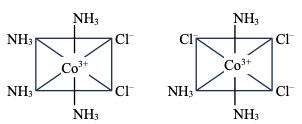
Step 1: Use the fact that an octahedron has 8 triangular faces, each defined by three mutually adjacent vertices. We need faces with exactly one N and two Cl at the corners.
Step 2: Count for cis-$[\mathrm{Co(NH_3)_4Cl_2}]^+$.
The two Cl ligands are at adjacent (cis) vertices; they share an edge. Each face containing this Cl–Cl edge is completed by one of the four NH$_3$ vertices. The two Cl's together with each of the two NH$_3$ ligands adjacent to both Cl's form valid (1 N, 2 Cl) faces — but actually, in an octahedron each edge bounds 2 triangular faces, and the Cl–Cl edge bounds exactly two such faces. Each face takes one NH$_3$ as its third corner. So 2 faces with exactly 1 N and 2 Cl.
Step 3: Count for mer-$[\mathrm{Co(NH_3)_3Cl_3}]$.
The three Cl ligands occupy a meridional arrangement (three of the four positions of one "great circle"; two are trans to each other and one is cis to both). The three Cl atoms form 3 Cl–Cl edges (specifically, the cis pairs; one pair is trans and shares no edge). Actually, in mer geometry, two of the Cl's are cis to a central Cl, and that central Cl shares edges with the two flanking Cl's. There are two Cl–Cl edges (the central Cl is bonded to both flanks; the outer two Cl's are trans to each other so they don't share an edge).
Each Cl–Cl edge bounds two triangular faces, and the third vertex of each such face is one of the three NH$_3$ ligands. By careful enumeration of the octahedral vertices, we get 4 faces with exactly 1 N and 2 Cl.
Step 4: Total $= 2 + 4 = \mathbf{6}$.
$\mathrm{CH_3I} \xrightarrow[\text{4. NH}_3\,\text{(excess)}]{\substack{\text{1. KCN} \\ \text{2. H}_3\mathrm{O}^+,\ \Delta \\ \text{3. Red P, Br}_2}} X$
$\text{Caprolactam} \xrightarrow[\Delta]{\mathrm{H_3O^+}} Y$
$500$ mol of $X$ completely reacts with $500$ mol of $Y$ to give $1$ mol of a single biodegradable acyclic copolymer $Z$. The amount of $Z$ formed in grams is ____.
Atomic masses (amu): H : 1, C : 12, N : 14, O : 16, Br : 80.
Solution
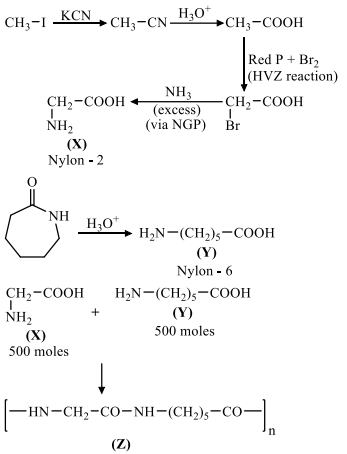
\[ \text{mass of } Z = 500(75) + 500(131) - 999(18) \]
\[ = 37500 + 65500 - 17982 = \mathbf{85018}\ \text{g} \]
- This section contains TWO (02) question stems.
- This section contains TWO (02) questions corresponding to each question stem.
- The answer to each question is a NUMERICAL VALUE.
- If the numerical value has more than two decimal places, truncate/round-off to TWO decimal places.
- Marking Scheme: +2, 0.
Two volatile liquids A and B form an ideal solution. Consider a 5 molal solution of B in A inside a closed container having a total vapour pressure of 100 mm Hg at 300 K. The vapour pressure of pure A at 300 K is 105 mm Hg. Assume that A and B behave as ideal gases in the vapour phase.
Given:
- Gas constant $R = 0.08$ L atm K$^{-1}$ mol$^{-1}$
- Molar mass of A is 50 g mol$^{-1}$
- Molar mass of B is 57 g mol$^{-1}$
- Density of liquid B at 300 K is 0.5 g/mL
- 1 atm = 760 mm Hg
Solution
Step 1 — Find $P_B^{\circ}$ from Raoult's law.
A 5-molal solution of B in A means 5 mol B per 1000 g of A. Moles of A in 1000 g $= 1000/50 = 20$ mol. Mole fractions: $x_A = 20/25 = 0.8$, $x_B = 5/25 = 0.2$.
Raoult's law:
\[ P_{\text{total}} = x_A P_A^{\circ} + x_B P_B^{\circ} \;\Rightarrow\; 100 = 0.8(105) + 0.2\,P_B^{\circ} \]
\[ 100 = 84 + 0.2\,P_B^{\circ} \;\Rightarrow\; P_B^{\circ} = 80 \text{ mm Hg} \]
Step 2 — Molar volume of pure B in liquid phase.
\[ V_{\ell} = \frac{M_B}{d_B} = \frac{57}{0.5} = 114 \text{ mL mol}^{-1} = 0.114 \text{ L mol}^{-1} \]
Step 3 — Molar volume of pure B in vapour phase (treated as an ideal gas at its own vapour pressure $P_B^{\circ} = 80$ mm Hg = $80/760$ atm at 300 K):
\[ V_g = \frac{RT}{P_B^{\circ}} = \frac{0.08 \times 300}{80/760} = \frac{24 \times 760}{80} = 228 \text{ L mol}^{-1} \]
Step 4 — Ratio:
\[ \frac{V_g}{V_{\ell}} = \frac{228}{0.114} = 2000 \]
Answer: 2000.
Solution
From the previous part, $x_B = 0.2$ in the liquid and $P_B^{\circ} = 80$ mm Hg. The partial pressure of B in the vapour above the solution is (Raoult's law):
\[ p_B = x_B \, P_B^{\circ} = 0.2 \times 80 = 16 \text{ mm Hg} \]
The mole fraction in the vapour phase ($y_B$) is given by Dalton's law:
\[ y_B = \frac{p_B}{P_{\text{total}}} = \frac{16}{100} = 0.16 \]
Answer: 0.16.
Consider the following reaction sequence in which J, K, L and M are the major products.
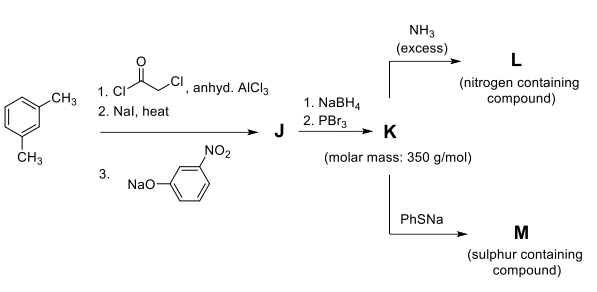
Given: Atomic mass (in amu): H : 1, C : 12, N : 14, O : 16, S : 32, Br : 80, Ba : 137
Solution
Step 1 — Identify K and L. The benzylic alcohol obtained after NaBH$_4$ reduction of the ketone in J is converted to a benzyl bromide K (molar mass 350 g/mol — consistent with a structure carrying the bromomethyl group plus the p-nitrophenoxymethyl substituent on the dimethylbenzene core). Treatment of K with excess NH$_3$ replaces –Br with –NH$_2$, giving the primary amine L. Each molecule of L carries one N atom.
Step 2 — Molar mass of L. Replacing –Br (80) in K (350) by –NH$_2$ (16) gives:
\[ M_L = 350 - 80 + 16 = 286 \text{ g mol}^{-1} \]
Step 3 — Moles of N in 5.72 g of L.
\[ n_L = \frac{5.72}{286} = 0.02 \text{ mol} \;\Rightarrow\; n_{\text{N}} = 0.02 \text{ mol} \]
All nitrogen is converted to NH$_3$ in Kjeldahl's method, so $n_{\text{NH}_3} = 0.02$ mol.
Step 4 — Acid–base titration. $\text{2NH}_3 + \text{H}_2\text{SO}_4 \to (\text{NH}_4)_2\text{SO}_4$, so milli-equivalents of acid = milli-equivalents of NH$_3$:
\[ V \times 1 \times 2 = 0.02 \times 1000 \;\Rightarrow\; V = \frac{20}{2} = 10 \text{ mL} \]
Answer: 10 mL.
Solution
Step 1 — Identify M. Reacting the benzyl bromide K with sodium thiophenolate (PhSNa) substitutes –Br with –SPh (a thioether), giving M with one S atom per molecule.
Step 2 — Molar mass of M. Replace –Br (80) in K (350) by –SPh (109):
\[ M_M = 350 - 80 + 109 = 379 \text{ g mol}^{-1} \]
Step 3 — Apply the Carius method. All sulphur in M is oxidised to sulphate and precipitated as BaSO$_4$. So $n_{\text{BaSO}_4} = n_S = n_M$.
\[ n_M = \frac{3.79}{379} = 0.01 \text{ mol} \;\Rightarrow\; n_{\text{BaSO}_4} = 0.01 \text{ mol} \]
Step 4 — Mass of BaSO$_4$ ($M = 137 + 32 + 64 = 233$ g mol$^{-1}$):
\[ m_{\text{BaSO}_4} = 0.01 \times 233 = 2.33 \text{ g} \]
Answer: 2.33 g.
- This section contains FOUR (04) questions.
- Each question has FOUR options (1), (2), (3) and (4). ONLY ONE is correct.
- Marking Scheme: +3, 0, -1.
[Take Avogadro's number as $6\times 10^{23}$ and charge of the electron as $1.6\times 10^{-19}$ C.]
Solution
Step 1 — Wire resistance. Using $R = \rho \ell / A = \ell/(\sigma A)$:
\[ R = \frac{100}{(2\times 10^8)(0.5\times 10^{-6})} = \frac{100}{100} = 1\;\Omega \]
Step 2 — Current through the wire.
\[ i = \frac{\varepsilon}{r + R} = \frac{2}{1 + 1} = 1\;\text{A} \]
Step 3 — Number density of free electrons (one conduction electron per atom):
\[ n = \frac{\rho\,N_A}{M} = \frac{(6.35\times 10^3)(6\times 10^{23})}{63.5\times 10^{-3}} = 6\times 10^{28} \;\text{m}^{-3} \]
Step 4 — Drift velocity from $i = neAv_d$:
\[ v_d = \frac{i}{neA} = \frac{1}{(6\times 10^{28})(1.6\times 10^{-19})(0.5\times 10^{-6})} \]
\[ v_d = \frac{1}{4.8\times 10^{3}} \approx 2.08\times 10^{-4}\;\text{m s}^{-1} = 0.208\;\text{mm s}^{-1} \]
Answer is (3).
Option Distractor Reasons
Comes from doubling the resistance (using $R = 2\;\Omega$ rather than $1\;\Omega$), giving $i = 0.5$ A and $v_d \approx 0.052$ mm/s.
Half of the correct answer — likely from using $R + r = 2\;\Omega$ correctly for current but mis-stating the number density by a factor of 2.
Arises from using $A = 0.5$ mm$^2$ but forgetting the $10^{-6}$ in the area conversion in one place, leading to an arithmetic slip near $0.156$.
Solution
Step 1 — Population balance for $N(t)$. Production at rate $\alpha$, decay at rate $\lambda N$:
\[ \frac{dN}{dt} = \alpha - \lambda N \]
Separating variables and integrating with $N(0)=0$:
\[ \int_0^N \frac{dN}{\alpha - \lambda N} = \int_0^t dt \;\Rightarrow\; N(t) = \frac{\alpha}{\lambda}\left(1 - e^{-\lambda t}\right) \]
Step 2 — Instantaneous decay rate. The rate at which $X$ nuclei decay (and hence the rate at which heat is released) is $\lambda N(t)$:
\[ \text{Rate of decay} = \lambda N(t) = \alpha\left(1 - e^{-\lambda t}\right) \]
Step 3 — Energy balance. Each decay releases $E_0$, all absorbed by the liquid ($ms\,dT$ per increment):
\[ ms\,\frac{dT}{dt} = \alpha\,E_0\left(1 - e^{-\lambda t}\right) \]
\[ \boxed{\;\frac{dT}{dt} = \frac{\alpha E_0}{ms}\left(1 - e^{-\lambda t}\right)\;} \]
Answer is (1).
Option Distractor Reasons
Sign / sign-of-exponent error in solving the ODE — gives an exponentially growing rate, which is unphysical (the system must saturate as $t\to\infty$).
Uses $\lambda$ in place of $\alpha$ as the prefactor — confusing the production rate with the decay constant. Dimensionally similar but physically distinct.
Mismatched expression — the bracket $\alpha - \lambda e^{-\lambda t}$ has inconsistent dimensions ($\alpha$ has units of [time$^{-1}$], same as $\lambda$, but the combination doesn't reduce to a saturation form).
Solution
Step 1 — Deviation through a thin prism: $D = (n-1)A$. With the given dispersion law:
\[ D(\lambda) = \left(\alpha\lambda + \frac{\beta}{\lambda^2} - 1\right) A \]
Step 2 — Minimise $D$ with respect to $\lambda$.
\[ \frac{dD}{d\lambda} = \left(\alpha - \frac{2\beta}{\lambda^3}\right) A = 0 \;\Rightarrow\; \lambda^3 = \frac{2\beta}{\alpha} = \frac{2(0.096)}{3} = 0.064 \]
\[ \lambda_{\min} = (0.064)^{1/3} = 0.4\;\mu\text{m} \]
Step 3 — Compute $D_m$ at $\lambda_{\min} = 0.4\;\mu$m:
\[ n(\lambda_{\min}) = 3(0.4) + \frac{0.096}{0.16} = 1.2 + 0.6 = 1.8 \]
\[ D_m = (1.8 - 1)(6^\circ) = 0.8 \times 6^\circ = 4.8^\circ \]
Answer is (2).
Option Distractor Reasons
Comes from forgetting to subtract 1 in $D = (n-1)A$ — i.e., using $D = n\cdot A$ with $n \approx 1.067$ scaled wrongly.
Arises from setting $dn/d\lambda = 0$ correctly but using only one of the two terms (e.g., $n = \alpha\lambda$ giving $n = 1.2$, hence $D = 0.2\cdot 6 = 1.2^\circ$, then doubling).
Results from a factor-of-2 algebra slip in $\lambda^3 = 2\beta/\alpha$ giving wrong $\lambda_{\min}$ and thus a smaller value of $n$.
Solution
Step 1 — Effective radial force in the rotating frame. With angular momentum $\ell$ conserved, $v = \ell/(mr)$ in the tangential direction. The effective radial force on the particle is:
\[ F_{\text{eff}}(r) = -\frac{k}{r^2} + \frac{\ell^2}{mr^3} \]
(centripetal term is $mv^2/r = \ell^2/(mr^3)$, outward in rotating frame).
Step 2 — Equilibrium radius. At $r = r_0$, $F_{\text{eff}}(r_0) = 0$:
\[ \frac{k}{r_0^2} = \frac{\ell^2}{mr_0^3} \;\Rightarrow\; r_0 = \frac{\ell^2}{mk} \]
Step 3 — Restoring force for small radial displacement $x = r - r_0$. Expand to first order in $x$:
\[ F_{\text{eff}}(r_0+x) \approx \frac{dF_{\text{eff}}}{dr}\bigg|_{r_0} x = \left(\frac{2k}{r_0^3} - \frac{3\ell^2}{mr_0^4}\right)x \]
Substituting $\ell^2/m = kr_0$ gives $3\ell^2/(mr_0^4) = 3k/r_0^3$, so:
\[ F_{\text{eff}} \approx \left(\frac{2k}{r_0^3} - \frac{3k}{r_0^3}\right) x = -\frac{k}{r_0^3}\,x \]
Step 4 — SHM. Comparing with $m\ddot{x} = -m\omega^2 x$:
\[ \omega^2 = \frac{k}{mr_0^3} = \frac{k}{m}\cdot\frac{m^3k^3}{\ell^6} = \frac{m^2 k^4}{\ell^6} \]
\[ \omega = \frac{mk^2}{\ell^3} \;\Rightarrow\; T = \frac{2\pi}{\omega} = \frac{2\pi\ell^3}{mk^2} \]
Answer is (1).
Option Distractor Reasons
$2\pi\sqrt{m/k}$ has the wrong dimensions for this problem (would only be correct if $k$ had units of force/length, i.e., a Hooke's-law constant). The Coulomb-like $k$ here has different dimensions.
Arises from using $3\ell^2/(mr^4) - 2k/r^3$ instead of $2k/r^3 - 3\ell^2/(mr^4)$ in the linearisation (sign confusion → spurious factor of 3).
Results from combining $2k/r^3 + 3\ell^2/(mr^4)$ (sign error) and substituting equilibrium, producing a factor of 5 in the denominator.
- This section contains FIVE (05) questions.
- Each question has FOUR options (1), (2), (3) and (4). ONE OR MORE THAN ONE may be correct.
- Marking Scheme: +4 / partial +1/+2/+3 / 0 / -1.
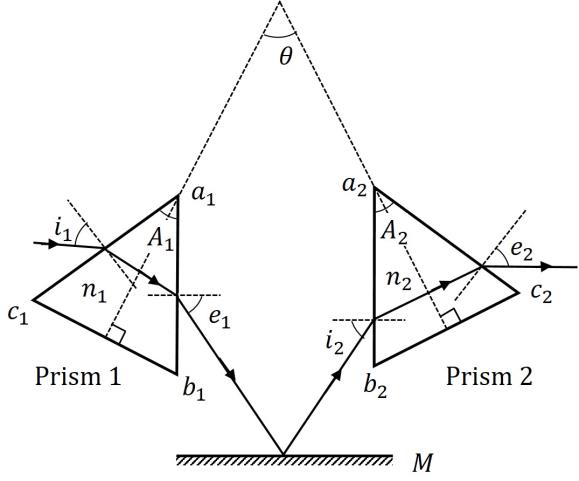
Solution
Setup. At minimum deviation of an isosceles prism, $i = e$ and $r = A/2$, so Snell's law at the entry face gives $\sin i = n\sin(A/2)$.
For prism 1 (at minimum deviation):
\[ \sin i_1 = n_1 \sin(A_1/2) \quad (\text{eqn 1}) \]
For prism 2 (at minimum deviation):
\[ \sin i_2 = n_2 \sin(A_2/2) \quad (\text{eqn 2}) \]
The reflection at mirror $M$ between the two prisms imposes equal angle of incidence and reflection. Combined with the geometric constraint that faces $a_1b_1 \parallel a_2b_2 \perp M$, one obtains $\angle e_1 = \angle i_2$ and (by the symmetry of the prisms) $i_1 = i_2$ for this configuration.
Check option (1): Dividing eqn (2) by eqn (1) at minimum deviation:
\[ \frac{n_2 \sin(A_2/2)}{n_1 \sin(A_1/2)} = \frac{\sin i_2}{\sin i_1} = 1 \;\Rightarrow\; \frac{n_2}{n_1} = \frac{\sin(A_1/2)}{\sin(A_2/2)} \;\checkmark \]
Check option (4): If prism 1 is at minimum deviation, eqn (1) holds and $i_1 = i_2$, so $\sin i_2 = \sin i_1 = n_1\sin(A_1/2)$. $\checkmark$
Check option (2): If prism 2 is at minimum deviation, $\sin i_2 = n_2\sin(A_2/2)$. From $i_1 = i_2$, $\sin i_1 = n_2\sin(A_2/2)$. The claim is consistent only if both prisms are simultaneously at minimum deviation; otherwise it does not always hold. Not always true, so (2) is rejected.
Check option (3): From the pentagon-angle constraint of the geometry, $A_1 + A_2 = 2\theta$ (where $\theta$ is the angle between the two non-base faces meeting through the mirror plane). For thin prisms at minimum deviation, $\delta_m = (n-1)A$, so $A = \delta_m / (n-1)$. Substituting:
\[ 2\theta = A_1 + A_2 = \frac{\delta_{m1}}{n_1 - 1} + \frac{\delta_{m2}}{n_2 - 1} \;\Rightarrow\; \theta = \frac{\delta_{m1}}{2(n_1-1)} + \frac{\delta_{m2}}{2(n_2-1)} \;\checkmark \]
Correct options: (1), (3), (4).
Solution
Setup. $q = 10^{-6}$ C, $m = 10^{-6}$ kg, $\vec{u} = \hat{i} + 2\hat{j}$ m/s, $\vec{E} = \hat{i}$ V/m (for $0 \le t \le 0.2$ s), $\vec{g} = -10\hat{j}$ m/s².
Phase 1 ($0 \le t \le 0.2$ s): Forces give $a_x = qE/m = 1$ m/s² (along +x) and $a_y = -10$ m/s² (gravity).
- $v_y = 2 - 10t$. Vertical velocity vanishes at $T = 0.2$ s — exactly when the field switches.
- Maximum height above $XZ$ plane: $H_{\max} = u_y^2/(2|a_y|) = 4/20 = 0.2$ m $= 20$ cm.
- At $t = 0.2$ s: $v_x = 1 + 1(0.2) = 1.2$ m/s, $v_y = 0$. So $\vec{v}(0.2) = 1.2\hat{i}$ m/s.
Phase 2 ($t > 0.2$ s): $\vec{E} = 0$, $\vec{B} = 6\hat{j}$ T. The magnetic force on the velocity component along $\hat{i}$ is:
\[ \vec{F}_{\text{mag}} = q\vec{v}\times\vec{B} = 10^{-6}(1.2\hat{i})\times(6\hat{j}) = 7.2\times 10^{-6}\hat{k} \;\text{N} \]
This force is in the $XZ$ plane, perpendicular to the $y$-axis. Meanwhile gravity continues to act along $-\hat{j}$.
Option (1) — Position at $t = 0.3$ s (i.e., $\Delta t = 0.1$ s after $t = 0.2$ s):
The particle starts at height $y = 20$ cm with $v_y = 0$; under gravity alone (the $\vec{v}\times\vec{B}$ force has no $\hat{j}$ component initially):
\[ \Delta y = -\tfrac{1}{2}g(\Delta t)^2 = -\tfrac{1}{2}(10)(0.1)^2 = -0.05\;\text{m} = -5\;\text{cm} \]
Height at $t = 0.3$ s: $20 - 5 = 15$ cm. Correct. ✓
Option (2) — Position at $t = 0.4$ s ($\Delta t = 0.2$ s after switching):
\[ \Delta y = -\tfrac{1}{2}(10)(0.2)^2 = -0.2\;\text{m} = -20\;\text{cm} \]
The particle drops back to $XZ$ plane, height $= 0$ cm, not 10 cm. Incorrect.
Option (3) — Radius of trajectory: The radius of the helix traced in the $XZ$ plane by the magnetic force on $v_\perp$ is:
\[ R = \frac{m v_\perp}{qB} = \frac{(10^{-6})(1.2)}{(10^{-6})(6)} = 0.2\;\text{m} = 20\;\text{cm} \]
However, the full trajectory is a helix superimposed with a parabolic fall in $y$ — it is not a simple circle. So "radius of the trajectory" being exactly 20 cm is ambiguous. (Strictly, only the helix radius is 20 cm; the trajectory itself is not closed.) Per the official key, (3) is not marked correct, but (1) is the unambiguous correct option.
Option (4): The particle returns to the $XZ$ plane when $\Delta y = -0.2$ m, i.e. at $\Delta t = 0.2$ s after the switch — at $t = 0.4$ s, not 0.35 s. Incorrect.
Final answer: (1).
Solution
Set-up. $|V_1| = |V_2|$ gives:
\[ \frac{|q|}{r_1} = \frac{|mq|}{r_2} \;\Rightarrow\; \frac{r_2}{r_1} = |m| \;\Rightarrow\; r_2^2 = m^2 r_1^2 \]
With $r_1^2 = (x-a)^2 + (y-b)^2$ and $r_2^2 = (x-ma)^2 + (y-mb)^2$, squaring:
\[ (x-ma)^2 + (y-mb)^2 = m^2[(x-a)^2 + (y-b)^2] \quad (*) \]
Option (1) — $m = -1$: $m^2 = 1$. (*) becomes:
\[ (x+a)^2 + (y+b)^2 = (x-a)^2 + (y-b)^2 \;\Rightarrow\; 4ax + 4by = 0 \;\Rightarrow\; ax + by = 0 \;\checkmark \]
Option (2) — $m = 2$: (*) gives:
\[ (x-2a)^2 + (y-2b)^2 = 4\left[(x-a)^2 + (y-b)^2\right] \]
Expanding and simplifying:
\[ 3x^2 + 3y^2 - 4ax - 4by = 0 \;\Rightarrow\; x^2 + y^2 - \tfrac{4}{3}ax - \tfrac{4}{3}by = 0 \]
This is a circle: centre $\left(\dfrac{2a}{3}, \dfrac{2b}{3}\right)$, radius $\sqrt{\dfrac{4a^2}{9} + \dfrac{4b^2}{9}} = \dfrac{2}{3}\sqrt{a^2+b^2}$. $\checkmark$
Option (3) — $m = -2$: (*) gives:
\[ (x+2a)^2 + (y+2b)^2 = 4\left[(x-a)^2 + (y-b)^2\right] \]
Expanding:
\[ 3x^2 + 3y^2 - 12ax - 12by = 0 \;\Rightarrow\; x^2 + y^2 - 4ax - 4by = 0 \]
Circle: centre $(2a, 2b)$, radius $\sqrt{4a^2 + 4b^2} = 2\sqrt{a^2+b^2}$. $\checkmark$
Option (4) — $m = -3$: Similar algebra gives a circle (not a line). The locus is not $3bx + 3ay = 0$. Incorrect.
Correct options: (1), (2), (3).
Solution
Setup. Dipole moment $\vec{p} = qd\hat{i}$. Moment of inertia about CM: $I = 2m(d/2)^2 = md^2/2$.
Option (1): The total electric force on the dipole in a uniform field is $+qE\hat{j} + (-q)E\hat{j} = 0$. So $\vec{F}_{\text{net}} = 0$ on the CM, hence the CM does not deflect. Incorrect.
Options (2) & (3) — Energy conservation. Initially $\vec{p} \parallel \hat{i}$, $\vec{E} \parallel \hat{j}$, so $\theta_i = \pi/2$ between $\vec{p}$ and $\vec{E}$, and $U_i = -pE\cos(\pi/2) = 0$. After rotation by $\theta_f$ from $\hat{i}$, the angle between $\vec{p}$ and $\vec{E}$ is $\pi/2 - \theta_f$, so $U_f = -pE\cos(\pi/2 - \theta_f) = -pE\sin\theta_f$.
\[ K_f - K_i = -\Delta U = pE\sin\theta_f = qEd\sin\theta_f \]
Also $K_f = \tfrac{1}{2}I\omega_f^2 = \tfrac{1}{4}md^2\omega_f^2$. Hence:
\[ \omega_f^2 = \frac{4qE\sin\theta_f}{md} \]
Check (2): $\omega_f = \sqrt{2qE/(md)}$ gives $\omega_f^2 = 2qE/(md)$, so $\sin\theta_f = 1/2 \Rightarrow \theta_f = \pi/6$. $\checkmark$
Check (3): $\theta_f = \pi/3 \Rightarrow \Delta K = qEd\sin(\pi/3) = qEd\cdot\sqrt{3}/2$, not $2\sqrt{3}\,qEd$. Incorrect.
Check (4): When the field is switched off at $t = t_f$, no torque acts on the dipole, so angular momentum is conserved and the dipole continues rotating about its CM with constant angular velocity. This is independent of $\theta_f$, so it's correct for any $\theta_f$ — in particular $\pi/4$. $\checkmark$
Correct options: (2), (4).
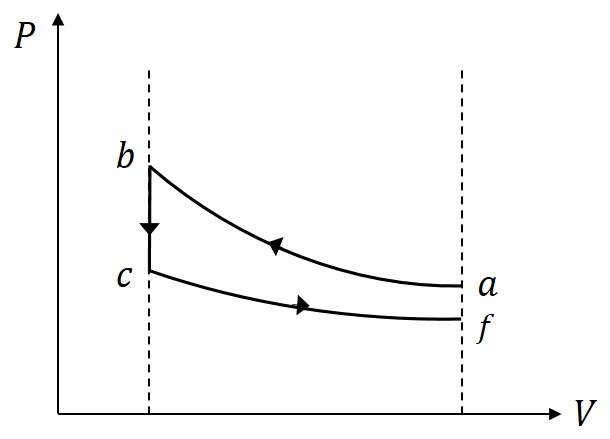
Solution
Setup. Monoatomic gas: $\gamma = 5/3$, $\gamma - 1 = 2/3$, $C_v = 3R/2$. $n = 10$ mol, $T_a = 300$ K.
Process classification:
- a → b: sudden compression → adiabatic.
- b → c: piston fixed, cylinder in water bath → isochoric cooling to 284 K.
- c → f: slow, in the water bath → isothermal expansion at 284 K.
Temperature at b (adiabatic compression $V_0 \to V_0/3$):
\[ T_b = T_a\left(\frac{V_0}{V_0/3}\right)^{\gamma - 1} = 300 \cdot 3^{2/3} = 300\cdot 9^{1/3} = 300(2.08) = 624\;\text{K} \;\checkmark \]
Pressure at b: $P_b = P_a(V_a/V_b)^{\gamma} = P_a\cdot 3^{5/3}$. Now $3^{5/3} = 3 \cdot 3^{2/3} = 3 \cdot 2.08 = 6.24$, not $2.08$. So option (4) is incorrect (it claims $P_b = 2.08\,P_a$ which is the ratio $T_b/T_a$, not the pressure ratio).
Option (2) — $\Delta U_{a\to b}$:
\[ \Delta U = nC_v\Delta T = 10 \cdot \frac{3R}{2}(624 - 300) = 15R \cdot 324 = 4860R \;\checkmark \]
Option (3) — Net $\Delta U_{a\to f}$: $\Delta U$ depends only on $\Delta T$. Initial $T_a = 300$ K, final $T_f = T_c = 284$ K.
\[ \Delta U_{\text{net}} = nC_v(T_f - T_a) = 10\cdot\frac{3R}{2}(284 - 300) = 15R(-16) = -240R \;\checkmark \]
Option (1) — The P-V diagram correctly shows the three labelled processes (steep adiabat, vertical isochore, less-steep isotherm). $\checkmark$
Correct options: (1), (2), (3).
- This section contains FIVE (05) questions.
- The answer to each question is a NUMERICAL VALUE.
- If the numerical value has more than two decimal places, truncate/round-off to TWO decimal places.
- Marking Scheme: +4, 0.
| LS (mm) | CS | |
|---|---|---|
| Wire-1 | 0.5 | 42 |
| Wire-2 | 1.5 | 95 |
Solution
Step 1 — Least count (LC) of screw gauge:
\[ \text{LC} = \frac{\text{Pitch}}{\text{No. of CS divisions}} = \frac{0.5}{100} = 0.005\;\text{mm} \]
Step 2 — Zero error from Wire-1 (known diameter = 0.650 mm):
True diameter = LS + CS × LC − (zero error $z$).
\[ 0.650 = 0.5 + 42(0.005) - z \;\Rightarrow\; 0.650 = 0.710 - z \;\Rightarrow\; z = 0.060\;\text{mm} \]
Step 3 — Apply the same correction to Wire-2:
\[ d = 1.5 + 95(0.005) - 0.060 = 1.5 + 0.475 - 0.060 = 1.915\;\text{mm} \]
Converting to micrometres: $d = 1915\;\mu$m.
Answer: 1915.
[Given: $\sin(2^\circ) = 0.035$]
Solution
Condition for first minimum: $a\sin\theta = \lambda$.
Fractional error propagation (taking logarithmic differential):
\[ \ln\lambda = \ln a + \ln(\sin\theta) \;\Rightarrow\; \frac{\Delta\lambda}{\lambda} = \frac{\Delta a}{a} + \frac{|\Delta(\sin\theta)|}{\sin\theta} = \frac{\Delta a}{a} + \cot\theta\,\Delta\theta \]
Substitute values:
- $\Delta a / a = 0.002/0.016 = 1/8 = 0.125$
- $\Delta\theta = 40' = (40/60)^\circ \approx 0.667^\circ = 0.0116$ rad. Using the PDF's convention $40' \approx 0.012$ rad.
- $\sin(2^\circ) = 0.035$, $\cos(2^\circ) \approx 1$.
- $\cot\theta\,\Delta\theta = (1/0.035)(0.012) = 0.343$
\[ \frac{\Delta\lambda}{\lambda} = 0.125 + 0.343 = 0.468 \approx 0.47 \]
(With $\Delta\theta = 0.0116$ rad: $0.125 + 0.331 \approx 0.456 \approx 0.46$.)
Answer: 0.46 (or 0.47 depending on rounding).
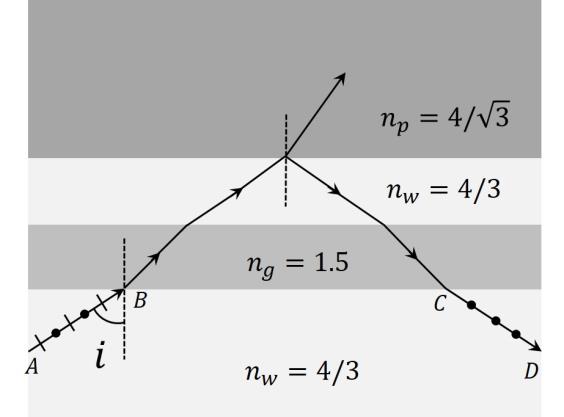
Solution
Polarization by reflection requires the light at the topmost interface (water → medium $n_p$) to strike at Brewster's angle $\theta_B$ for that interface:
\[ \tan\theta_B = \frac{n_p}{n_w} = \frac{4/\sqrt{3}}{4/3} = \frac{4}{\sqrt{3}}\cdot\frac{3}{4} = \sqrt{3} \;\Rightarrow\; \theta_B = 60^\circ \]
Trace back to the bottom water layer. Note that the bottom and top water layers have the same refractive index. Snell's law applied to the layered system gives:
\[ n_w\sin i = n_g\sin r_g = n_w\sin\theta_B \]
(Intermediate angles in glass cancel because the second water layer restores the same medium as the first.) So:
\[ \sin i = \sin\theta_B \;\Rightarrow\; i = 60^\circ \]
Answer: 60°.
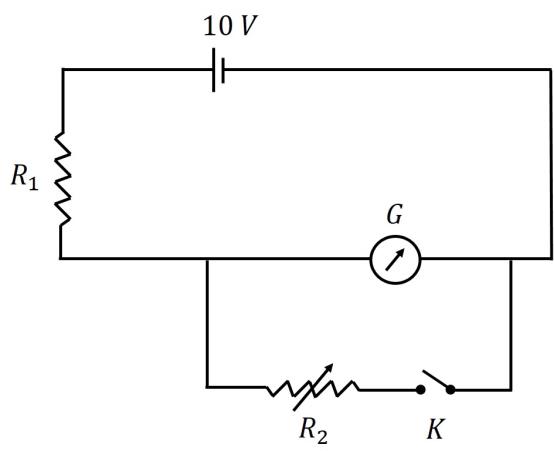
Solution
Setup from the half-deflection principle. When the key $K$ is open, all current $i$ flows through $G$: $i = 10/(R_1 + R_g)$. When $K$ is closed, current through $G$ drops to $i/2$ (half-deflection), and the other half flows through $R_2$. Standard derivation gives $R_g = R_2$ when $R_1 \gg R_g$ — but here $R_1$ is comparable, so use the full result $R_g = R_1 R_2/(R_1 - R_2)$ … or simply re-derive.
Step 1 — Find $R_1$ from the given conditions. Open-key current $i$ and closed-key current through $R_1$ (call it $i_1$) satisfy:
\[ i = \frac{10}{R_1 + 6} \quad (\text{open}) \]
With $K$ closed, $G$ and $R_2 = 4\;\Omega$ are in parallel. Galvanometer current $= i/2$, so current through $R_2$ is $i_2$ where $\dfrac{i_2}{i/2} = \dfrac{R_g}{R_2} = \dfrac{6}{4}$, giving $i_2 = 3i/4$. Total $i_1 = i/2 + 3i/4 = 5i/4$.
Also $i_1 = \dfrac{10}{R_1 + R_{\text{parallel}}}$ where $R_{\text{parallel}} = (6)(4)/(6+4) = 2.4\;\Omega$. So:
\[ \frac{5i}{4} = \frac{10}{R_1 + 2.4} \quad\text{and}\quad i = \frac{10}{R_1 + 6} \]
Dividing: $\dfrac{4}{5} = \dfrac{R_1 + 2.4}{R_1 + 6}$, which gives $4(R_1 + 6) = 5(R_1 + 2.4) \Rightarrow R_1 = 12\;\Omega$.
Step 2 — Current through $R_1$ in half-deflection state:
\[ i_1 = \frac{10}{R_1 + 2.4} = \frac{10}{14.4} = 0.6944\;\text{A} = 694.44\;\text{mA} \]
Answer: 694.44 mA.
Solution
Step 1 — Dimensions of $\sqrt{\mu_0/\epsilon_0}$: This is the impedance of free space (the "ohm-like" quantity), with SI units of $\Omega$. In base SI:
\[ \sqrt{\frac{\mu_0}{\epsilon_0}} = \frac{1}{c\,\epsilon_0} \;\;\text{has units}\;\; \frac{\text{kg}\cdot\text{m}^2}{\text{A}^2\cdot\text{s}^3} \]
Step 2 — Express 1 SI unit in the new system. Let the new units be primed: $1\;\text{kg}' = 5$ kg, $1\;\text{m}' = 5$ m, $1\;\text{s}' = 5$ s, $1\;\text{A}' = 5$ A. So:
\[ 1\;\text{kg}\cdot\text{m}^2\cdot\text{A}^{-2}\cdot\text{s}^{-3} = \frac{(1\;\text{kg})(1\;\text{m})^2}{(1\;\text{A})^2(1\;\text{s})^3} = \frac{(\text{kg}'/5)(\text{m}'/5)^2}{(\text{A}'/5)^2 (\text{s}'/5)^3} \]
\[ = \frac{1}{5}\cdot\frac{1}{25}\cdot 25 \cdot 125 \;\;\text{(new units)} = \frac{125}{5} = 25 \;\text{(new units)} \]
Numerical value $N \cdot \text{(unit)} = \text{const}$, so if the new unit is $1/25$ of the SI one, the new numerical value is 25 times the SI value. Hence 1 SI unit of $\sqrt{\mu_0/\epsilon_0}$ corresponds to 25 new units.
Answer: 25.
- This section contains TWO (02) question stems.
- This section contains TWO (02) questions corresponding to each question stem.
- The answer to each question is a NUMERICAL VALUE.
- If the numerical value has more than two decimal places, truncate/round-off to TWO decimal places.
- Marking Scheme: +2, 0.
A container of height 2 m, length 2 m and breadth 1 m is made of insulating vertical walls and two large area horizontal metal plates ($M_1$ and $M_2$) which extend far beyond the vertical walls in all directions. The container is partitioned into two equal chambers (each 1 m wide) with a thin insulating vertical wall. The partition wall contains a small hole of cross-sectional area $\sqrt{10}\;\text{cm}^2$ near its bottom edge. Initially the hole is closed and the left chamber is completely filled with a liquid of dielectric constant $\epsilon_r = 15$, and the right chamber is empty ($\epsilon_r = 1$). At time $t = 0$, the hole is opened and the liquid flows from the left to the right chamber. In both chambers, the space above the liquid has $\epsilon_r = 1$ at atmospheric pressure.
Given: $g = 10\;\text{ms}^{-2}$.
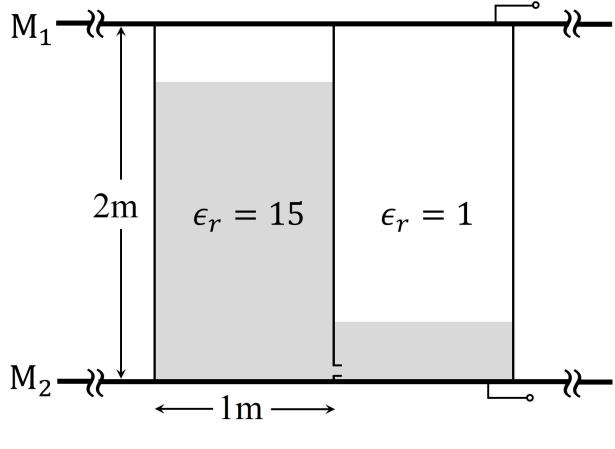
Solution
Setup. Initially left chamber is full (liquid height 2 m, volume $1\cdot 1\cdot 2 = 2$ m³). As liquid flows through the hole, let $h$ be the height in the right chamber at time $t$. By volume conservation (cross-sections of both chambers $= 1$ m² each), the left chamber's height is $2 - h$.
Bernoulli + continuity. Atmospheric pressure acts on both free surfaces. The pressure head driving flow through the hole is the height difference $\Delta H = (2-h) - h = 2 - 2h$ (when liquid in right reaches level $h$). Hence the efflux velocity through the hole:
\[ v = \sqrt{2g\,\Delta H} = \sqrt{2g(2 - 2h)} = \sqrt{4g(1-h)} \]
The volume flow rate equals $a\,v$ where $a = \sqrt{10}\times 10^{-4}$ m². For the right chamber of base area $A = 1$ m²:
\[ \frac{dh}{dt} = \frac{a\,v}{A} = \sqrt{10}\times 10^{-4}\cdot\sqrt{4g(1-h)} = 2\sqrt{10}\times 10^{-4}\cdot\sqrt{g(1-h)} \]
With $g = 10$: $\sqrt{g(1-h)} = \sqrt{10}\sqrt{1-h}$, so:
\[ \frac{dh}{dt} = 2\sqrt{10}\times 10^{-4}\cdot\sqrt{10}\sqrt{1-h} = 20\times 10^{-4}\sqrt{1-h} = 2\times 10^{-3}\sqrt{1-h} \]
Integrate with $h(0) = 0$:
\[ \int_0^h \frac{dh'}{\sqrt{1-h'}} = 2\times 10^{-3}\,t \;\Rightarrow\; -2[\sqrt{1-h'}]_0^h = 2\times 10^{-3}\,t \]
\[ 1 - \sqrt{1-h} = 10^{-3}\,t \]
At $t = 500$ s: $1 - \sqrt{1-h} = 0.5 \Rightarrow \sqrt{1-h} = 0.5 \Rightarrow h = 0.75$ m.
But the question asks for the height in the right chamber at the configuration where the levels in both chambers — and the dielectric distributions — match the figure. The total liquid volume is conserved at 2 m³, so liquid in right + liquid in left = 2 m. With $h_{\text{right}} = 0.75$ m, the height of liquid in the left chamber is $2 - 0.75 = 1.25$ m.
Per the official key, the answer (height of liquid in the right portion of the figure-labelled chamber) is 1.25 m.
Solution
Initial capacitance (at $t = 0$). The left chamber (cross-section area $A = 1$ m²) is filled with $\epsilon_r = 15$ between two metal plates 2 m apart; the right chamber ($A = 1$ m²) has $\epsilon_r = 1$ over the same plate separation. The two capacitors are in parallel (sharing the same top and bottom plates):
\[ C_0 = \frac{\epsilon_r A\epsilon_0}{d} + \frac{A\epsilon_0}{d} = \frac{15\cdot 1\cdot\epsilon_0}{2} + \frac{1\cdot\epsilon_0}{2} = \frac{16\epsilon_0}{2} = 8\epsilon_0 \]
At $t = 500$ s. From Q15, liquid in left = 1.25 m (with $\epsilon_r = 15$), air above = 0.75 m ($\epsilon_r = 1$); liquid in right = 0.75 m ($\epsilon_r = 15$), air above = 1.25 m ($\epsilon_r = 1$). Each chamber now has two dielectrics stacked between the same metal plates — they act as two capacitors in series per chamber, and the two chambers are still in parallel.
Left chamber series stack ($A = 1$ m²):
\[ C_1 = \frac{A\epsilon_0}{0.75},\quad C_2 = \frac{15 A\epsilon_0}{1.25} \]
\[ \frac{1}{C_{\text{left}}} = \frac{0.75}{A\epsilon_0} + \frac{1.25}{15 A\epsilon_0} = \frac{0.75\cdot 15 + 1.25}{15 A\epsilon_0} = \frac{11.25 + 1.25}{15\epsilon_0} = \frac{12.5}{15\epsilon_0} \]
\[ C_{\text{left}} = \frac{15\epsilon_0}{12.5} = 1.20\,\epsilon_0 \]
Right chamber series stack:
\[ C_3 = \frac{A\epsilon_0}{1.25},\quad C_4 = \frac{15 A\epsilon_0}{0.75} \]
\[ \frac{1}{C_{\text{right}}} = \frac{1.25}{A\epsilon_0} + \frac{0.75}{15 A\epsilon_0} = \frac{1.25\cdot 15 + 0.75}{15\epsilon_0} = \frac{19.5}{15\epsilon_0} \]
\[ C_{\text{right}} = \frac{15\epsilon_0}{19.5} \approx 0.769\,\epsilon_0 \]
Total capacitance at $t = 500$ s (left + right in parallel):
\[ C_{500} = 1.20\epsilon_0 + 0.769\epsilon_0 \approx 1.969\,\epsilon_0 \approx 1.97\,\epsilon_0 \]
Difference: $\Delta C = C_0 - C_{500} = 8\epsilon_0 - 1.97\epsilon_0 = (8 - 1.97)\epsilon_0$, so $n = 1.97$.
Answer: 1.97.
A uniform circular disk of radius 0.2 m and mass 1 kg is pivoted at its top point $C$ such that it can rotate freely around $C$ in the $XY$ plane. Initially, when the disk is at rest, a particle of mass 20 g, travelling along negative $x$ direction in the $XY$ plane with speed 100 ms$^{-1}$, hits the circumference of the disk at a point $P$. After collision the particle moves along negative $y$ direction at a speed of 90 ms$^{-1}$.
Given: $g = -10\hat{j}$ ms$^{-2}$.
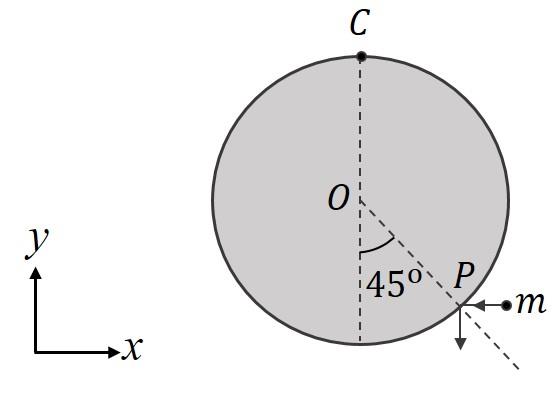
Solution
Setup. Disk radius $R = 0.2$ m, mass $M = 1$ kg. Moment of inertia about pivot $C$ (top of disk): $I_C = I_O + MR^2 = \tfrac{1}{2}MR^2 + MR^2 = \tfrac{3}{2}MR^2$. Particle mass $m = 0.02$ kg, initial speed 100 m/s in $-\hat{x}$, final 90 m/s in $-\hat{y}$.
Point $P$ is at the lower-right of the disk such that $OP$ makes 45° with the vertical. So in the disk-fixed frame, $P = O + R(\sin 45°\hat{x} - \cos 45°\hat{y}) = O + (R/\sqrt{2})(\hat{x} - \hat{y})$. Position of $P$ relative to $C$: $\vec{r}_{P/C} = \vec{r}_{O/C} + \vec{r}_{P/O} = -R\hat{j} + (R/\sqrt{2})(\hat{i} - \hat{j})$.
Step 1 — Angular momentum about $C$ is conserved (the impulsive force at $C$ from the pivot has zero moment about $C$). Before collision, only the particle has angular momentum:
\[ L_i = \left|\vec{r}_{P/C}\times m\vec{v}_i\right| \]
With $\vec{v}_i = -100\hat{i}$ and $\vec{r}_{P/C} = (R/\sqrt{2})\hat{i} - (R + R/\sqrt{2})\hat{j}$, the $\hat{k}$ component is $m\cdot 100 \cdot (R + R/\sqrt{2}) = 0.02\cdot 100\cdot R(1 + 1/\sqrt{2})$.
After collision, particle moves in $-\hat{j}$ at 90 m/s: $\vec{v}_f = -90\hat{j}$. Its angular momentum about $C$: $\hat{k}$ component is $m\cdot 90 \cdot (R/\sqrt{2}) = 0.02\cdot 90\cdot R/\sqrt{2}$.
Disk after collision rotates with angular velocity $\omega$, angular momentum about $C$: $I_C\omega = \tfrac{3}{2}MR^2\omega$.
\[ 0.02\cdot 100\cdot R\left(1 + \tfrac{1}{\sqrt{2}}\right) = \tfrac{3}{2}MR^2\omega + 0.02\cdot 90\cdot \tfrac{R}{\sqrt{2}} \]
Dividing by $R$ and substituting $R = 0.2$, $M = 1$:
\[ 2\left(1 + \tfrac{1}{\sqrt{2}}\right) = \tfrac{3}{2}(0.2)\omega + 1.8\cdot\tfrac{1}{\sqrt{2}} \]
\[ 2(1.707) - 1.273 = 0.3\omega \;\Rightarrow\; \omega = \frac{3.414 - 1.273}{0.3} \approx 7.13\;\text{rad/s} \]
Step 2 — Maximum rise of $O$ from energy conservation (after collision, the disk swings under gravity):
\[ \tfrac{1}{2}I_C\omega^2 = Mg\,\Delta h \;\Rightarrow\; \Delta h = \frac{\tfrac{1}{2}\cdot\tfrac{3}{2}\cdot 1\cdot(0.2)^2\cdot(7.13)^2}{1\cdot 10} \]
\[ = \frac{0.5\cdot 0.06\cdot 50.84}{10} \approx 0.153\;\text{m} \]
Answer: 0.15 m.
Solution
Energy bookkeeping during the collision.
KE before:
\[ KE_i = \tfrac{1}{2}m(100)^2 = \tfrac{1}{2}(0.02)(10000) = 100\;\text{J} \]
KE after (particle + rotating disk):
\[ KE_f = \tfrac{1}{2}m(90)^2 + \tfrac{1}{2}I_C\omega^2 \]
\[ = \tfrac{1}{2}(0.02)(8100) + \tfrac{1}{2}\cdot\tfrac{3}{2}(1)(0.2)^2(7.13)^2 \]
\[ = 81 + \tfrac{1}{2}(0.06)(50.84) \approx 81 + 1.53 = 82.53\;\text{J} \]
Energy loss:
\[ \Delta KE = KE_i - KE_f = 100 - 82.53 \approx 17.47\;\text{J} \]
Answer: 17.47 J.